Showing posts with label Packard. Show all posts

Monday, December 21, 2020

Packard "Ask the man who owns one”


 Packard
"Ask the man who owns one” 


1933 Packard Eight Coupe Roadster 


Not many years after it’s founding in 1899, Packard Motor Car Company   established itself as America's premier fine car maker, as it claimed over 50% of the luxury market by the time the “Tenth Series” was introduced in 1933 as “the greatest Packards ever built.” 
However, the Depression brought with it slumping sales of luxury cars but Packard hoped to increase sales by stretching the product line into three distinct groups– the Eight, the Super Eight, and the Twelve.

Even as Packard's entry-level model, the Eight was still well and truly a full luxury car. With a 320-cubic inch 120-horsepower aluminum-‘L’ head straight-8 cylinder engine with down-draft carburetor and full synchronized transmission, the 1933 Packard Eight provided exceptional performance and was considered a performance car of the era for those who could afford them. 
The sales price for the 1933 Packard Eight series automobile started at $2,150, at a time when the average family earned $2,956 annually in taxable income, and for comparison, a new 1936 Plymouth Six sold for $445. 
   

Fewer than 5,000 examples of the “Tenth Series” Packard were produced and of that total, only 1800 Packard Eights were built,  spread over fourteen different body styles. 
As displayed at the Blackhawk Museum, this two-tone red 4-passenger Coupe Roadster, a body style which was offered only in 1933, rides on a 127-1/2 inch wheelbase features a rumble seat, side-mounted spare tire, white wall tires and Trippe driving lights.

Trippe lights, sold and installed by Packard dealers, were mounted on the bumper bar and were fixed as opposed to the more expensive “self-steering” Pilot Ray lights which moved in concert with the with the front wheels through a series of linkages   
This car, which was listed for sale for $325,000, previously received the Classic Car Club of America (CCCA) National First Place Award and a 100-point Senior Award.


1934 Packard Super Eight Dual Cowl Sport Phaeton

In 1934, Packard introduced the “Eleventh Series” which maintained the three distinct products lines – the Eight, the Super Eight and the Twelve. This car also displayed at the Blackhawk Museum is a Super Eight, ,shared the same chassis as the twelve-cylinder cars, and in the case of this car, rides on a 142-inch wheelbase.

This car is powered by the Packard 385-cubic inch straight eight cylinder L-head engine with aluminum alloy pistons that produced 145 horsepower connected to a three-speed synchro-mesh transmission. Packard factory literature indicated that customers could expect to travel ten miles per gallon of gasoline under average conditions. 
Before leaving the factory 'Super Eight 'engines were run-in with an electric motor for nine hours then run on a dynamometer for one hour and 15 minutes. After the engine was installed in the chassis, the car was given a road test at the Packard Proving Grounds 

The striking four-passenger deluxe dual-cowl sport phaeton body was built in the 22-acre body plant inside the mile-long Packard factory.  As is typical of the era, this is not an all-steel body rather kiln-dried hardwoods are used for the supporting structure of the 19-gauge (7/16th inch) steel body panels. Packard literature stated that a composite body was lighter than an equivalent all-steel body and less prone to rattles and squeaking.


This car, retailed from the factory for a base price of $3,440 is equipped with chrome plated wire wheels which sold for $32 each and a pair of side-mounted tire mirrors at $16  for the pair.  
The dual trumpet horns were a standard feature introduced for the eleventh series, and the new-for-1934 fender lights are mounted on the redesigned eleventh series fenders with improved gutter construction on the underside of the fender to prevent water being thrown up at high speeds.

Packard Motor Car survived the Depression and emerged from World War Two production in solid financial condition, but management made some key mistakes by using the same styling on the lower and upper priced models. 
Packard continued to lead in fine car sales until 1950, but as the decade of the nineteen fifties continued, Packard sales declined perhaps because Packard still offered straight eight engines while the market had moved onto V-8 engines. 
In 1954 Packard merged with Studebaker but that marriage proved disastrous, with the last “true” Packard was built in Detroit in June 1956, and the Packard brand name disappeared altogether in 1959.    
All photos by the author


Wednesday, June 27, 2018

"Ask the man who owns one"


This exquisitely restored 1929 Packard 645 with a dual cowl phaeton body by Dietrich was recently spotted by the author parked in Rolling Hills Estates California. Click on the photographs to enlarge and appreciate the quality of construction of a Packard from a bygone era, which led to the famed Packard sales slogan "Ask the man who owns one."    

The car rides a 145 inch wheelbase chassis,
roughly the same as modern day extra cab pickup truck


The Packard's 385 cubic inch straight eight engine produces 105 HP with a remarkable 350 ft/lbs of torque


All photographs by the author 


Sunday, July 9, 2017


A collection of Packards
at the Automobile Driving Museum
 
The Automotive Driving Museum (ADM) located at 610 Lairport Street in El Segundo California near the LAX airport featured a number of Packard collector cars, making this museum a great place to visit.


One of the earliest Packards on display is this 1916 Packard “Twin Six” 12-cylinder 4-passenger convertible. In response to Cadillac’s introduction of a V-8 engine, Packard’s new chief engineer Jesse Vincent designed and developed the “Twin Six” which was introduced to the buying public in 1916. This first production V-12 engine which in its first year did not have detachable cylinder heads produced 88 horsepower from 424 cubic inches.

Next in the chronological history of the ADM’s Packards is this 1929 Packard 633 4-passenger convertible one of four Packard models (629, 633, 640 and 645) offered that year. This particular car sold in Australia this it is equipped with right-hand drive, is also equipped with the extra-cost sold Disteel wheels.


We will close this article with another Packard twelve cylinder, this 1937 V-12 Convertible Sedan. The V-12 powerplant produces 174 horsepower from 473 cubic inches connected to a three-speed manual transmission in a chassis with a 144 inch (12-foot) wheelbase.


All photographs by the  author  

Friday, February 3, 2017


1930 Packard 7-33 Sedan 
“Luxurious Transportation”


The author recently visited the fantastic Woodland Auto Display at the Estrella Warbird Museum in Paso Robles California and we will feature more cars from Richard “Dick” Woodland’s collection in future articles. Today we open the series with a study of Mr. Woodland’s gorgeous 1930 Packard 7-33 seven-passenger sedan.

James Ward Packard purchased a Winton automobile in the late 1890's and after he was unsatisfied with his new car thought he could build a better car. The Packard Motor Car Company which first manufactured its cars in Warren Ohio in 1899, before it moved to Detroit, From the beginning Packard was considered one of the elite luxury cars built in the United States reinforced with the advertising slogan “ask the man that owns one.”  

During the period from 1917 to 1919 Packard was very successful in automobile racing with cars fitted with airplane-style engines driven by Ralph DePalma. In 1923, DePalma led an ill-fated attempt to build a fleet of Packards to race at the Indianapolis Motor Speedway which resulted in disaster as all three cars retired before 225 miles were completed.

After the humiliating results, the jewel-like Packard race cars were returned to the factory and Chief Engineer Colonel Jesse Vincent reportedly ordered the cars and all related documents destroyed. The Packard factory never again participated in racing, although in  the 1937 Indianapolis ‘500,’ Russell Snowberger raced a supercharged Packard-powered entry at Indianapolis under the “Junk Formula” rules.
 
A period newspaper photo of actress Anita Stewart with her 1930 Packard Sedan
 

The 31st President of the United States Herbert Hoover owned several Packards as did the era’s top golfer Gene Sarazen. In Hollywood, Clark Gable and Western actor Jake Holt were both owners of 1930 Packards as were actresses Carole Lombard, Dorothy Jordan and Anita Stewart.

The 1930 Packard is considered to be one of the quintessential classic automobiles and prized because this series of Packard automobile was only produced for this single model year. The Seventh Series Packard “Standard Eight” introduced to the public in August 1929 was advertised with the claim that “anyone owning a car costing $1200 to $1500 can have a Packard at no extra cost over his present car ownership.” Packard prices ranged from $2300 - $2775, available in either the 127 ½ inch wheelbase, which was known as the 7-26, and the 134 ½ -inch wheelbase model known as the 7-33.

The 7-26 was available only as a five-passenger sedan while the 7-33 was available in twelve different body styles all built by the Packard factory. The 7-33 was available as a two-passenger Roadster (with a rumble seat), the 4-passanger Phaeton (an open body with no side windows), the Sport Phaeton,  a 7-passenger touring car which was a phaeton body style 2-, 4- and 5- passenger coupes, and the five-passenger club sedan.


The1930 Packard 7-33 model offering also included  2- and 4- passenger convertible coupes,  the seven-passenger sedan as shown in Paso Robles identified by the Packard factory as body number 404, and a seven-passenger limousine sedan which featured a curved glass partition to separate the driver from the passengers in the rear compartment. All the Packard “Standard Eight” models shared the same basic styling cue - a single flowing fender line from the crown of the fender to the running board.

In addition to the 7-26 and the 7-33 series, both sold as the “Standard Eight,” Packard also offered the “Custom Eight” known as the model 740 and the ”Deluxe Eight” known as the model 745, both equipped with a 384-cubic inch straight eight engine which were sold in very limited numbers often with custom bodies.   

With the United States economy in free fall following the October 1929 Wall Street stock crash, 1930 Packard sales declined dramatically from 1929’s total sales of 55,081vehicles ; for the 1930 model year there were 15,731 Model 7-26 sedans produced and 12,531 Model 7-33 body styles sold. In one year Packard’s net earnings fell from $19 million to $9 million and net profits fell 53%.

The wheelbase for the “Standard Eight” chassis had been increased 1 inch for 1930 because of the redesigned water pump which used twin rubber belts that also drove the fan. Underneath the long and graceful hood was a 320 cubic-inch straight eight L-head engine with two valves per cylinder and nine main bearings; the engine thermostat used in previous models was eliminated as thermostatically controlled radiator shutters controlled engine temperature.


The Packard straight eight engine developed 90 horsepower with the addition of the new model 51 updraft Detroit Lubricator carburetor. Powered was transmitted to the rear wheels through the transmission with a single plate clutch which with the addition of an extra low gear in 1930 had four forward speeds. The Packard 7-33 used a seven-volt lighting system with pure silver parabolic headlight reflectors and featured four-wheel assisted 16-inch mechanical drum brakes for 20-inch diameter wheels.

Since 1924 all Packard cars had featured the patented George Bijur chassis lubrication system, which lubricated 43 points of the chassis from a one quart central reservoir with a vacuum operated pump which was triggered by a spring-loaded handle adjacent to the steering column. The Packard 7-33 used a seven-volt lighting system with pure silver parabolic headlight reflectors and featured four-wheel assisted 16-inch mechanical drum brakes for 20-inch diameter wheels.

The 4745-pound curb weight seven-passenger sedan shown in the Woodland Auto Display features the optional fender parking lights (a $20 option) as well as the optional dual side-mount spare wheels. The big sedan is equipped the standard steel disc wheels instead of the optional wire or wooden wheels which fell out of vogue with the buying public in the early nineteen thirties. .


Dick Woodland’s car features the “Adonis” (alternately known as the “sliding boy”) hood ornament designed by New York sculptor Edward McCarten which was only offered by the Packard factory for two model years.  This hood ornament design patent (as opposed to a utility patent) was applied for on November 7 1928 with patent D79561 issued by the United States government on August 8 1929.
 

Even as the Depression deepened, Packard remained committed to the production of opulent cars and introduced a twelve-cylinder (or “twin six”) model in 1932. By 1935, Packard management gave in to the economic realities and introduced a lower-cost “Junior” series (the six-cylinder 110 and the eight-cylinder 120) which sold for less than $1000 and the brisk “Junior” sales saved the company. In 1936, a Packard “Junior Series” ‘120’ convertible coupe paced the start of the Indianapolis 500-mile race and at the suggestion of its driver Tommy Milton, that car began the tradition of awarding the Pace Car to the race winner.   

During World War Two Packard earned a sterling reputation for building aviation and marine engines, but following the war, the buying public became unable to differentiate the blurred lines between the Packard “Junior” and “Senior” series (sold as the Six, Custom, Deluxe and Super) and Packard sales slowly declined. Packard and Studebaker entered into an ill-conceived merger in 1954 largely funded by the Metropolitan Life Insurance Company, but afterwards Packard sales continued to slide.

The last “true” Packard a four-door Patrician rolled off the Detroit assembly line on June 25 1956. The final two years of production in South Bend Indiana used Studebakers with fiberglass panels bolted on and are known derisively as “Packardbakers;” the last car rolled off the South Bend assembly line on July 13, 1958.
Except as noted all photos were taken by the author who extends his thanks to Dick Woodland for maintaining and sharing his great collection.

Saturday, October 29, 2016


A beautiful pair of Packards in Oregon
 
This past week, the author had the opportunity to visit the Western Antique Aeroplane and Automobile Museum (WAAAM) in Hood River Oregon, and we will feature several of the most interesting automobiles in their excellent collection. Today, we’ll share a couple of Packards, one of the most respected brands of luxury cars during the nineteen twenties and thirties. The Packard advertising slogan was “Ask the man who owns one.”
 
 
The first car featured is a 1929 Packard Model 626 Sport Coupe which was originally sold by the Earle C. Anthony, the Packard distributor for the state of California, initially it was used a demonstrator for the optional wooden artillery wheels, which proved to be unpopular, as customers thought the wooden wheels looked “old fashioned” and preferred solid disk wheels. The Packard 626 series car introduced in 1929 was powered by 320 cubic inch straight eight engine that produced 90 horsepower but was a very smooth-running powerplant.


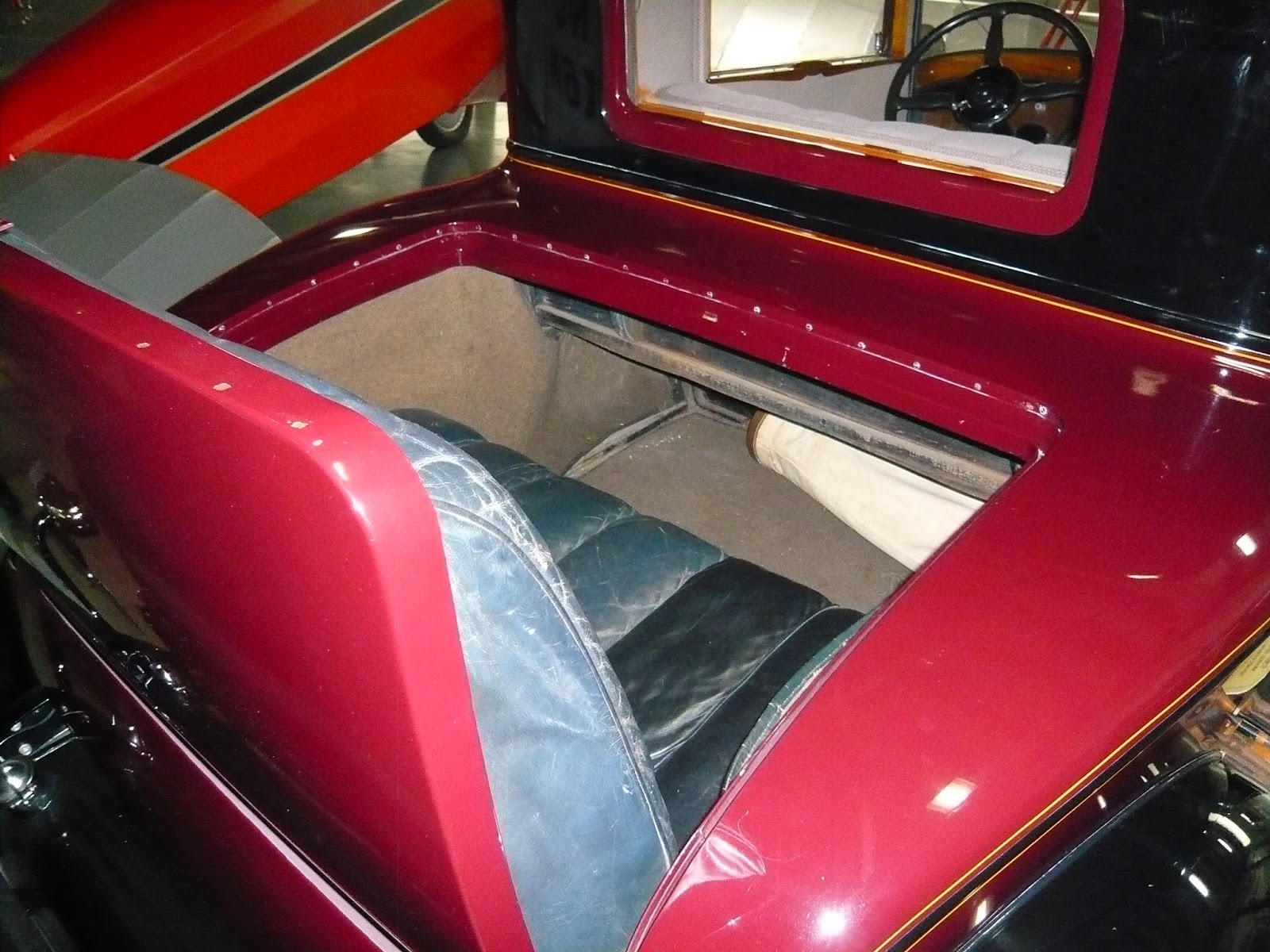
Earle Anthony dealerships actually sold this car twice, as it was traded in by the original owner and sold as a used car to the second owner who kept the car for over thirty years. This remarkable car is on it fourth owner in 87 years. Much of the car is original but it has been repainted in its attractive maroon and black finis with dark yellow pinstriping. Note that there is not a separate compartment for the golf bag; rather the bag rests in the footwell of the rumble seat.   


The other Packard in the WAAAM collection is this spectacular 1935 Packard twelve-cylinder convertible coupe, finished in dark blue with gold pinstriping.


The 473 cubic inch V-12 engine has aluminum heads with hydraulic valve lifters and produced 160 horsepower. Unlike the 1929 Sport Coupe, this Packard has been totally restored.


Reportedly there were just 788 Packard Twelves built during the 1935 model year at the height of the Great Depression. One can easily imagine a  movie star or wealthy playboy behind the wheel of this magnificent Packard.