Tuesday, September 19, 2017


1951 Ford Woodie wagon


At the 2017 “Autos of Alamo” car show, the author spied this 1951 Ford Country Squire wagon, Ford’s last wood-bodied station wagon built in its Iron Mountain factory using maple and birch from Ford’s own Upper Peninsula forests.  Some purists disdain these cars as the body is mostly steel inlaid with wood.
 
 
Comparing the two sides of this 1951 Ford demonstrates how little wood was actually used in building these cars.  


Ford had remained the woodie wagon market after Chevrolet had abandoned it following the 1948 model year, as General Motors found that all-steel station wagons were much more cost competitive. Ford dropped the price of the V8 flathead powered 1951 top of the line Country Squire wagon to $2028 but sales for the model year totaled just 22,292 units.
 
In late 1951 Ford Motor Company sold the Iron Mountain factory, and for 1952 the re-designed Ford Country Squire used 'Di-Noc' wood laminate paneling on the sides and tailgate framed by wood, but the real wood was replaced by wood-grained fiberglass mid-way through the 1953 model year.   

All photographs by the author

Monday, September 11, 2017


Alex Schutte dominates Gold Cup midgets


Twenty midget racers were on hand at the famed Sliver Dollar Speedway in Chico California on Thursday night September 7 for a joint Bay Cities Racing Association (BCRA)/United States Auto Club (USAC) Western States midget race. The mighty midgets were part of the second night of racing for the four-night 64th annual “Gold Cup Week” non-winged program together with the USAC/CRA sprint cars.  

Following the three preliminary hot lap sessions, the #3 machine of Sparky Howard and the #35W car of Nate Wait were both withdrawn from further competition due to terminal mechanical problems. Shane Golobic topped the field in single car time trials with a best lap of 14.256 seconds in the Wood #17W, followed closely by Courtney Crone at 14.275 seconds in the Jerome Rodela owned #25 Toyota-powered machine.
 
Chad Boat in the Tucker/Boat #84 was a just tick behind at 14.318 seconds, followed in fourth by Ronnie Gardner the only one competitor signed up for “double duty” with both a sprint car and midget ride in the Ted Finkenbinder #3F at 14.379 seconds with BCRA points leader Maria Cofer fifth fastest at 14.435 seconds.

In the first 8-lap heat race, Alex Schutte who started on the front row by virtue of his sixth-fastest qualifying time out-dragged pole sitter Randi Pankratz into turn one and never looked back as he streaked to victory over Golobic, Pankratz and Robert Dalby. Post-race inspection found that Golobic’s #17W car had lost its muffler during the race and the car was disqualified, which moved Pankratz and Dalby up to second and third place respectively with Gardner and Cody Hodgson rounding out the top five finishers.  

In the second heat race, front row starter Michael Faccinto jumped in the lead ahead of pole sitter Frankie Guerrini and led all eight circuits to finish ahead of Crone, Cofer, the #63 of Guerrini, Cory Elliott’s #11E and Floyd Alvis who celebrated his 83rd birthday on September 1.

Oklahoma’s Michele Decker in Shannon McQueen’s Spike/Esslinger #7D continued the night’s trend of front row domination as she led wire-to-wire in the third heat race from her pole starting position. Behind Michele at the finish were Boat, Mason Daniels, David Prickett, McQueen and JR Williams still on the comeback after his traffic accident following the Stockton dirt track race.

The re-draw for the eighteen-car starting field for the 30-lap BCRA/USAC “Light up the World Beverages” feature race put Alex Schutte on the coveted pole position in his family’s #28 midget with Michael Faccinto alongside, while the second all-female row was comprised of Decker and Pankratz. The third row was all Toyota power with Crone and Boat while the fourth row was shared by young guns Dalby and Cofer. By virtue of his heat race disqualification, Shane Golobic was slotted sixteenth on the grid alongside Shannon McQueen in her trademark pink blue and black Boss chassis #7.

As the field charged into the first turn at the drop of the green flag, chaos erupted back in the field which eliminated the top two drivers in the BCRA points chase. Maria Cofer lost control due to a deflating right rear tire and spun in front of Floyd Alvis; both cars suffered heavy damage and were moved to the infield by the track safety crew, finished for the night. The first ragged restart attempt was called back, but the second attempt was clean as Alex Schutte shot into the lead over Faccinto. On lap two, Decker got around Faccinto to claim second place.

The red flag flew on lap five after a serious crash in between turns one and two that involved fourth-place driver Chad Boat whose car half-spun to a halt and was struck by the machines of Pankratz and Dalby. Boat’s chassis suffered a broken left front shock absorber mount so Chad was done for the night.
 
The cars of Dalby and Pankratz went to the work area and with the concerted volunteer efforts of the members of several crews both cars were able to restart at the tail of the field. When racing resumed within a few laps Dalby’s machine pulled into the infield with a battery problem while Faccinto’s machine retired with an apparent engine failure

On lap eleven the running order remained Schutte, Decker, Crone and Pickett as those front four cars had separated themselves from the pack. By lap 16, Golobic had gained ten positions to run sixth, and two laps later Shane caught a pair of breaks as Courtney Crone brought out the caution flag with power steering problems for the second straight event. Courtney’s retirement moved the #17W to fifth and bunched up the field for the single-file restart.  

On lap 19, Gololbic’s blue #17W machine moved past Mason Daniels’ #33M to claim fourth, then two laps later, Shane made a daring outside pass around Prickett through turns one and two to claim third place. On lap 28, as Schutte continued to lead, Golobic made another turn two outside pass, this time on Decker to claim second, and then Prickett passed the #7D which dropped Decker to fourth place.

At the drop of the checkered flag, Alex Schutte picked up the wire-to-wire Gold Cup win trailed by Shane Golobic, David Prickett and Michele Decker as Mason Daniels rounded out the top five finishers. Sixth through tenth finishers were Frankie Guerrini, Shannon McQueen in seventh up from fifteenth,  USAC Western States points leader Ronnie Gardner eighth with USAC Western States runner-up Cory Elliott ninth and Randi Pankratz who recovered from her lap five accident and finished tenth. The non-finishers in order were Cody Hodgson, Courtney Crone, Robert Dalby, Michael Faccinto, Chad Boat, JR Williams, Maria Cofer and Floyd Alvis.   

The BCRA midgets return to action on Saturday September 16th at Madera Speedway as part of the 45th Annual Harvest Classic presented by Midland Tractor and John Deere.  In addition to the mighty midgets, the Western Winged Super Sprint Series, USAC HPD Midgets, Super Hobby Stock Series, NCMA Sprints, CSS/360 Super Modifieds, Legends of Kearney Bowl, and the California Hard Tops will all be in action, with a special added feature multi supercharged engine pulling tractors.


Tuesday, September 5, 2017

Dream cars at the Petersen Museum

The author recently had the opportunity to visit the Petersen Automotive Museum in Los Angeles and we will feature a number of features from that visit in the coming weeks. Today we look at the ‘Dream Cars’ exhibit which displayed three dream cars built in the decade of the nineteen fifties.

Mercury D-528


First up is the Mercury D-528, built in 1955 as a test vehicle for advanced concepts that included air conditioning, “safety seating” and suspension. It was radical for its time as its original design used a cantilevered roof with no front "A" pillars and four headlights. The car rode on coil spring suspension cloaked in a fiberglass body built in house at Ford Motor Company. The unusual name came from it being the 528th Ford experimental design. Apparently the pillar less top was a problem as eventually the car was rebuilt with thin “A” pillars.   


Auto manufacturer foresaw air conditioning as becoming a popular option in the future, but in 1955 because the required evaporators were so large they had to be located in the trunk. This affected the design – in order to provide adequate luggage room, the characteristic hinged rear humps were added on the rear fenders, with the gas tank access on one side and the spare tire in the other. The hooded reversed retractable back window became a design cue used in 1963 Mercury production cars

In the early sixties the D-528 was sold to Paramount Pictures and sent to Hollywood where it was remodeled by George Barris, who painted the car red and removed the name "D-528" from the front fenders and replaced it with "Beldone" – a name selected by its new owners. The “Beldone” fitted with a number of remote-controlled features was used in the 1964 Jerry Lewis movie, The Patsy, (a loose sequel of his 1960 film The Bellhop) and appeared later in several other movies and television shows.  

The Zeder Storm

Fred Zeder Jr. the son of famed Chrysler engineer wanted to develop an American powered dual-purpose sports car with a “swappable” body which could be partially for racing. Zeder partnered with Eugene Cassaroll, owner of Auto Shippers Incorporated which delivered Chrysler products around the country and Indianapolis car owner and the pair formed the Sports Car Development Corporation.

While on vacation in Europe, Zeder visited the custom Italian body builder Bertone and struck an agreement to build the body for Zeder’s creation. Although the body took six months longer than agreed, the finished car was shipped to New York via the ocean liner SS Andrea Doria and when Zeder drove it on the streets on New York City it reportedly caused a sensation.


The car, called the Zeder Storm Z-250, was taken to Chrysler's design headquarters in Hamtramck in April of 1954 in the car of his uncle, who was Chrysler’s Chief Engineer. The Chrysler Corporation kept the car powered by a 260 horsepower Dodge ‘Red Ram’ Hemi V-8 with other MoPar components that included the brakes, radiators, clutch, fuel tank, rear axle, and steering system for two years, but ultimately decided the car was too expensive to manufacture and returned it to Fred Zeder who drove it for many years.


The Storm Z-250 concept of American power and Italian bodywork was later still pursued by Cassaroll who later financed the 315-cubic inch Chrysler V-8 powered Dual Ghia with bodywork fabricated by the Italian coach builder Ghia. The Dual Ghia passenger car debuted in 1954, but although it a number of Hollywood actors Frank Sinatra, Sterling Hayden Desi Arnaz and Ronald Reagan each owned, the Dual Ghia ceased production in 1958 with just over 100 cars built which proved Chrysler’s decision on viability of the Zeder Z-250 Storm as correct.

Plymouth Explorer


Beginning in 1950 and continuing through the nineteen fifties, the Chrysler Corporation paired with Turin body builder Ghia to create two dozen drivable dream cars with hand built custom bodies.  The 1954 Plymouth Explorer coupe rides on a 114 inch wheelbase 1953 Plymouth Cranbrook chassis powered by a “Powerflow Six” a 110-horsepower 230-cubic inch 6-cylinder engine coupled to a HyDrive semi-automatic transmission; the driver only used the clutch to put the car in gear.


The attractive two-seat Explorer is finished in a brilliant metallic green paint with the bucket seat interior was covered with white leather with fitted luggage behind the seats. The “spear” on the sides of the car is not chrome; rather it is painted white to match the interior.  The last of the Italian bodied specials was the Chrysler “Norseman” was a four-seat fastback coupe built by Ghia. The concept car was lost (ironically) during the sinking of the ocean liner SS Andrea Doria in July 1956.

Due to cost, concept cars have lost favor among automotive manufacturers, but concept cars are still alive in the minds of dreamers, such as this radical futuristic race car model displayed in the Auto Center College of Design workshop inside the Petersen Automotive Museum. Could we see something like this car on race tracks in the near future?    


All photos by the author

Monday, August 28, 2017


Faccinto brings his broom
 
to the Stockton dirt track


On Saturday August 26 a field of eleven Bay Cities Racing Association (BCRA) midgets took part in the Stockton Dirt Track’s Salute to Leroy Van Conett in a program together that also included the Elk Grove Ford Sprint Car Challenge Tour (SCCT) winged 360 cubic inch sprint cars. One BCRA competitor Cory Elliott from Bakersfield took up the challenge of racing with both BCRA and SCCT entries on the same night on the San Joaquin County Fairgrounds 4/10-mile clay oval.

Michael Faccinto led the field in time trials with a best lap of 16.519 seconds in his CP-Carillo Rods sponsored midget trailed by Alex Schutte in the family #8 midget with a best of 16.625 seconds with Elliott third at 16.655 seconds. Mason Daniels in his family’s #33M and Australian Danny Carroll in Sean Dodenhoff’s #9C rounded out the top five qualifiers.

Nate Wait and BCRA points leader Maria Cofer paced the field for the start of the first eight-lap heat race, and Maria led the field for the first few circuits as Faccinto carved his way through the field from his sixth starting position to grab the lead on the fourth lap. The final finishing order for the first heat race was Faccinto, Cofer, Elliott, Carroll, and Wait while JR Williams, who was battling an upset stomach, dropped out early. 

At the start of the second heat race Mason Daniels leapt into the lead while Alex Schutte who started from the tail made contact with another car at the start and immediately retired with a bent shock absorber. A few laps into the race, Scott Pierovich in his first dirt track appearance in a couple of seasons, lost the left front wheel as his midget entered turn three but Scott safely made it into the infield.
 
When the race resumed after the caution, Daniels appeared on his way to victory when the torque tube bolts sheared off the rear end and he coasted to a stop and Brett Felkins of nearby Lodi inherited the win over the ageless Floyd Alvis.

While the crews of Pierovich and Schutte were able to affect repairs to their respective machines, unfortunately the #33M midget of Daniels was too damaged for his crew to make repairs and he scratched from the night’s 25-lap feature event.
 
With the re-draw for starting positions, the team cars of Felkins and Wait were side-by-side on the front row, with Pierovich and Carroll in row two. With Daniels a scratch, the machines of Schutte and Elliott shared row three, Cofer and Faccinto comprised row four and Williams and Alvis shared row five.

Felkins led the first lap of the feature before Pierovich surged by, but on lap four the race had its first caution period when Felkins spun to a stop in turn four. Faccinto was already scored in second place trailed by Schutte, Carroll and Elliott. When racing resumed Faccinto snuck past Pierovich on the back stretch of the 4/10 mile oval and established his lead before the field was frozen by a second spin by Felkins on lap seven which ended his night early.

The ‘top five’ running order under the caution flag was Faccinto, Pierovich, Schutte, Cofer and Carroll but when the green flag reappeared Carroll maneuvered past Cofer to capture fourth position. As the laps wound down, Faccinto steadily built up a commanding lead of nearly half a lap over the field. On lap 21, Faccinto put Alvis a lap down as the engine in Floyd’s #1 midget had gone off song.   

With the drop of the checkered flag, Michael Faccinto completed his second “clean sweep” of a BCRA racing program in less than a month, as he set quick time, won his heat race and the feature just as he had at Fernley Speedway at the end of July.   Faccinto was followed across the stripe by Pierovich, Schutte, Cofer, Carroll, Elliott, Nate Wait and Floyd Alvis. Brett Felkins and JR Williams both failed to finish and as previously mentioned Mason Daniels did not start the feature.

In a postscript to the night’s BCRA racing action, JR Williams was involved in a serious accident on his trip home when another driver crossed the highway centerline and struck JR’s truck just behind the driver’s door. JR’s truck and trailer were both demolished, but thankfully JR was unhurt although tragically one of the occupants in the other car lost his life in the accident.

The always smiling resilient JR plans to back in action on Thursday September 7 for the next BCRA race held as part of the  second preliminary night of racing of ‘Gold Cup week’ at Silver Dollar Speedway in Chico California. The program co-sanctioned with the United States Auto Club (USAC) Western States ‘Light Up the World’ midgets will also feature the AMSOIL USAC/CRA sprint cars on their fourth race of the six-race California sprint week.        


Thursday, August 24, 2017


Bugatti Royale at the Petersen

The name Bugatti captivates the imagination of car enthusiasts, whether their interest is focused on the modern sports cars, the famous pre-war racing cars, or the magnificent coach-built road-going masterpieces.

The largest car built by Ettore Bugatti was the Type 41, the Royale, the car of kings.  Originally Bugatti intended to build twenty-five of these monstrous machines but in fact only seven were built, and only three were sold in period, none to royalty.
 
The 169-inch (over 14 feet) wheelbase chassis was sold without the body at a cost of $30,000 (over $400,000 today) during the Great Depression.   The straight-eight Bugatti Royale engine, an aircraft inspired design, with the block and head as a single casting displaces 778 cubic inches.  The massive powerplant which developed perhaps 285  horsepower at a leisurely 1700 revolutions per minute (RPM) was connected to a 3-speed manual transmission

Consider that this one engine displaces more cubic inches than the engines of eight Miller 91 race cars. The engine with just three main bearing a single overhead camshaft and a single carburetor develops 300 horsepower at a sedate 2000 revolutions per minute. The cast-aluminum wheels are 24 inches in diameter integrally cast with the brakes drums. Understandably the cable-actuated brakes without any power assistance were extremely difficult to use to slow the 7000-pound machine.  

This was the first Royale sold in 1931, and was initially fitted with a roadster body with a rumble seat and no headlights designed by Ettore’s eldest son Jean Bugatti. Initially this Royale was known as the ‘Royale Esders Roadster’ after its buyer French textile manufacturer Armand Esders. After its ownership by a French politician who had it re-bodied as it appears today; a coupe for the passengers with the chauffer in an open cockpit.


Each Bugatti Royale is named; the example on display at the Petersen Automotive Museum through October is known as the ‘Coupe de ville Binder,’ named after the Parisian coachwork company that crafted its second and current body, Henri Binder.
 
 
The Royale’s radiator cap is a posed elephant from a sculpture by Ettore’s younger brother Rembrandt Bugatti who committed suicide in 1916 in Paris
Click the photograph to enlarge  

After World War 2 during which time it was hidden reportedly in a Paris sewer, the Binder Bugatti made its way to United States where it was owned at various times by Floridian Dudley Wilson, Atlanta banker Mills Lane, and casino owner William Harrah. Homebuilder and United States Air Force Reserve General William Lyon listed the car at auction in 1996 with an unmet reserve of $15 million. The current owner of Royale Coupe de ville Binder is Volkswagen AG, the owner of the modern Bugatti brand which uses the car as a promotional vehicle.
 
Reproduction of an Auto Rail Poster
courtesy of the Bugatti Trust
 

The author recalls reading an article as a child about the Bugatti Royales that noted that due to poor sales, several Royale engines were used to power locomotives. The truth is that the line of Bugatti Auto Rail trains saved the Bugatti company from certain financial ruin. Ettore designed an aerodynamic luxurious rail car with innovative automotive type suspension and braking systems.  


Powered by four of the mighty Bugatti Royale engines the Auto Rail prototype attained 106 miles per hour in testing in the spring of 1933. More than 80 of the railcars were built, with a dozen powered by just two Royale engines. Unbelievably these trains were still in service as late as 1956; the remaining example is in the Cité du Train in Mulhouse France, but the Petersen has one of the rail engines on display.        
 
All photos by the author except as noted


Monday, August 14, 2017

A collection of
America’s Most Beautiful Roadsters
at the Petersen

Now on display through April 15 2018 in the Customization Gallery at the Petersen Automotive Museum are a number of the past winners of the America’s Most Beautiful Roadster (AMBR) trophy annually awarded at the Grand National Roadster Show (GNRS). Since 1950, hot rod builders have vied to win the 9-foot tall AMBR trophy created by show promoter Al Slonaker , and through the years, some fairly radical cars won the AMBR trophy, a few of which the author photographed.   


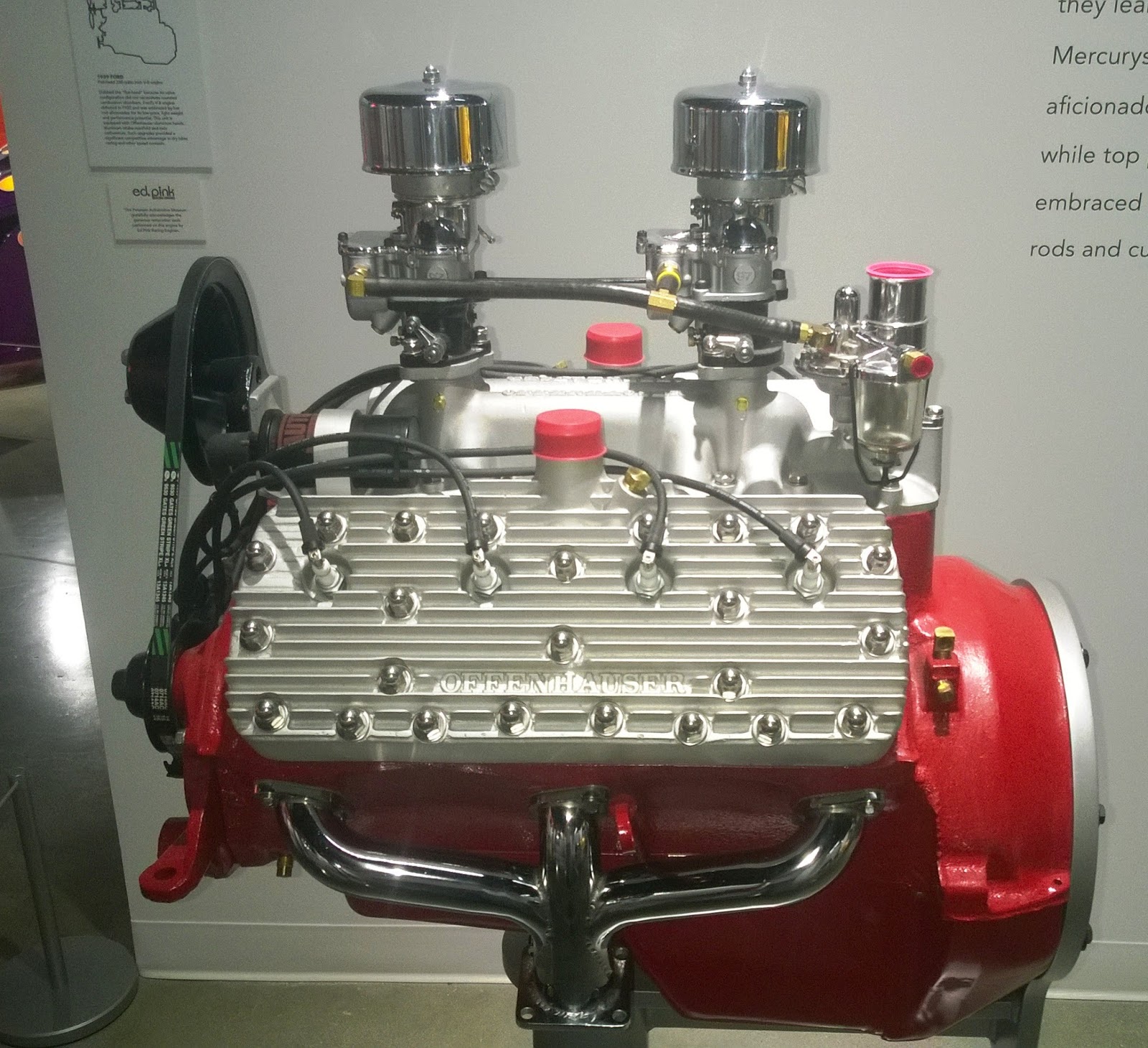
The AMBR story begins with the very first winner, the 1929 Ford roadster built by Bill Niekamp of Long Beach California over a course of thirteen months and a cost of close to $2,000.  Niekamp who worked as a body man and painter in the Long Beach Plymouth assembly plant used parts from many different cars to create his simple masterpiece. The frame is from a 1927 Essex, the car is powered by a highly modified 1942 Mercury “flathead” V-8 engine which feeds a 1939 Ford rear axle, and tail of the car uses 1949 Plymouth tail lamps. 

The Niekamp roadster’s belly pan, hood panels and the “track nose” were hand-fabricated from aluminum by metalsmith Dwight “Whitey” Clayton and the car is finished in 1950 Chrysler Blue.  Niekamp did not use his roadster just as show car; he participated in the 1950 and 1951 Pasadena Reliability Runs and achieved a top speed of 142.40 miles per hour (MPH) at El Mirage dry lake in July 1952. The car is shown as it would have appeared at the dry lakes in 1952, sans headlights and windshield.  


The “Alien” the 1969 AMBR winner is registered as a 1937 Ford, as that the identity of the chassis, but the dune buggy-like body is built of plywood and fiberglass and painted by brothers Art and Mickey Hmisl of Concord California. The car is powered by a 289-cubic inch Ford engine fitted with Shelby-American cylinder heads and the flip-top body is so severely raked that the roof has a smoked transparent panel to allow the driver who is practically prone to see out of the car.  The brothers actually sold their creation during the 1969 Grand National Roadster Show.


This 1923 Ford Model T roadster pickup now known as the “Candy Root Beer” was built by Lonnie Gilbertson of Portland and won the 1971 AMBR trophy. The car then painted bright red or orange was equipped with an independent rear suspension from a Jaguar XKE, and powered by a 350-cubic inch Chevrolet V-8 engine fed by a four Weber carburetors with chrome side pipes. 
 
The 1971 AMBR winner and trophy
Photo courtesy of the Petersen archives
 
After the car was repainted yellow with wild murals and the engine fitted with custom cylinder heads and a supercharger it won the 1975 AMBR trophy. It is displayed at the Petersen as it appeared after 1975 when it won twenty-nine additional trophies at car shows across the country.


The “Golden Star” is based on a 1925 Ford Model T roadster, and Phoenix racer and builder Ermie Immerso who had won the 1988 AMBR award with his “Orange Twist” used two Model T bodies to come up with this creation powered by a Ford 255-cubic inch double overhead camshaft (DOHC) racing engine as used in nineteen sixties Indianapolis cars.


Ernie was a “racing guy,” as he raced on the Salt Flats, worked on Clint Brawner’s crew at the 1954 Indianapolis 500-mile race and later worked for Carroll Shelby and Holman Moody. From his stockpile of Ford DOHC V-8 engine parts, Ernie built the highly-detailed engine in the configuration it would have for a dirt championship car, with the intakes on the upper side of the engine.  
 
When it debuted at the 1989 GNRS and won the AMBR award, the ‘Golden Star” was painted red with darker red flames. Two years later, with the interior reupholstered the addition of the odd canard-style fairings in front of the rear wheels and painted orange with wild flame accents as shown today, it captured the 1991 AMBR trophy. The “Golden Star” is currently owned by the Petersen Museum.
The engine is always a focal point of any hot rod, so it is fitting that we close out report on the display which one of its features - two engines built by Ed Pink racing engines- a 1959 Buick ‘nailhead” V-8 (top) and a Ford “flathead” V-8.    


All photos by the author except as noted


Monday, August 7, 2017


Nichols blazes to a clean sweep in
2nd annual Tom Manning Memorial
at Stockton 99 Speedway
 
Ten speedy Bay Cities Racing Association (BCRA) midgets took part in Stockton 99 Speedway’s “Night of Champions” on Saturday night August 5 with the second annual Tom Manning Memorial race. Eight of the ten cars posted times in the 13-second bracket in time trials, paced by third generation racer Chad Nichols in the Shanoanian Esslinger as he set a new track record of 13.072 seconds to tour the high-banked paved quarter mile track.

Davey Hamilton Junior, himself a third-generation racer posted the night’s second fastest qualifying lap of 13.165 seconds in Bob Rosen’s midget, which just edged out Alex Schutte’s fast lap of 13.176 seconds in Del Morris’ #71R machine.  Cody Gerhardt, also a multi-generational racer wound up fourth fastest at 13.207 seconds.

Maria Cofer in the Arata Racing #88 led the early laps of the first heat race, as Nichols picked off car after car as he moved up from his fifth starting position. Late in the six-lap event, Nichols slipped past point leader Cofer on the low side of turns one and two to grab the lead which he held to the drop of the checkered flag trailed by Cofer, Schutte, Randi Pankratz, and Mark Maliepaard.

Pole-sitter David Goodwill immediately jumped into lead at the start of the second heat race with Hamilton in close pursuit, trailed by Floyd Alvis, Gerhardt and JR Williams. As Hamilton exited turn four on lap four, he spun the Mr. Espresso #4 machine in the oil-absorbent left over from late model time trials.
Hamilton locked down the brakes and spun harmlessly to a stop backwards at the head of the front straightaway. After he restarted, Hamilton stormed back through the field to challenge Gerhardt for second place but had to settle for third place.  Goodwill won the heat race as he led all six laps ahead of Gerhardt, Hamilton Alvis and Williams.

Fast qualifier Nichols drew the #6 pill to set the invert for the 30-lap Tom Manning Memorial feature race, with Goodwill and Maliepaard sharing the front row, Gerhardt and Schutte in row two and Hamilton and Nichols side-by-side in row three. The first attempt at a start was called back, as Goodwill proved a little quick on the throttle. Goodwill led away in the second start, trailed by Gerhardt, Maliepaard, Schutte and Hamilton.

As the race settled down, Nichols began his march forward and ran in third place on lap three, and then moved into second place on lap four.   Hamilton had had contact with another car which bent the front axle and negatively affected the handling for the rest of the race but on lap six Hamilton and Cofer battled for sixth position, which was settled in Hamilton’s favor but he could not make the expected threat for victory.

Nichols stalked Goodwill for several laps, then on lap twelve he began to press for the lead. At the end of the fifteenth lap Goodwill and Nichols crossed the start-finish line side-by-side. On lap 17, Nichols in the orange #17 machine surged past into the lead trailed by Goodwill, Gerhardt, Maliepaard and Schutte. Hamilton rode in sixth place followed by Cofer, Alvis and Pankratz, as Williams had pulled in the pit area with handling problems. As Nichols cruised to victory to complete his “clean sweep” of the evening, in the closing laps Schutte slipped past Maliepaard to claim fourth place in a race that was completed in six minutes.  

On August 29, the BCRA midgets will return to action in Stockton, but this time across town at the Stockton Dirt track located on the grounds of the San Joaquin County Fairgrounds.