Showing posts with label Petersen Automotive Museum. Show all posts

Thursday, August 24, 2017


Bugatti Royale at the Petersen

The name Bugatti captivates the imagination of car enthusiasts, whether their interest is focused on the modern sports cars, the famous pre-war racing cars, or the magnificent coach-built road-going masterpieces.

The largest car built by Ettore Bugatti was the Type 41, the Royale, the car of kings.  Originally Bugatti intended to build twenty-five of these monstrous machines but in fact only seven were built, and only three were sold in period, none to royalty.
 
The 169-inch (over 14 feet) wheelbase chassis was sold without the body at a cost of $30,000 (over $400,000 today) during the Great Depression.   The straight-eight Bugatti Royale engine, an aircraft inspired design, with the block and head as a single casting displaces 778 cubic inches.  The massive powerplant which developed perhaps 285  horsepower at a leisurely 1700 revolutions per minute (RPM) was connected to a 3-speed manual transmission

Consider that this one engine displaces more cubic inches than the engines of eight Miller 91 race cars. The engine with just three main bearing a single overhead camshaft and a single carburetor develops 300 horsepower at a sedate 2000 revolutions per minute. The cast-aluminum wheels are 24 inches in diameter integrally cast with the brakes drums. Understandably the cable-actuated brakes without any power assistance were extremely difficult to use to slow the 7000-pound machine.  

This was the first Royale sold in 1931, and was initially fitted with a roadster body with a rumble seat and no headlights designed by Ettore’s eldest son Jean Bugatti. Initially this Royale was known as the ‘Royale Esders Roadster’ after its buyer French textile manufacturer Armand Esders. After its ownership by a French politician who had it re-bodied as it appears today; a coupe for the passengers with the chauffer in an open cockpit.


Each Bugatti Royale is named; the example on display at the Petersen Automotive Museum through October is known as the ‘Coupe de ville Binder,’ named after the Parisian coachwork company that crafted its second and current body, Henri Binder.
 
 
The Royale’s radiator cap is a posed elephant from a sculpture by Ettore’s younger brother Rembrandt Bugatti who committed suicide in 1916 in Paris
Click the photograph to enlarge  

After World War 2 during which time it was hidden reportedly in a Paris sewer, the Binder Bugatti made its way to United States where it was owned at various times by Floridian Dudley Wilson, Atlanta banker Mills Lane, and casino owner William Harrah. Homebuilder and United States Air Force Reserve General William Lyon listed the car at auction in 1996 with an unmet reserve of $15 million. The current owner of Royale Coupe de ville Binder is Volkswagen AG, the owner of the modern Bugatti brand which uses the car as a promotional vehicle.
 
Reproduction of an Auto Rail Poster
courtesy of the Bugatti Trust
 

The author recalls reading an article as a child about the Bugatti Royales that noted that due to poor sales, several Royale engines were used to power locomotives. The truth is that the line of Bugatti Auto Rail trains saved the Bugatti company from certain financial ruin. Ettore designed an aerodynamic luxurious rail car with innovative automotive type suspension and braking systems.  


Powered by four of the mighty Bugatti Royale engines the Auto Rail prototype attained 106 miles per hour in testing in the spring of 1933. More than 80 of the railcars were built, with a dozen powered by just two Royale engines. Unbelievably these trains were still in service as late as 1956; the remaining example is in the Cité du Train in Mulhouse France, but the Petersen has one of the rail engines on display.        
 
All photos by the author except as noted


Monday, August 14, 2017

A collection of
America’s Most Beautiful Roadsters
at the Petersen

Now on display through April 15 2018 in the Customization Gallery at the Petersen Automotive Museum are a number of the past winners of the America’s Most Beautiful Roadster (AMBR) trophy annually awarded at the Grand National Roadster Show (GNRS). Since 1950, hot rod builders have vied to win the 9-foot tall AMBR trophy created by show promoter Al Slonaker , and through the years, some fairly radical cars won the AMBR trophy, a few of which the author photographed.   


The AMBR story begins with the very first winner, the 1929 Ford roadster built by Bill Niekamp of Long Beach California over a course of thirteen months and a cost of close to $2,000.  Niekamp who worked as a body man and painter in the Long Beach Plymouth assembly plant used parts from many different cars to create his simple masterpiece. The frame is from a 1927 Essex, the car is powered by a highly modified 1942 Mercury “flathead” V-8 engine which feeds a 1939 Ford rear axle, and tail of the car uses 1949 Plymouth tail lamps. 

The Niekamp roadster’s belly pan, hood panels and the “track nose” were hand-fabricated from aluminum by metalsmith Dwight “Whitey” Clayton and the car is finished in 1950 Chrysler Blue.  Niekamp did not use his roadster just as show car; he participated in the 1950 and 1951 Pasadena Reliability Runs and achieved a top speed of 142.40 miles per hour (MPH) at El Mirage dry lake in July 1952. The car is shown as it would have appeared at the dry lakes in 1952, sans headlights and windshield.  


The “Alien” the 1969 AMBR winner is registered as a 1937 Ford, as that the identity of the chassis, but the dune buggy-like body is built of plywood and fiberglass and painted by brothers Art and Mickey Hmisl of Concord California. The car is powered by a 289-cubic inch Ford engine fitted with Shelby-American cylinder heads and the flip-top body is so severely raked that the roof has a smoked transparent panel to allow the driver who is practically prone to see out of the car.  The brothers actually sold their creation during the 1969 Grand National Roadster Show.


This 1923 Ford Model T roadster pickup now known as the “Candy Root Beer” was built by Lonnie Gilbertson of Portland and won the 1971 AMBR trophy. The car then painted bright red or orange was equipped with an independent rear suspension from a Jaguar XKE, and powered by a 350-cubic inch Chevrolet V-8 engine fed by a four Weber carburetors with chrome side pipes. 
 
The 1971 AMBR winner and trophy
Photo courtesy of the Petersen archives
 
After the car was repainted yellow with wild murals and the engine fitted with custom cylinder heads and a supercharger it won the 1975 AMBR trophy. It is displayed at the Petersen as it appeared after 1975 when it won twenty-nine additional trophies at car shows across the country.


The “Golden Star” is based on a 1925 Ford Model T roadster, and Phoenix racer and builder Ermie Immerso who had won the 1988 AMBR award with his “Orange Twist” used two Model T bodies to come up with this creation powered by a Ford 255-cubic inch double overhead camshaft (DOHC) racing engine as used in nineteen sixties Indianapolis cars.


Ernie was a “racing guy,” as he raced on the Salt Flats, worked on Clint Brawner’s crew at the 1954 Indianapolis 500-mile race and later worked for Carroll Shelby and Holman Moody. From his stockpile of Ford DOHC V-8 engine parts, Ernie built the highly-detailed engine in the configuration it would have for a dirt championship car, with the intakes on the upper side of the engine.  
 
When it debuted at the 1989 GNRS and won the AMBR award, the ‘Golden Star” was painted red with darker red flames. Two years later, with the interior reupholstered the addition of the odd canard-style fairings in front of the rear wheels and painted orange with wild flame accents as shown today, it captured the 1991 AMBR trophy. The “Golden Star” is currently owned by the Petersen Museum.
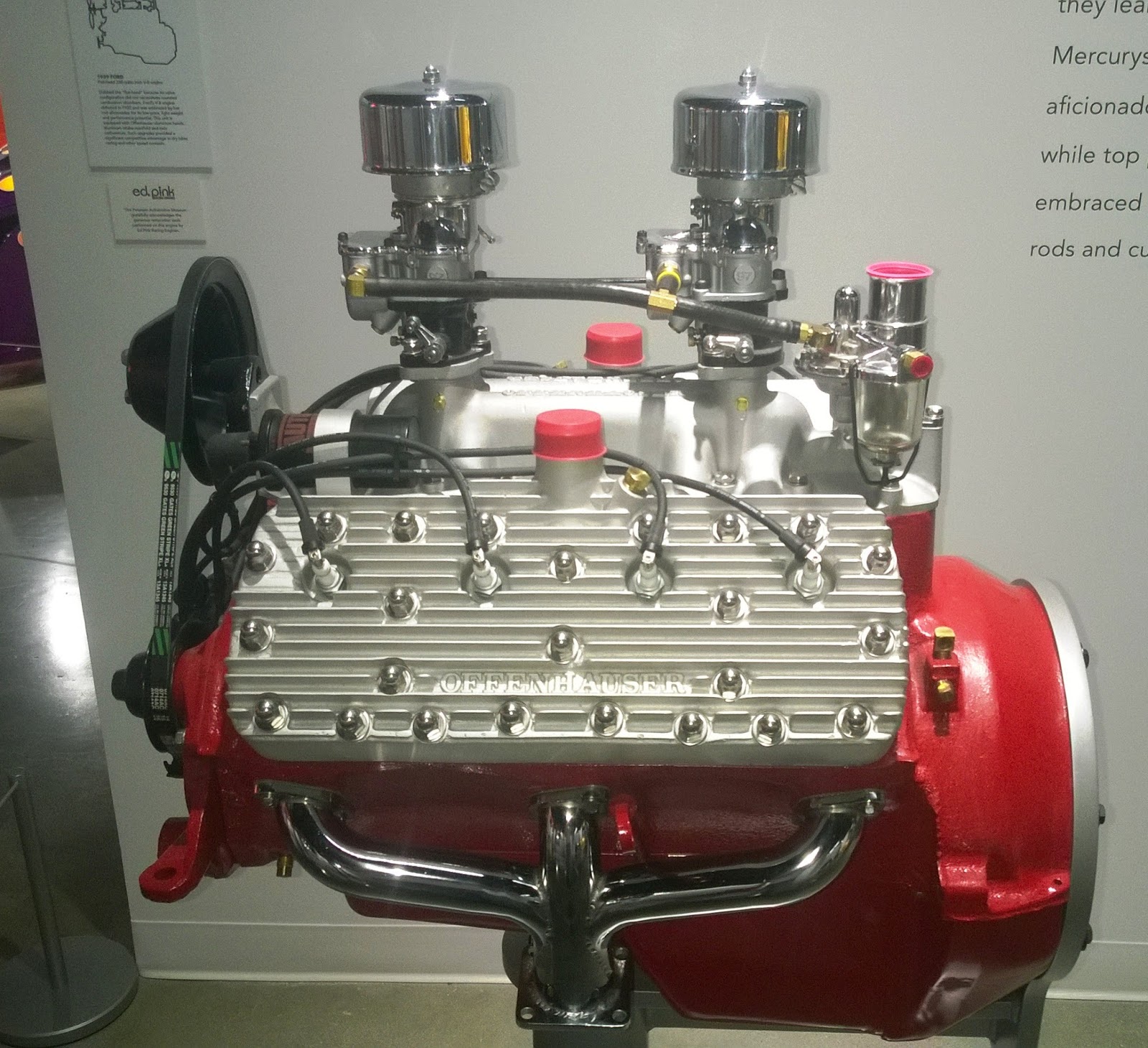
The engine is always a focal point of any hot rod, so it is fitting that we close out report on the display which one of its features - two engines built by Ed Pink racing engines- a 1959 Buick ‘nailhead” V-8 (top) and a Ford “flathead” V-8.    


All photos by the author except as noted


Thursday, July 20, 2017


“Fatty’s” custom 1914 Renault type EF
 
 
Photo by the author
 

Comedian Roscoe “Fatty” Arbuckle was one of the biggest stars in the Hollywood during the silent movie era until his disastrous fall from grace in 1921.  Acting as both the director and acting star, “Fatty’s” slapstick comedic short films were hugely successful and he earned over a million dollars a year.  Arbuckle lived a lavish lifestyle which included his ownership of several custom cars including this 1914 Renault, a 1919 Pierce Arrow model 66 and later a 1923 McFarlan originally ordered by fellow actor Wallace Reid.
 
Photo by the author
 

The most striking styling detail of the Renault EF on display at the Petersen Automotive Museum is the characteristic sleek sloping nose. The nose slopes dramatically because the car's radiator is positioned behind the 158 cubic inch four-cylinder side-valve engine.

“Fatty” wanted a sportier look than the right-hand drive four-seater torpedo body. To build his vision, Arbuckle went to the firm run by Los Angeles coachbuilder Jacob W Earl Earl Automotive Works located at the corner of Pico Boulevard and Los Angles Street in Los Angeles. 
 
 
photograph of a Renault EF four seater
torpedo courtesy of Bohams
  

Jacob's son Harley J. Earl later become renowned as the head of design at General Motors. Harley graduated from Hollywood High School in 1911 and enrolled in 1912 at the University of Southern California then  transferred to Stanford University in 1914. Harley at 6 feet 6 inches tall, was active in sports and the Phi Delta Theta fraternity  and finally graduated from Stanford University in 1918. Harley joined his father’s firm as a designer to support himself and his bride.    

According to a 1956 New York Times article, while his father on vacation young Harley took over and his first sale was to “Fatty” Arbuckle –  for the work on this car. Upon his return the elder Earl reportedly was furious when he learned about what his son had been doing, but the profit from the build changed his mind.  Soon after the Renault with the sloping windscreen was completed, it appeared in the 1920 short silent picture The Garage with Arbuckle and Joseph “Buster” Keaton.

The Earl Body Works became a division of the Don Lee empire and later built customs for movie stars and industry executives including the cowboy actor Tom Mix and built Arbuckle a second custom, his Pierce Arrow finished in a vivid purple color which was the car ‘Fatty” drove on his fateful trip to San Francisco for Labor Day weekend 1921.  Following the scandalous death of Virginia Rappe, Arbuckle was arrested and arraigned on the charge of manslaughter on September 17, 1921.
 
After a third trial, he was exonerated, but Arbuckle was financially ruined and due to his inability to find work in Hollywood, Arbuckle lost all the trappings of his success, including the Renault, the Pierce-Arrow and the McFarlan.

The custom Renault is in the Petersen Automotive Museum in Los Angeles, with the Earl custom bodied Pierce-Arrow displayed several years ago at the Petersen while the magnificent McFarlan is part of the permanent Nethercutt collection in Sylmar California.