Showing posts with label Flathead Ford. Show all posts

Monday, January 29, 2018


Hot Rod Lincoln at SEMA 

As a teenager in the nineteen seventies the author loved Commander Cody’s version of the song “Hot Rod Lincoln” but when my father heard the song he would say that in his youth he had owned a 1941 V-12 Lincoln Zephyr which was a “dog” when it came to performance. The truth was the 292-cubic inch Lincoln V-12 flathead engines only developed a little over 110 horsepower and were notoriously unreliable.


Pat Reisinger of Reisinger Custom Rebuilding LLC of Evansville Indiana loved the idea of a “Hot Rod Lincoln” but he decided to send his 1947 306-cubic inch V-12 flathead engine to H& H Flatheads to add power. H&H in La Cresenta California added Ken Austin aluminum cylinder heads and a supercharger topped by four Stromberg 97 carburetors that brought the engine to life with 295 horsepower.


Now with the engine making good power, Pat built the car as he started with a Brookville Roadsters 1931 Model A 5-window body mounted on 1932 Ford rails with a Winters quick-change rear end and dropped I-beam front end. The period look is finished off with steel wheels with Lincoln V-12 hubcaps.
.


Reisinger’s creation which he calls “V Doce” (Doce is Spanish for twelve) was on display in the NSRA (National Street Rod Association) booth at the 2017 SEMA (Specialty Equipment Market Association) show.
All photos by the author

Saturday, September 23, 2017


A hot rod  with a historic connection 
at the Autos of Alamo car show

At the “Autos of Alamo” car show held on the evening of September 18 at the Alamo Square shopping Center, the author found a unique hot rod with a connection to both hot rod history and the history of the Indianapolis 500-mile race.


From a distance this is a nice full-fendered 1932 Ford Model 18 Deluxe coupe “three window” fitted with a Sparton horn, but the outstanding feature of this hot rod is its flathead V-8 engine fitted with original Navarro 89 cylinder heads. Barney Navarro was a ground breaking early Southern California hot rodder who built hop-up parts for at his Navarro Engineering shop at 5142 San Fernando Road in Glendale California.

Rambler ad scanned from the September 1967
 issue of Motor Trend magazine

For five years Barney Navarro raced on the United States Auto Club (USAC) championship racing circuit, principally at the Indianapolis Motor Speedway with an unlikely engine – a Rambler straight six engine as used in the Rambler American passenger car. Barney sleeved the engine down from its original 199 cubic inches down to 183 cubic inches and turbocharged it. A Rambler advertisement in Motor Trend magazine in September 1967 claimed that the engine developed over 550 horsepower.

Unfortunately the chassis in which the engine was installed in for its 1967 debut was a bit long in the tooth; the first rear-engine Watson chassis which powered by a Ford DOHC V-8 engine was driven to second place by Rodger Ward in the 1964 Indianapolis ‘500.’

 Les Scott's official Indianapolis Motor Speedway photo


Navarro bought the car in 1966 from racer Norm Hall who had raced it unsuccessfully during the 1965 USAC engine fitted with an Offenhauser engine. The Rambler-powered car was entered in the 1967 Indianapolis ‘500’ for Kokomo Indiana rookie driver Les Scott who passed his rookie test but failed to qualify for the 33-car starting field.

Over the next few years, Barney Navarro continued to attempt to qualify at Indianapolis with Scott as the driver although other notable drivers tried it. In 1968, after Scott failed his refresher test journalist turned racer Ken Titus crashed the Navarro Watson in practice.

In 1969 Mike Moseley who drove for Wilke Racers and AJ Watson took the car for a “test hop” to help sort of the handling but in the end Scott and the #50 Navarro Engineering Special failed to qualify for the ‘500.’ Later during the 1969 USAC racing season Al Loquasto tried to qualify the car at two races, and  Southern California road racer Dino Dioguardi did not qualify for the starting field at the 1969 season-ending “Rex Mays 300.”

Ace midget car pilot Arnie Knepper drove the red white and blue “Navarro American Motors Special” in practice at Indianapolis in 1970 but did not attempt to qualify. Later that season both Les Scott and Denny Zimmerman unsuccessfully tried to qualify the car for the inaugural ‘California 500’ at the Ontario Motor Speedway in September 1970.

Dave Strickland's official Indianapolis Motor Speedway photo


The following year the Navarro Rambler-powered car now fitted with twin turbochargers finally made the starting field for a USAC race and ran in both heats of the “Rafaela Indy 300” held in Argentina, driven by midget racing stalwart Dave Strickland. The #50 car was flagged in 19th place in the first 153-mile heat race, and 15th in the second heat 8 laps behind the winner.  

After adjustments made during a tire test session at Phoenix improved the old chassis’ handling, the team went to Indianapolis with high hopes. Dave Strickland passed his rookie test, but the over-stressed Rambler engine then reputed to develop 700 horsepower had reliability issues and eventually Strickland stepped out of the car after a practice incident. 
The Navarro-owned Rambler-powered Watson chassis reappeared at the Indianapolis Motor Speedway in 1972 as the “Roughneck Drilling Special” driven by hard-luck racer Leon “Jigger” Sirois, who practiced the car but never made a qualifying attempt.

During the 1980’s Barney Navarro sold the 1964 Watson chassis less its unique engine back to its original driver Rodger Ward who had the car restored to Ford DOHC power with its original 1964 livery as the “Kaiser Aluminum Special.” 

Barney Navarro a true hot rod and racing innovator passed away two days after his 88th birthday in August 2007 but his company carries on and sells modern examples of Barney’s original castings.    

Color photographs by the author
Black & White photographs courtesy of the IUPUI University Library Center for Digital Studies Indianapolis Motor Speedway Collection

Tuesday, September 19, 2017


1951 Ford Woodie wagon


At the 2017 “Autos of Alamo” car show, the author spied this 1951 Ford Country Squire wagon, Ford’s last wood-bodied station wagon built in its Iron Mountain factory using maple and birch from Ford’s own Upper Peninsula forests.  Some purists disdain these cars as the body is mostly steel inlaid with wood.
 
 
Comparing the two sides of this 1951 Ford demonstrates how little wood was actually used in building these cars.  


Ford had remained the woodie wagon market after Chevrolet had abandoned it following the 1948 model year, as General Motors found that all-steel station wagons were much more cost competitive. Ford dropped the price of the V8 flathead powered 1951 top of the line Country Squire wagon to $2028 but sales for the model year totaled just 22,292 units.
 
In late 1951 Ford Motor Company sold the Iron Mountain factory, and for 1952 the re-designed Ford Country Squire used 'Di-Noc' wood laminate paneling on the sides and tailgate framed by wood, but the real wood was replaced by wood-grained fiberglass mid-way through the 1953 model year.   

All photographs by the author

Monday, August 14, 2017

A collection of
America’s Most Beautiful Roadsters
at the Petersen

Now on display through April 15 2018 in the Customization Gallery at the Petersen Automotive Museum are a number of the past winners of the America’s Most Beautiful Roadster (AMBR) trophy annually awarded at the Grand National Roadster Show (GNRS). Since 1950, hot rod builders have vied to win the 9-foot tall AMBR trophy created by show promoter Al Slonaker , and through the years, some fairly radical cars won the AMBR trophy, a few of which the author photographed.   


The AMBR story begins with the very first winner, the 1929 Ford roadster built by Bill Niekamp of Long Beach California over a course of thirteen months and a cost of close to $2,000.  Niekamp who worked as a body man and painter in the Long Beach Plymouth assembly plant used parts from many different cars to create his simple masterpiece. The frame is from a 1927 Essex, the car is powered by a highly modified 1942 Mercury “flathead” V-8 engine which feeds a 1939 Ford rear axle, and tail of the car uses 1949 Plymouth tail lamps. 

The Niekamp roadster’s belly pan, hood panels and the “track nose” were hand-fabricated from aluminum by metalsmith Dwight “Whitey” Clayton and the car is finished in 1950 Chrysler Blue.  Niekamp did not use his roadster just as show car; he participated in the 1950 and 1951 Pasadena Reliability Runs and achieved a top speed of 142.40 miles per hour (MPH) at El Mirage dry lake in July 1952. The car is shown as it would have appeared at the dry lakes in 1952, sans headlights and windshield.  


The “Alien” the 1969 AMBR winner is registered as a 1937 Ford, as that the identity of the chassis, but the dune buggy-like body is built of plywood and fiberglass and painted by brothers Art and Mickey Hmisl of Concord California. The car is powered by a 289-cubic inch Ford engine fitted with Shelby-American cylinder heads and the flip-top body is so severely raked that the roof has a smoked transparent panel to allow the driver who is practically prone to see out of the car.  The brothers actually sold their creation during the 1969 Grand National Roadster Show.


This 1923 Ford Model T roadster pickup now known as the “Candy Root Beer” was built by Lonnie Gilbertson of Portland and won the 1971 AMBR trophy. The car then painted bright red or orange was equipped with an independent rear suspension from a Jaguar XKE, and powered by a 350-cubic inch Chevrolet V-8 engine fed by a four Weber carburetors with chrome side pipes. 
 
The 1971 AMBR winner and trophy
Photo courtesy of the Petersen archives
 
After the car was repainted yellow with wild murals and the engine fitted with custom cylinder heads and a supercharger it won the 1975 AMBR trophy. It is displayed at the Petersen as it appeared after 1975 when it won twenty-nine additional trophies at car shows across the country.


The “Golden Star” is based on a 1925 Ford Model T roadster, and Phoenix racer and builder Ermie Immerso who had won the 1988 AMBR award with his “Orange Twist” used two Model T bodies to come up with this creation powered by a Ford 255-cubic inch double overhead camshaft (DOHC) racing engine as used in nineteen sixties Indianapolis cars.


Ernie was a “racing guy,” as he raced on the Salt Flats, worked on Clint Brawner’s crew at the 1954 Indianapolis 500-mile race and later worked for Carroll Shelby and Holman Moody. From his stockpile of Ford DOHC V-8 engine parts, Ernie built the highly-detailed engine in the configuration it would have for a dirt championship car, with the intakes on the upper side of the engine.  
 
When it debuted at the 1989 GNRS and won the AMBR award, the ‘Golden Star” was painted red with darker red flames. Two years later, with the interior reupholstered the addition of the odd canard-style fairings in front of the rear wheels and painted orange with wild flame accents as shown today, it captured the 1991 AMBR trophy. The “Golden Star” is currently owned by the Petersen Museum.
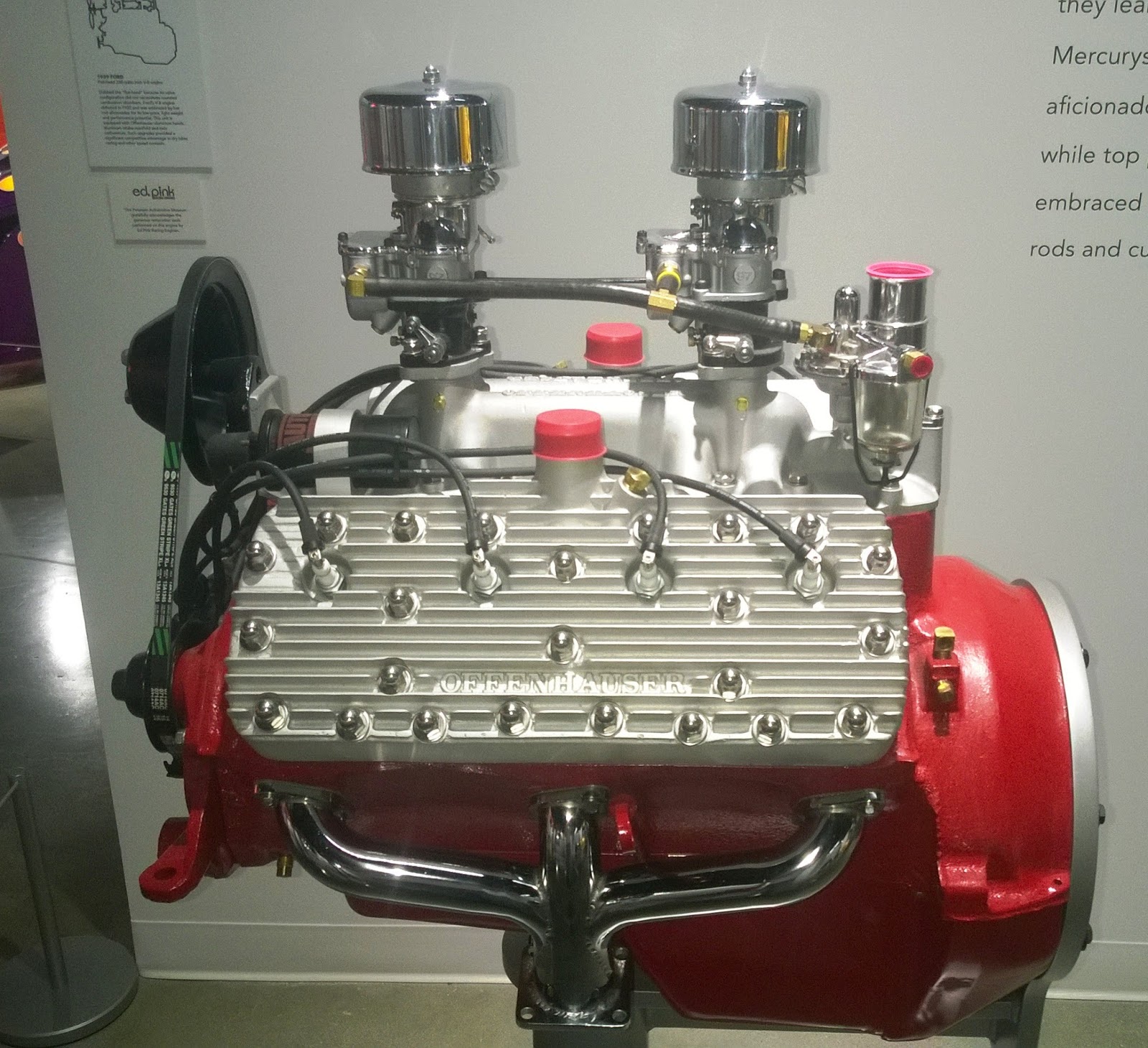
The engine is always a focal point of any hot rod, so it is fitting that we close out report on the display which one of its features - two engines built by Ed Pink racing engines- a 1959 Buick ‘nailhead” V-8 (top) and a Ford “flathead” V-8.    


All photos by the author except as noted