Showing posts with label Alamo. Show all posts

Friday, May 3, 2019

1960 Ford Thunderbird convertible


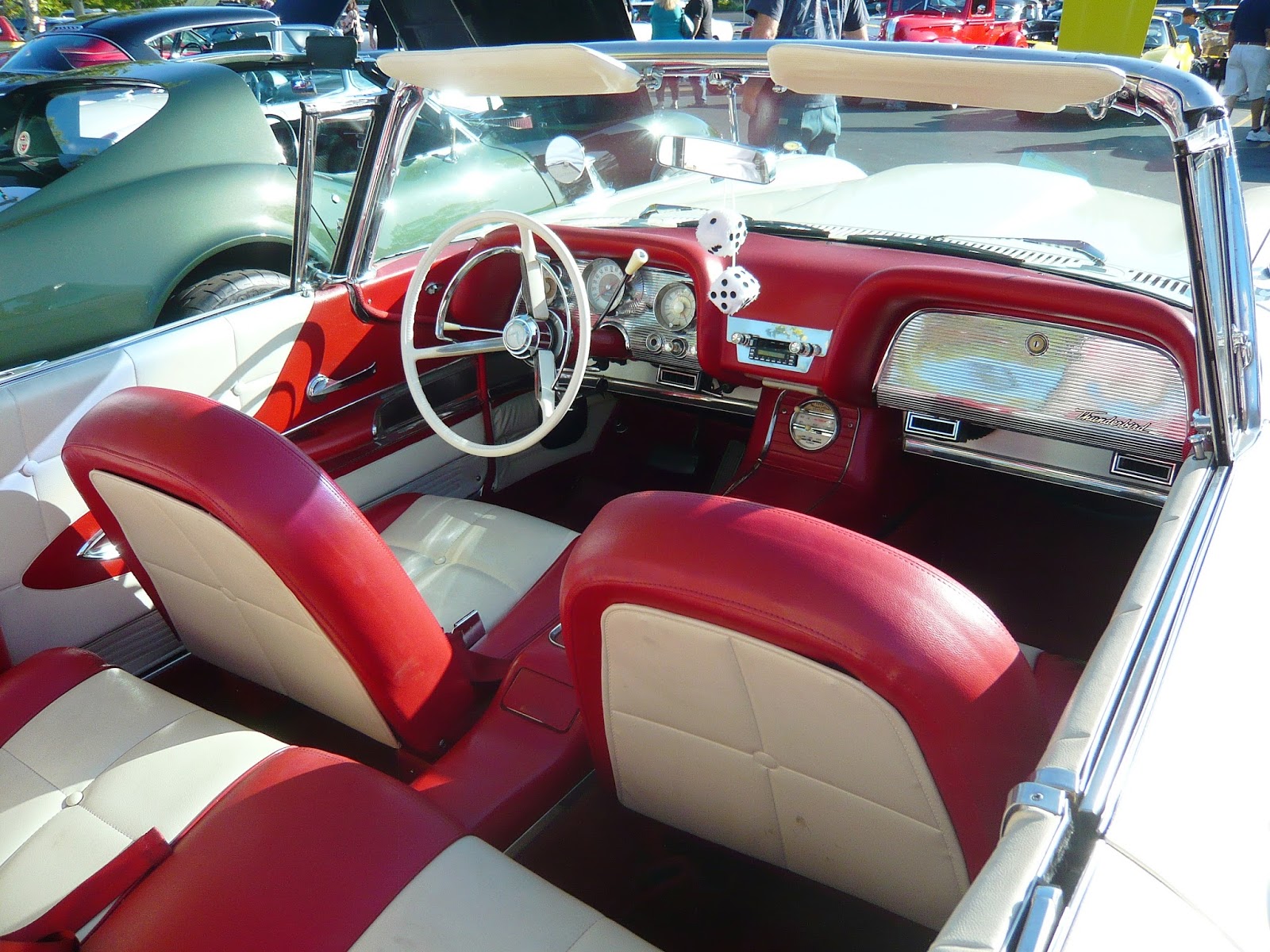
The 1960 Ford Thunderbird was the third and final year of the second generation “square birds” which replaced the first generation two-seater Thunderbird the sales of which Ford Motor Company executives believed were held back by only having seating for two.  When introduced in 1958, the new four-seat Thunderbird was the first Ford built using unibody construction (no separate chassis).

Ford executives were correct about enlarging the new Thunderbird as it won the Motor Trend Car of the Year award and sales increased each model year. In 1958 total Thunderbird sales totaled nearly 38,000 in just nine months of production. Sales shot up to nearly 67,500 units, and in 1960, Ford sold 92,800 Thunderbirds, which included 11,800 convertibles like this one shown at the "Autos of Alamo" car show.
The 1960 Ford Thunderbird is distinguished from the front three-quarter view  by the egg crate style grille and triple vertical chrome "hashes" on the rear quarter panels.

The 1960 Thunderbird is easily identified from the rear by its triple taillights
352-cubic inch V-8 engine developed 300 horsepower from the factory

The 1960 Thunderbird was equipped with bucket front seats and a console


The car shown at Alamo was equipped with optional Kelsey-Hayes wire wheels

The convertible top eliminated much of the trunk room

All photos by the author

Tuesday, January 2, 2018


deTomaso Pantera by Ghia
 imported by Lincoln-Mercury


In September 1969 Ford Motor Company signed an agreement with Italian auto manufacturer Alejandro deTomaso to build a high-volume wedge shaped mid-engine budget supercar, the Pantera (panther in Italian) for the United States market.
Ford knew there would be a limited window of sales for this car as the Tom Tjaarda design would not meet 1975 United States crash standards, but Ford anticipated selling 5000 Panteras a year in the United States at $10,925.00 each through Lincoln-Mercury dealers. At that time a Ferrari sold for $25,000, so Ford was selling a supercar at a bargain price.  

The first Pantera, a yellow car shown at the 1970 Los Angeles Auto Show was actually a European market car with push button doors and was later photographed for the initial Pantera brochures. The Pantera was powered by a Ford 351 cubic inch V-8 fitted with a four barrel carburetor that produced 310 horsepower.
 
click to enlarge
 
The mid-mounted engine fed the power to the independently suspended rear end through a ZF five-speed transmission. With a curb weight of 3123 pounds the Pantera accelerated from a standing start to 60 miles per hour (MPH) in 5.5 seconds and covered the quarter mile in 14 seconds.
 
The Pantera was a hand-built Italian supercar with four wheel power disc brakes and four-wheel independent suspension and cast magnesium  wheels  but being hand built, the cars had some problems. The author recalls making a trip with his father in 1971 as a thirteen year old to a Lincoln-Mercury dealer in Fort Wayne Indiana to look at a Pantera.
 
Upon arrival, the dealer’s salesman was unfamiliar with the car and had no brochures. The dealership’s single medium blue example was not on the showroom floor, but rather was in the service department. The salesman admitted the car wouldn’t run and was in the shop to diagnosis an apparent electrical problem.

My father and I were left alone to wander back into the empty dealership service area to look at the car and were shocked at the poor build quality in the interior and exterior panel fitment. Panteras were notoriously unreliable, with engine cooling issues as well as an inadequate cockpit ventilation system. My father bought a Lincoln Mark III instead (as if he was going to buy anything else).   

Several celebrities owned Panteras. Elvis Presley bought a yellow Pantera for one of his girlfriends, and when it wouldn’t start the enraged star shot the steering wheel, after which the car reportedly started. Playboy Enterprises bought a white 1972 Pantera, had it stripped and painted pink and gave the car to 1972 Playmate of the year Liv Lindeland. In 1974 Canadian hockey star and restaurateur Tim Horton died after he crashed his 1972 white Pantera at over 110 MPH and  was ejected. A later investigation revealed that Horton's blood alcohol was twice the legal limit.   
 
 
click to enlarge
 
The early Panteras were equipped with attractive thin chrome bumperettes, but by 1973 to meet the new US crash standards, the Pantera Lusso (“L”)  as the example seen at the “Autos of Alamo” car show was equipped with energy-absorbing reinforced steel rubber bumpers which were certainly more attractive than some cars’ added safety bumpers.   
 
At the end of the 1974 model year, as planned Lincoln-Mercury dropped the Pantera line with a  documented total of only 5262 cars sold, far short of the planned 5,000 a year. Many of the surviving Panteras have been modified as the one seen at Alamo which has a non-original pant color and  is fitted larger diameter wheels which are similar to the original Campagnolo design in addition to obvious engine upgrades.
 
The 1973 Pantera had a redesigned instrument cluster with optional wood grain – the original Pantera featured a “twin pod” design
 
All photographs by the author  

Thursday, October 26, 2017

Everyone loves a Nomad -today


This understated 1955 Chevy Bel Air Nomad mild custom drew a lot of attention at the 2107 "Autos of Alamo" car show.


1955 Nomad wasn't the first two-door station wagon that honor goes to the 1950 Ford Country Squire wagon, but it groundbreaking with styling that copied the Chevrolet hardtop sedan. The Nomad traced its origins back to the 1954 General Motor Motorama  "Dream Car" car of the same name.


Although today we look back upon this 2-door design as iconic, sales of the Nomad the most expensive car in the Chevrolet showroom ($2571 in 1955), never met expectations.  Introduced four months into the 1955 model year there were 8,386 1955 Nomads produced, but full-year sales totals actually dropped in 1956 to 7,886 units and dropped again in 1957 with just 6,100 Nomads sold. Future Chevrolet Nomads were four doors, except for the short-lived 1976 Vega Nomad wagon.


The Pontiac Division of General Motors shared the same body and sold it as the Safari wagon. The Safari was even more expensive that the Nomad with a list price of approximately $500 more and Safari sales were less than half those of the Nomad for the same three model years 1955-1957. After 1957 Pontiac Safari wagon featured a four-door body design.  

All photographs by the author

.

Tuesday, October 10, 2017

1932 Chevrolet Confederate sedan


Given today’s poetically correct social environment, many people will likely be surprised to learn that in 1932, Chevrolet Division of the General Motors Company marketed its new BA series car as the “Confederate.” Chevrolet advertised that the Confederate had “V-16 styling at a six cylinder price" and emphasized that it was the "Great American Value."
 
The Confederate series encompassed fourteen different body styles and a total of 313,395 were built in five factories across the United States during the 1932 sales year.
 
Notice the Chevrolet Spark passing in the background
 
The wire mesh grille was standard
The chrome louvers on the hood dual spare tire side mounts and cowl lights on this car which was seen at the “Autos of Alamo” car show identify it as a Confederate Special sedan.


 The Confederate rides on 18-inch true spoke wire wheels.


The Confederate series was powered by the trusty 194 cubic inch 60-horsepower (up 10 from 1931) “Stovebolt Six” engine connected to the all-new three-speed “Silent Synchro-Mesh” transmission and the "Simplified Free Wheeling" mode was standard, which permitted the car to coast when the driver's foot was lifted from the accelerator via an over-running clutch, that disengaged the driveshaft from the output shaft.


This beauty is very well-equipped fitted with the dual front "Town and Country" horns, dual rear-view mirrors, luggage racks, front and rear bumpers and the optional passenger side brake and parking light. All of these options that could have been added either at the factory or the dealership.    
 
After one year of disappointing sales with many sales lost to the new V-8 Ford,  the Confederate  was replaced for 1933 by the CA series sold as the "Eagle" and "Master" which when combined sold 140,000 more units than the 1932 Confederate.  
 
All photos by the author

Friday, September 29, 2017

Owned by the same man for 56 years
 
 
Spotted at the 2017 Autos of Alamo Car Show in amongst the shiny brightly painted hot rods and sport cars was this  rather weather-beaten 1961 Chevrolet Impala coupe. This Roman Red with an Ermine white hardtop has an interesting story, as it has been owned by the same man for 56 years and it has spent the last 44 years in the City of Alamo. 


The owner hasn't restored the bdoywork (yet) but he has rebuilt the  235 cubic  inch 135-horsepower  "Hi Thrift" straight six engine.

If this was your car, what would you do - restore it or preserve it as original?  

Saturday, September 23, 2017


A hot rod  with a historic connection 
at the Autos of Alamo car show

At the “Autos of Alamo” car show held on the evening of September 18 at the Alamo Square shopping Center, the author found a unique hot rod with a connection to both hot rod history and the history of the Indianapolis 500-mile race.


From a distance this is a nice full-fendered 1932 Ford Model 18 Deluxe coupe “three window” fitted with a Sparton horn, but the outstanding feature of this hot rod is its flathead V-8 engine fitted with original Navarro 89 cylinder heads. Barney Navarro was a ground breaking early Southern California hot rodder who built hop-up parts for at his Navarro Engineering shop at 5142 San Fernando Road in Glendale California.

Rambler ad scanned from the September 1967
 issue of Motor Trend magazine

For five years Barney Navarro raced on the United States Auto Club (USAC) championship racing circuit, principally at the Indianapolis Motor Speedway with an unlikely engine – a Rambler straight six engine as used in the Rambler American passenger car. Barney sleeved the engine down from its original 199 cubic inches down to 183 cubic inches and turbocharged it. A Rambler advertisement in Motor Trend magazine in September 1967 claimed that the engine developed over 550 horsepower.

Unfortunately the chassis in which the engine was installed in for its 1967 debut was a bit long in the tooth; the first rear-engine Watson chassis which powered by a Ford DOHC V-8 engine was driven to second place by Rodger Ward in the 1964 Indianapolis ‘500.’

 Les Scott's official Indianapolis Motor Speedway photo


Navarro bought the car in 1966 from racer Norm Hall who had raced it unsuccessfully during the 1965 USAC engine fitted with an Offenhauser engine. The Rambler-powered car was entered in the 1967 Indianapolis ‘500’ for Kokomo Indiana rookie driver Les Scott who passed his rookie test but failed to qualify for the 33-car starting field.

Over the next few years, Barney Navarro continued to attempt to qualify at Indianapolis with Scott as the driver although other notable drivers tried it. In 1968, after Scott failed his refresher test journalist turned racer Ken Titus crashed the Navarro Watson in practice.

In 1969 Mike Moseley who drove for Wilke Racers and AJ Watson took the car for a “test hop” to help sort of the handling but in the end Scott and the #50 Navarro Engineering Special failed to qualify for the ‘500.’ Later during the 1969 USAC racing season Al Loquasto tried to qualify the car at two races, and  Southern California road racer Dino Dioguardi did not qualify for the starting field at the 1969 season-ending “Rex Mays 300.”

Ace midget car pilot Arnie Knepper drove the red white and blue “Navarro American Motors Special” in practice at Indianapolis in 1970 but did not attempt to qualify. Later that season both Les Scott and Denny Zimmerman unsuccessfully tried to qualify the car for the inaugural ‘California 500’ at the Ontario Motor Speedway in September 1970.

Dave Strickland's official Indianapolis Motor Speedway photo


The following year the Navarro Rambler-powered car now fitted with twin turbochargers finally made the starting field for a USAC race and ran in both heats of the “Rafaela Indy 300” held in Argentina, driven by midget racing stalwart Dave Strickland. The #50 car was flagged in 19th place in the first 153-mile heat race, and 15th in the second heat 8 laps behind the winner.  

After adjustments made during a tire test session at Phoenix improved the old chassis’ handling, the team went to Indianapolis with high hopes. Dave Strickland passed his rookie test, but the over-stressed Rambler engine then reputed to develop 700 horsepower had reliability issues and eventually Strickland stepped out of the car after a practice incident. 
The Navarro-owned Rambler-powered Watson chassis reappeared at the Indianapolis Motor Speedway in 1972 as the “Roughneck Drilling Special” driven by hard-luck racer Leon “Jigger” Sirois, who practiced the car but never made a qualifying attempt.

During the 1980’s Barney Navarro sold the 1964 Watson chassis less its unique engine back to its original driver Rodger Ward who had the car restored to Ford DOHC power with its original 1964 livery as the “Kaiser Aluminum Special.” 

Barney Navarro a true hot rod and racing innovator passed away two days after his 88th birthday in August 2007 but his company carries on and sells modern examples of Barney’s original castings.    

Color photographs by the author
Black & White photographs courtesy of the IUPUI University Library Center for Digital Studies Indianapolis Motor Speedway Collection

Tuesday, September 19, 2017


1951 Ford Woodie wagon


At the 2017 “Autos of Alamo” car show, the author spied this 1951 Ford Country Squire wagon, Ford’s last wood-bodied station wagon built in its Iron Mountain factory using maple and birch from Ford’s own Upper Peninsula forests.  Some purists disdain these cars as the body is mostly steel inlaid with wood.
 
 
Comparing the two sides of this 1951 Ford demonstrates how little wood was actually used in building these cars.  


Ford had remained the woodie wagon market after Chevrolet had abandoned it following the 1948 model year, as General Motors found that all-steel station wagons were much more cost competitive. Ford dropped the price of the V8 flathead powered 1951 top of the line Country Squire wagon to $2028 but sales for the model year totaled just 22,292 units.
 
In late 1951 Ford Motor Company sold the Iron Mountain factory, and for 1952 the re-designed Ford Country Squire used 'Di-Noc' wood laminate paneling on the sides and tailgate framed by wood, but the real wood was replaced by wood-grained fiberglass mid-way through the 1953 model year.   

All photographs by the author