Showing posts with label Plymouth. Show all posts

Friday, December 4, 2020

Thriller custom from SEMA360


Thriller Custom


The 1970 Plymouth Sport Satellite nicknamed “Thriller” was built by Randy Weaver of Weaver Customs in West Jordan, Utah and appeared in the SEMA360 virtual Battle of the Builders showcase.   


The top of the 900-horsepower supercharged SRT Hellcat Gen III Hemi V-8 peeks through the hood.  All that horsepower passes through a T-56 manual six-speed transmission and to the rear wheels through a narrowed Ford 9-inch rear end.


The car rides on a Scotts Hotrods independent front suspension and a triangulated four-link rear suspension with a Watt’s link.  Wilwood disc brakes provide the stopping power tucked inside a set of EVOD Industries three-piece wheels wrapped in Mickey Thompson rubber.


JS Custom Interiors in Salt Lake City handled the interior work with Hyde’s leather offset with billet accessories.   The dash is filled with Dakota Digital VHX-1023 instruments and a digital touch screen to run the Kicker audio system. The custom center console houses a Dakota Digital DCC-series controller for the Vintage Air climate package, and custom made billet shifter reminiscent of the Pistol Grip shifter made famous in the nineteen seventies Chrysler Corporation muscle cars.


All photos courtesy of SEMA 

Monday, November 16, 2020

1971 Plymouth Barracuda custom

 1971 Plymouth Barracuda custom 


This beautiful 1971 Plymouth Barracuda custom was built by Andy Leach and his crew at Cal Automotive Creations in Bennington, Nebraska for owner Kent Matranga was entered in the SEMA360 virtual "Battle of the Builders Contest" presented by the Specialty Equipment Market Association and reached the Top 12 finalists.


Underneath the tastefully modified bodywork painted by Charley Hutton with PPG Paints "Bronze Fire metallic" is the 700-horsepower supercharged Hellcat 6.2 liter Hemi engine hooked to a Bowler T56 six-speed transmission.


The ‘Cuda rides on 18-inch diameter x 8-inch wide EVOD wheels up front  and massive 20-inch diameter by 10-inch wide EVOD wheels in the rear with Baer brakes at all four corners.


Photos courtesy of SEMA

Wednesday, November 4, 2020

1968 Plymouth Barracuda Formula S custom at SEMA360


1968 Plymouth Barracuda Formula S custom at SEMA360


Garret Kitchen of Garret's Rod Shop in Columbus Ohio entered this 1968 Plymouth Barracuda Formula S owned by Byron Spade called the "Hemi-S Barracuda” in the SEMA360 Battle of the Builders contest, the 2020 virtual trade show for the Specialty Equipment Market Association. (SEMA).


The Barracuda rides on an Art Morrison Sport Frame with a RideTech Ride Pro suspension system and Wilwood brakes. The car painted with two shades of Axalta Tungsten Gray in two shades.


Power comes from a Gen-III Mopar
 6.1L Hemi topped by a Magnuson TVS2300 supercharger backed by Tremec manual six-speed gearbox. The “Hemi-S” rolls on Billet Specialties wheels fitted with Falken Azenis tires.  


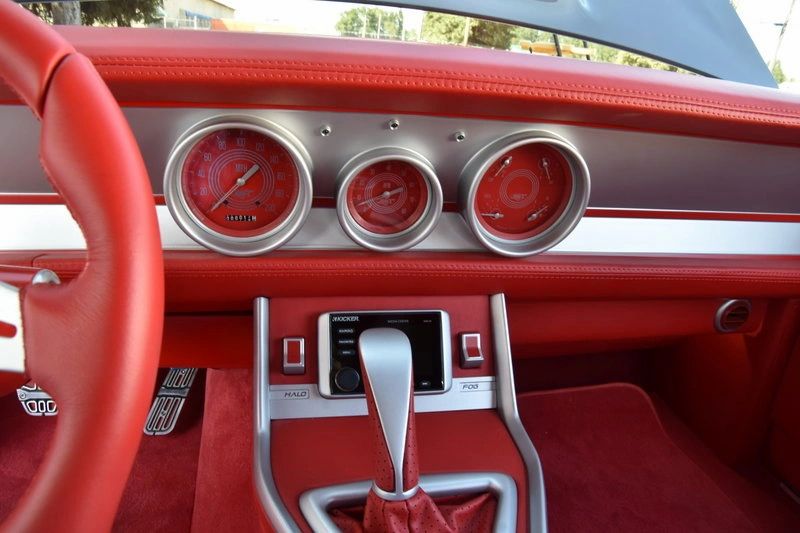
Recovery Room Interiors in Plattsmouth, Nebraska finished the eye-searing red interior and the dashboard with Custom Classic Instruments gauges.  This beauty was built using the Ron Francis Wiring ‘Express Wiring Kit.’  Check out the vendor website at  https://www.ronfrancis.com/


Photos provided by SEMA

Friday, October 9, 2020

F & F - the forgotten auto manufacturer


F & F  - a forgotten auto manufacturer


One of the United States’ largest automobile manufacturers in the decades of the nineteen fifties and sixties - from 1950 through 1967 - was based in Dayton, Ohio.  Readers are forgiven if they are not familiar with the name of F & F Mold & Die Works Incorporated because the vehicles they manufactured were made of plastic and only 3-1/4 inches long, but in 1991, an article in the Dayton Daily News pointed out that “at one time F & F made more plastic Fords than the automaker.“    

German emigres John and Joseph Fiedler came to the United States in 1927 and founded Fiedler & Feidler (later shortened to F & F) Mold & Die Works in Dayton Ohio in 1938 in a shop behind the family home at 34 Pierce Street in Dayton. By 1942, the busy with war work, the company moved into a two-story building at the corner of Sachs and Pruden Streets also in East Dayton.  

Joseph’s son, Otto Fiedler, who was born December 1919 in Nuremberg Germany, graduated from Fairmont High School in Dayton then attended Harvard College on a scholarship and  graduated in 1940 in the same class as a young man named John F. Kennedy. Otto came home to Dayton, registered for the draft and studied sculpture at the Dayton Art Institute.    

After he graduated from the Art Institute in 1942, he entered the military and during World War II Otto served in the U.S. Army counter-intelligence division. In 1946 he returned home to Dayton and oversaw the installation and start-up of F & F’s three new plastic injection machines in the new facility at 103 Sachs Street in East Dayton. At first, the company manufactured imitation tortoise shell plastic purses, but the following year they made plastic refrigerator dishes and ice cube trays.  

In that era, many food consumers purchased a boxed product then sent an order form on the package together with a small amount of money to redeem for a special premium item. In 1947 on the hunt for new business, F&F attended food industry trade shows and displayed a line of plastic premiums for buyers’ consideration.

At one trade show, a representative of the Quaker Oats Company asked Otto if F & F could design and manufacture an Aunt Jemima themed item that could sell for about 50 cents. F & F eventually made 16 million of Otto’s Aunt Jemima syrup pitchers, the first of many Aunt Jemima themed items that F & F made through the years.   

The company also manufactured large and small plastic novelty salt and pepper sets, sugar and creamer sets, spice holders and cookie jars.  Later the company found a niche making novelty plastic mugs that pictured Roy Rogers, Mr. Quaker, Tony the Tiger, Yogi Bear, Dennis the Menace, the Flintstones, and many more for General Mills, Post Cereals, Kool-Aid, and Quaker Oats.

F & F Mold and Die Works entered the scale automobile cereal premium business with plastic cars wrapped in cellophane that were larger than model railroad HO (1/87) scale and smaller than model railroad O scale (1/43). Their debut premium car, for the Kellogg Company, was a 1950 Ford four door sedan with a magnet cemented inside on the underside of the roof. The car rode on white wheels and tires with metal axles.


For 25 cents and the mail-in proof of purchase card, customers received a metal ring and a Ford Sedan in one of three colors – orange, yellow or blue. The idea was that the ring attracted the magnet, and allowed the user to move the car without touching it, although over time, the magnet often became separated from the car.  The same car without the “Ford” logo on the hood, and sans the ring and magnet was offered in blue and red in 1951.


With its business growth, F & F rented second-floor warehouse space in a building on Pine Street in Dayton.  All the Pine Street inventory was destroyed by fire in September 1951. Four young neighborhood boys admitted to playing with matches which started the fire which destroyed $54,000 of F & F inventory and cost the life of one Dayton firefighter, Clarence Dunkman, who died on the scene of a heart attack. 

During this period, F & F Mold and Die Works rented an old tobacco warehouse in Verona Ohio, northwest of Dayton, and expanded its manufacturing operations. The Verona facility grew to employ nearly 100 workers working three shifts at its peak in 1955.


F & F offered a huge product line in 1954 for Post cereal with both Ford and Mercury toy automobiles, with ten cars total in each of seven different colors which simulated the real car colors. The Ford models included the Thunderbird convertible, Crestline Sunliner, Victoria and 4-Door Sedan, the Customline Club Coupe, and the Ranch Wagon.

The F & F four-car 1954 Mercury line included the XM-800 Dream Car (prized by collectors), and the Monterey 4-Door Sedan, Sports Coupe and Convertible. Joseph Fiedler, Otto’s father and one of the founders of F & F passed away in March 1954 at only 56 years of age. Otto and his uncle John carried on with management of the F & F Mold and Die Works. 

For 1955, F & F manufactured five different 1955 Ford premium cars – the Thunderbird convertible, Fairlane Crown Victoria and Sunliner convertible, Customline 2-Door Sedan, and the Country Sedan Wagon, each in one of five colors.


In 1956, the Post cereal premiums moved away from cars with Ford tractor cabs and five varieties of Fruehauf trailers - freighter, moving van, tanker, gooseneck, and flatbed. The trucks and trailers came in four different colors appeared on the scene with either black or white wheels. The rigs came in four colors - orange, red, yellow and aluminum. F & F also manufactured two styles of Greyhound busses, both cast in blue and two styles of boats in five color-and-white combinations. 


In 1957 F & F created and built five new Ford models. The Ford Custom 300 2-Door Sedan Fire Chief are and the Ford Country Sedan Wagon Ambulance came in red only.   The rest of the 1957 Ford F & F lineup - the Custom 4-Door Sedan,  Fairlane 500 Town Victoria, Fairlane 500, and the Fairlane Sunliner  came in one of seven colors which mimicked  real Ford colors - Coral Sand, Dresden Blue, Inca Gold, Cumberland Green, Colonial White, Silver Mocha, and Flame Red.  

For 1959, there were only two cereal premium models - the Ford Thunderbird hardtop or the convertible which F & F manufactured in six colors - Raven Black, Brandywine Red, Cordovan, Flamingo, Starlight Blue (nearly black), and Glacier Green. Instead of a mail-away premium, the Thunderbird cars came packaged inside the cereal boxes.


During 1959, the Food and Drug Administration enacted new consumer safety rules which prohibited packages of food items from containing premiums with metal parts.   F & F changed the design to white plastic one-piece wheel and axles in order to comply with the new rule. The other big change in 1961 was that the cars were not Fords but Plymouths.  The three models offered were the Fury Convertible and Sports Coupe, and the Suburban Station Wagon, each one of six different colors.

F & F returned to building Fords in 1961 with three Thunderbird models – the Sports Roadster, the convertible and hardtop, each in one of five colors. In December 1962 F & F suffered another disastrous fire, this one at the Sachs Street facility which Fire Department investigators determined was caused by a carelessly discarded cigarette by one of the company’s twenty-five employees.  The company lost a majority of its inventory and suffered production delays as it took four months to rebuild the facility.


1966 F & F produced three Mustang models for Post cereals. The convertible, hardtop, and GT 2+2 fastback were offered in just three colors - Springtime Yellow, Arcadian Blue, and Signal Flare Red. F & F completed its automobile manufacturing in 1967 with the Mercury Cougar in one of six colors with black instead of white wheels.  


For 1969, Post Cereals switched suppliers - from F & F to the John V. Zimmerman Company of St. Louis, Missouri.  “JVZ” built four models of Mercury cars - the Cougar Hardtop, Cyclone CJ Fastback, Maurader X-100 Sportsroof and Marquis 4-Door Sedan - in six different colors with black one-piece wheels and axles.  

In 1973 Otto Fiedler suffered a massive heart attack while on vacation in Germany and became the eleventh person in the world to receive a battery powered heart pacemaker which lasted for five years before Otto underwent a replacement procedure.  

John Fiedler passed away in 1983 at age 82 which left Otto solely in control of F & F.  In June 1985 as the company approached being sold, F& F suffered another fire at Sachs Street, which destroyed the warehouse and finishing side of the facility. 

The Dayton Fire Department determined defective wring as the cause of the fire.  After the facility was again rebuilt, Otto sold the business and retired in 1987 to his home in suburban Kettering then passed away in 1989 at age 69.  

In 2020, more than fifty years after the last car shipped, the F & F Mold and Die Works building still stands at 103 Sachs Street in Dayton Ohio and F & F cars and trucks have an active collector community.


Monday, September 21, 2020

The famous "HEMI UNDER GLASS"


"HEMI UNDER GLASS"
Wheelstander


The massive Shell/Pennzoil/Quaker State display at the 2019 Specialty Equipment Market Association show in Las Vegas offered attendees a rare opportunity for an up-close look at the 1968 version of the famous “Hemi under Glass” exhibition wheel stander.


The supercharged Hemi powered Plymouth Barracuda was conceived in 1965 and according to legend sketched onto a cocktail napkin by Hot Rod magazine editor Ray Brock for George Hurst. Brock intended it to be a competitive racer, but testing uncovered a problem– the mid-engine placement of the supercharged Hemi engine caused the lightened front end of the car to jump into the air at the hit of the accelerator pedal.


Instead of a competitive race car, Hurst, a master promoter, put the wheel standing car on tour and it became a huge hit with spectators and spawned dozens of imitators.   

The “Hemi Under Glass” has only had three drivers through the years – Bob Shrewsberry, Bob Riggle and the current driver, Mike Mantel. 

Shrewsberry left  the "Hemi Under Glass" and Hurst after one season, and developed his own "LA Dart" wheel stander ( a later version featured the supercharged Hemi engine in the car's trunk) sponsored by LA area Dodge dealers.  Later in the late seventies Shrewsberry toured the "Berry Wagon" a fiberglass 1930 Ford Model delivery truck wheelstander sponsored by the Knott's Berry Farm amusement park.     

The original 1965 "Hemi Under Glass" power train was used for the construction of the 1968 Barracuda body style and the 1965 car no longer exists.  Multiple versions of the  second generation "Hemi Under Glass" toured the country for Hurst through 1970, then the company was sold and Hurst just sponsored the cars until Riggle was injured in a crash in 1975.
 
Bob Riggle reintroduced the "Hemi Under Glass" in 1992 and performed with the car until another crash in 2016, after which Mantel became the designated driver.  The author was assured by Shell officials that the car shown at SEMA 2019 was not the same car crashed on the famous episode of "Jay Leno's Garage." 

Mantel planned to introduce a new  modern "Hellephant" supercharged 1,000 hp and 950 lb-ft of torque Hemi powered LX- class Dodge "Hemi under Glass" Challenger for the 2020 season.  

All photos by the author 


Monday, May 21, 2018


Plymouth Air Radial truck at SEMA 2017


The Covercraft booth at the 2017 SEMA (Specialty Equipment Market Association) show in Las Vegas featured the Plymouth Air Radial truck built as a promotional tool by Colorado Auto Parts, a U-Pick yard near Denver.


The Plymouth division of the Chrysler Corporation had a commercial division that built and sold commercial body cars as well as half-ton pickup trucks known as the PT105 from 1937 until production halted in 1941, as the trucks were never very high-volume sellers.

The owners of Colorado Auto Parts owned this particular pickup for over 30 years but it wasn’t until they also obtained a Cessna C195 airplane for scrap that this concept came together. The crew removed the cab and bed, chopped the top and built a custom tube frame chassis to cradle the 505-pound 575-cubic inch Jacobs Aircraft Engine Company R-755-A2 7-cylinder radial engine.  


The biggest problem for the build was how to transmit the steel cylinders with twin-plug aluminum-alloy cylinder head engine’s 300 horsepower. The crew attached a toothed 3-inch wide rubber drive belt to the engine’s propeller shaft and used the belt to turn a pulley attached to the V-drive (as used in boats) mounted ahead of the engine. The V-drive’s output shaft is connected to a GM Turbo 400 automatic transmission which transmits the power and torque to the Franklin quick change rear end.

Colorado Auto Parts intended to race the truck at the Bonneville Salt Flats but learned that the Southern California Timing Association did not have a class for radial engines and that the SCAT didn’t consider the truck’s roll cage as safe, but still allowed the crew to drive the truck to run it alongside the course. Unfortunately the radial engine smokes a lot and overheats after about ten minutes, so this truck is not for commuting, just for show and exhibitions, and has been featured in Hot Rod and Autoweek magazines and on Jay Leno’s Garage.


Shown alongside the Plymouth Air Radial truck was a hot-rodded version of a Clark CK20 aircraft tug from the same era as the truck and engine. The original tug was powered by a 122-cubic inch 4-cylinder Continental flathead engine which allowed the tug to pull up to 20,000 pounds.

Covercraft Industries in business since 1965 offers a full line of automotive covers – from car covers, seat covers, dash pads, sunscreens, front ends bras, and floor mats for cars trucks, boats. Covercraft says they provide “protection for whatever you drive.” You can reach them on the internet at https://www.covercraft.com/us/en

all photos by the author


Thursday, March 22, 2018


A four-door Barracuda? YES!


Scan of 1970 Plymouth sales poster from author's collection
 

The third-generation Plymouth Barracuda built from 1970 to 1974 used the Chrysler Corporation two-door E-body platform shared with the Dodge Challenger.


For years, the internet contained stories of a red with black vinyl top four-door hardtop 1970 Plymouth Barracuda styling exercise seen in the center of Chrysler’s Highland Park, Michigan in the fall of 1969.  Dave Walden and Steve Been of ECS Automotive Concepts near St. Louis, Missouri decided to replicate the legend.


The starting point of the project was a cut-up and stripped four-door roof and pillars from a 1972 four-door Dodge Coronet. After the roof was chopped an inch, every piece of the car was hand-built as the crew massaged and modified both original and reproduction parts, a process that took six years and an estimated 10,000 hours of labor.


This running and driving “what if” four-door Barracuda shown at the 2017 SEMA (Specialty Equipment Market Association) show rides on a 118-inch wheelbase, weighs 3500 pounds, and is powered by a 275 horsepower Chrysler ‘LA’ 340 cubic inch V-8 fitted with a 4 -barrel carburetor 275 mated to a three-speed Torqueflite automatic transmission with a Chrysler 8-3/4 inch rear-end.  
 
Photos by the author

Tuesday, September 5, 2017

Dream cars at the Petersen Museum

The author recently had the opportunity to visit the Petersen Automotive Museum in Los Angeles and we will feature a number of features from that visit in the coming weeks. Today we look at the ‘Dream Cars’ exhibit which displayed three dream cars built in the decade of the nineteen fifties.

Mercury D-528


First up is the Mercury D-528, built in 1955 as a test vehicle for advanced concepts that included air conditioning, “safety seating” and suspension. It was radical for its time as its original design used a cantilevered roof with no front "A" pillars and four headlights. The car rode on coil spring suspension cloaked in a fiberglass body built in house at Ford Motor Company. The unusual name came from it being the 528th Ford experimental design. Apparently the pillar less top was a problem as eventually the car was rebuilt with thin “A” pillars.   


Auto manufacturer foresaw air conditioning as becoming a popular option in the future, but in 1955 because the required evaporators were so large they had to be located in the trunk. This affected the design – in order to provide adequate luggage room, the characteristic hinged rear humps were added on the rear fenders, with the gas tank access on one side and the spare tire in the other. The hooded reversed retractable back window became a design cue used in 1963 Mercury production cars

In the early sixties the D-528 was sold to Paramount Pictures and sent to Hollywood where it was remodeled by George Barris, who painted the car red and removed the name "D-528" from the front fenders and replaced it with "Beldone" – a name selected by its new owners. The “Beldone” fitted with a number of remote-controlled features was used in the 1964 Jerry Lewis movie, The Patsy, (a loose sequel of his 1960 film The Bellhop) and appeared later in several other movies and television shows.  

The Zeder Storm

Fred Zeder Jr. the son of famed Chrysler engineer wanted to develop an American powered dual-purpose sports car with a “swappable” body which could be partially for racing. Zeder partnered with Eugene Cassaroll, owner of Auto Shippers Incorporated which delivered Chrysler products around the country and Indianapolis car owner and the pair formed the Sports Car Development Corporation.

While on vacation in Europe, Zeder visited the custom Italian body builder Bertone and struck an agreement to build the body for Zeder’s creation. Although the body took six months longer than agreed, the finished car was shipped to New York via the ocean liner SS Andrea Doria and when Zeder drove it on the streets on New York City it reportedly caused a sensation.


The car, called the Zeder Storm Z-250, was taken to Chrysler's design headquarters in Hamtramck in April of 1954 in the car of his uncle, who was Chrysler’s Chief Engineer. The Chrysler Corporation kept the car powered by a 260 horsepower Dodge ‘Red Ram’ Hemi V-8 with other MoPar components that included the brakes, radiators, clutch, fuel tank, rear axle, and steering system for two years, but ultimately decided the car was too expensive to manufacture and returned it to Fred Zeder who drove it for many years.


The Storm Z-250 concept of American power and Italian bodywork was later still pursued by Cassaroll who later financed the 315-cubic inch Chrysler V-8 powered Dual Ghia with bodywork fabricated by the Italian coach builder Ghia. The Dual Ghia passenger car debuted in 1954, but although it a number of Hollywood actors Frank Sinatra, Sterling Hayden Desi Arnaz and Ronald Reagan each owned, the Dual Ghia ceased production in 1958 with just over 100 cars built which proved Chrysler’s decision on viability of the Zeder Z-250 Storm as correct.

Plymouth Explorer


Beginning in 1950 and continuing through the nineteen fifties, the Chrysler Corporation paired with Turin body builder Ghia to create two dozen drivable dream cars with hand built custom bodies.  The 1954 Plymouth Explorer coupe rides on a 114 inch wheelbase 1953 Plymouth Cranbrook chassis powered by a “Powerflow Six” a 110-horsepower 230-cubic inch 6-cylinder engine coupled to a HyDrive semi-automatic transmission; the driver only used the clutch to put the car in gear.


The attractive two-seat Explorer is finished in a brilliant metallic green paint with the bucket seat interior was covered with white leather with fitted luggage behind the seats. The “spear” on the sides of the car is not chrome; rather it is painted white to match the interior.  The last of the Italian bodied specials was the Chrysler “Norseman” was a four-seat fastback coupe built by Ghia. The concept car was lost (ironically) during the sinking of the ocean liner SS Andrea Doria in July 1956.

Due to cost, concept cars have lost favor among automotive manufacturers, but concept cars are still alive in the minds of dreamers, such as this radical futuristic race car model displayed in the Auto Center College of Design workshop inside the Petersen Automotive Museum. Could we see something like this car on race tracks in the near future?    


All photos by the author

Wednesday, June 21, 2017

Spectacular cars
at the Automobile Driving Museum

The Automotive Driving Museum located in El Segundo California (near the LAX airport) has several spectacular nineteen thirties luxury cars in a glassed-off section known as the Lairport Automotive Showroom ( the museum is located on Lairport Drive)


The beautiful 1930 Weymann bodied Stutz  patented design system that used a jointed wood frame covered in fabric. It was popular because the body system reduced the usual squeaks and rattles of metallic bodies and improved performance because of the body's lighter weight.  This four-door Stutz Monte Carlo Sedan is powered by a 287-cubic inch "Vertical Eight" 8-cylinder engine mounted in a chassis equipped with four-wheel hydraulic brakes. This car one of three built sold for $4,495 when new.  


After World War I pilot Charles Weymann used his knowledge of aircraft manufacturing techniques to develop a patented system for automobiles. He opened a factory in Paris in 1921 and through the decade the market for Weymann fabrics bodies  grew quickly and Weymann licensed his system to many of Europe's most prestigious manufacturers. Weymann opened a factory in Indianapolis Indiana in 1928 that was mainly devoted to building custom bodies for Stutz automobiles.

Early in the new decade of the nineteen thirties, the automobile buying public tastes shifted to high-gloss painted bodies and the Weymann fabric bodies with their matte finish fell out of fashion. Weymann's Paris factory closed in 1930 followed by the Indianapolis factory in 1931 making this 1930 one of the last of its breed.


Also behind glass was this 1937 Pierce Arrow Town Car with custom body built by Brunn & Company of Buffalo New York. In 1929 Studebaker had acquired the luxury automaker Pierce-Arrow which had been building its exclusive cars with the trademark styling cue of headlight built into the front fenders but in the Depression it was difficult to sell expensive custom-bodied car like this one. During the 1937 model year the full year of Pierce Arrow production only 164 cars were built.  Fewer than 20 Pierce Arrows were built during 1938 before production ground to a halt.  


Just outside the showroom was this magnificent 1932 Plymouth with a custom  Town Car with a body built Brewster & Company of Long Island New York. The original owner of this car was Franklin Delano Roosevelt and the car was used  for many years by Eleanor Roosevelt around their estate in Warm Spring Georgia. Roosevelt selected a more mundane Plymouth instead of a more ostentatious make of car to attract less attention during the Depression.  

All photographs by the author