Tuesday, February 7, 2017


The forgotten marque- the 1928 Whippet


In 1908 Elmira New York Overland automobile dealer John North Willys (pronounced Will-is) bought the struggling Indianapolis, Indiana Overland factory and quickly turned the company’s fortunes around around. The following year Willys purchased the Marion Motor Car Company from Marion Ohio and the bankrupt Pope-Toledo Motor Car Co. in Toledo, Ohio and consolidated the base of operations for his Willys-Overland Motor Company in Toledo.

In 1913, Willys acquired the license to build Charles Knight's sleeve-valve engine which was used in cars that bore the Willys-Knight nameplate. With his diverse line of automobiles in the period from 1912 to 1918, Willys-Overland became the second-largest producer of automobiles in the United States after Ford Motor Company. In 1925, John Willys bought out the Stearns Company of Cleveland and added the Stearns-Knight luxury car to his array of offerings.


In 1926 John N. Willys discontinued sales of cars with the Overland nameplate, and introduced a new economical type of car which he called the Whippet, after a mid-sized breed of racing dog smaller than a greyhound often called "the poor man's racehorse."  The 1927 Overland-Whippet was introduced to the American public on June 26 1926, and later in Britain, Canada and Australia. The Whippet was powered by a four-cylinder side-valve engine that displaced 134 cubic inches and produced 31 horsepower, which was plenty of power as the largest Whippet, the 12-foot long sedan, weighed little more than a ton.


The new Whippet featured 4-wheel brakes, a rear fuel tank, ‘Chadwick type” replaceable main engine bearings, Tryon spring shackles, water pump cooling and pressurized oil lubrication - all features not included on the Ford Model T. Whippet advertising touted the car’s European styling of a compact (100-inch wheelbase) yet roomy body, to combine good looks with good performance, handling, and economy. Early Whippet magazine advertisements quoted John Willys “Never before such beauty and quality for so little money.”  


The 1928 Whippet Model 96 such as the one on display at the Western Antique Aeroplane and Automobile Museum (WAAAM) in Hood River Oregon was offered in one of six body styles.  The low-price leader was the “touring car” a phaeton style body with a canvas top but no side windows which sold from the factory for $455.
 
 
Next up the Whippet price ladder came the roadster with rumble seat for $525, then the enclosed coupe and coach body styles which each sold for $535. The stylish Whippet Cabriolet Coupe (convertible) sold for $545 and the Model 96 passenger car line was topped by the four-door sedan as shown at WAAAM which sold for $585.   


Whippets were advertised as fast, durable, and economical and the factory proved that to the car-buying public with a number of performance tests. Best known is the effort of famed long-distance driver Erwin George “Cannon Ball” Baker who drove a Whippet touring car from Los Angeles to New York in late 1926. Baker who drove in the 1922 Indianapolis ‘500,’ covered the distance of 3,539.8 miles in 14 ½ days under the close observation of AAA (American Automobile Association) officials.

The test began with Carl Laemmle Junior, assistant manager of the Universal Picture Corporation witnessing the start at midnight on November 26 1926. A motorcycle escort led Baker and his official AAA ride-along observer, pioneering early race car driver Joe Nikrent (veteran of the 1913 Indianapolis 500), out of Los Angeles.  Baker and Nikrent followed the Southern transcontinental highway route as they passed through Arizona, New Mexico through El Paso and Dallas. Texas, then headed north to Memphis and Indianapolis and finally east in snowy weather through Philadelphia to the finish in New York City.

George Lewis, the Universal Pictures western silent film star and John N. Willys welcomed the pair at the end of the grueling economy test at noon on December 10 1926.  The Whippet touring car used 82 ¼ gallons of gasoline for the trip with an average fuel consumption of 43.28 miles to the gallon (MPG) which exceeded the advertised fuel economy of the Whippet by 13.28 MPG. At one point during the trip on December 1st between Sweetwater and Dallas Texas the Whippet’s fuel mileage peaked at the remarkable rate of 53.6 MPG.

110,344 Whippets were sold during the 1927 model year, and for the 1928 model year sales nearly doubled despite the introduction in late 1927 of the all-new Ford Model A. During 1928 Whippet added a 40 horsepower 178-cubic inch six-cylinder powered model, known as the Model 98, which sold alongside the four-cylinder model.  Sales continued to be strong and Willys-Overland ended 1929 in third place in US car sales behind Ford and Chevrolet.

As the Great Depression deepened, Willys-Overland discontinued the Whippet nameplate in the United States at the end of the 1930 model year after just four model years in favor of the Willys Six and Willy Eight.  The company staved off its creditors until World War II during which it built 363,000 “Jeeps” and returned to profitability. For the first few years after the war, Willys-Overland chose to concentrate on Jeeps and Jeep-based vehicles instead of passenger cars.  

In 1953, a subsidiary of the upstart car manufacturer Kaiser Manufacturing Corporation purchased the assets of Willys-Overland and changed its name to Willys Motors Incorporated.  U.S. production of Kaiser and Willys passenger cars ceased during 1955, but he company continued Jeep production and changed its name to Kaiser-Jeep in 1963.  Kaiser-Jeep was sold to American Motors Corporation (AMC) in 1970 as Kaiser Industries finally left the automobile business.  Chrysler Corporation purchased AMC and the Jeep nameplate in 1987; now a wholly owned subsidiary of Fiat Chrysler Automobiles (FCA) Jeep vehicles continues to be built in Toledo.

Friday, February 3, 2017


1930 Packard 7-33 Sedan 
“Luxurious Transportation”


The author recently visited the fantastic Woodland Auto Display at the Estrella Warbird Museum in Paso Robles California and we will feature more cars from Richard “Dick” Woodland’s collection in future articles. Today we open the series with a study of Mr. Woodland’s gorgeous 1930 Packard 7-33 seven-passenger sedan.

James Ward Packard purchased a Winton automobile in the late 1890's and after he was unsatisfied with his new car thought he could build a better car. The Packard Motor Car Company which first manufactured its cars in Warren Ohio in 1899, before it moved to Detroit, From the beginning Packard was considered one of the elite luxury cars built in the United States reinforced with the advertising slogan “ask the man that owns one.”  

During the period from 1917 to 1919 Packard was very successful in automobile racing with cars fitted with airplane-style engines driven by Ralph DePalma. In 1923, DePalma led an ill-fated attempt to build a fleet of Packards to race at the Indianapolis Motor Speedway which resulted in disaster as all three cars retired before 225 miles were completed.

After the humiliating results, the jewel-like Packard race cars were returned to the factory and Chief Engineer Colonel Jesse Vincent reportedly ordered the cars and all related documents destroyed. The Packard factory never again participated in racing, although in  the 1937 Indianapolis ‘500,’ Russell Snowberger raced a supercharged Packard-powered entry at Indianapolis under the “Junk Formula” rules.
 
A period newspaper photo of actress Anita Stewart with her 1930 Packard Sedan
 

The 31st President of the United States Herbert Hoover owned several Packards as did the era’s top golfer Gene Sarazen. In Hollywood, Clark Gable and Western actor Jake Holt were both owners of 1930 Packards as were actresses Carole Lombard, Dorothy Jordan and Anita Stewart.

The 1930 Packard is considered to be one of the quintessential classic automobiles and prized because this series of Packard automobile was only produced for this single model year. The Seventh Series Packard “Standard Eight” introduced to the public in August 1929 was advertised with the claim that “anyone owning a car costing $1200 to $1500 can have a Packard at no extra cost over his present car ownership.” Packard prices ranged from $2300 - $2775, available in either the 127 ½ inch wheelbase, which was known as the 7-26, and the 134 ½ -inch wheelbase model known as the 7-33.

The 7-26 was available only as a five-passenger sedan while the 7-33 was available in twelve different body styles all built by the Packard factory. The 7-33 was available as a two-passenger Roadster (with a rumble seat), the 4-passanger Phaeton (an open body with no side windows), the Sport Phaeton,  a 7-passenger touring car which was a phaeton body style 2-, 4- and 5- passenger coupes, and the five-passenger club sedan.


The1930 Packard 7-33 model offering also included  2- and 4- passenger convertible coupes,  the seven-passenger sedan as shown in Paso Robles identified by the Packard factory as body number 404, and a seven-passenger limousine sedan which featured a curved glass partition to separate the driver from the passengers in the rear compartment. All the Packard “Standard Eight” models shared the same basic styling cue - a single flowing fender line from the crown of the fender to the running board.

In addition to the 7-26 and the 7-33 series, both sold as the “Standard Eight,” Packard also offered the “Custom Eight” known as the model 740 and the ”Deluxe Eight” known as the model 745, both equipped with a 384-cubic inch straight eight engine which were sold in very limited numbers often with custom bodies.   

With the United States economy in free fall following the October 1929 Wall Street stock crash, 1930 Packard sales declined dramatically from 1929’s total sales of 55,081vehicles ; for the 1930 model year there were 15,731 Model 7-26 sedans produced and 12,531 Model 7-33 body styles sold. In one year Packard’s net earnings fell from $19 million to $9 million and net profits fell 53%.

The wheelbase for the “Standard Eight” chassis had been increased 1 inch for 1930 because of the redesigned water pump which used twin rubber belts that also drove the fan. Underneath the long and graceful hood was a 320 cubic-inch straight eight L-head engine with two valves per cylinder and nine main bearings; the engine thermostat used in previous models was eliminated as thermostatically controlled radiator shutters controlled engine temperature.


The Packard straight eight engine developed 90 horsepower with the addition of the new model 51 updraft Detroit Lubricator carburetor. Powered was transmitted to the rear wheels through the transmission with a single plate clutch which with the addition of an extra low gear in 1930 had four forward speeds. The Packard 7-33 used a seven-volt lighting system with pure silver parabolic headlight reflectors and featured four-wheel assisted 16-inch mechanical drum brakes for 20-inch diameter wheels.

Since 1924 all Packard cars had featured the patented George Bijur chassis lubrication system, which lubricated 43 points of the chassis from a one quart central reservoir with a vacuum operated pump which was triggered by a spring-loaded handle adjacent to the steering column. The Packard 7-33 used a seven-volt lighting system with pure silver parabolic headlight reflectors and featured four-wheel assisted 16-inch mechanical drum brakes for 20-inch diameter wheels.

The 4745-pound curb weight seven-passenger sedan shown in the Woodland Auto Display features the optional fender parking lights (a $20 option) as well as the optional dual side-mount spare wheels. The big sedan is equipped the standard steel disc wheels instead of the optional wire or wooden wheels which fell out of vogue with the buying public in the early nineteen thirties. .


Dick Woodland’s car features the “Adonis” (alternately known as the “sliding boy”) hood ornament designed by New York sculptor Edward McCarten which was only offered by the Packard factory for two model years.  This hood ornament design patent (as opposed to a utility patent) was applied for on November 7 1928 with patent D79561 issued by the United States government on August 8 1929.
 

Even as the Depression deepened, Packard remained committed to the production of opulent cars and introduced a twelve-cylinder (or “twin six”) model in 1932. By 1935, Packard management gave in to the economic realities and introduced a lower-cost “Junior” series (the six-cylinder 110 and the eight-cylinder 120) which sold for less than $1000 and the brisk “Junior” sales saved the company. In 1936, a Packard “Junior Series” ‘120’ convertible coupe paced the start of the Indianapolis 500-mile race and at the suggestion of its driver Tommy Milton, that car began the tradition of awarding the Pace Car to the race winner.   

During World War Two Packard earned a sterling reputation for building aviation and marine engines, but following the war, the buying public became unable to differentiate the blurred lines between the Packard “Junior” and “Senior” series (sold as the Six, Custom, Deluxe and Super) and Packard sales slowly declined. Packard and Studebaker entered into an ill-conceived merger in 1954 largely funded by the Metropolitan Life Insurance Company, but afterwards Packard sales continued to slide.

The last “true” Packard a four-door Patrician rolled off the Detroit assembly line on June 25 1956. The final two years of production in South Bend Indiana used Studebakers with fiberglass panels bolted on and are known derisively as “Packardbakers;” the last car rolled off the South Bend assembly line on July 13, 1958.
Except as noted all photos were taken by the author who extends his thanks to Dick Woodland for maintaining and sharing his great collection.

Wednesday, February 1, 2017

Good Guys 1963 1/2 Giveaway Galaxie


The Good Guys Rod & Custom Association booth at the 2016 SEMA (Specialty Equipment Market Association) show in Las Vegas featured the Good Guys 2017 Giveaway car, a custom 1963 ½ Ford Galaxie Fastback.


This body style with a sporty roof line and no post was introduced by Ford Motor Company mid-way through the 1963 model year known officially as the “Sports Hardtop.”  By changing the roofline, the improved aerodynamics made it more competitive in high-speed NASCAR (National Association of Stock Car Racing) competition.


Reportedly testing revealed that a 1963 ½ Ford Galaxie Sports Hardtop required 100 fewer horsepower to maintain 160 miles per hour around the Daytona Motor Speedway 2 ½-mile oval than did a 1963 Ford Galaxie “notchback.”  As a bonus to Ford, the fastback body style proved to be a winner in the showroom as well as the race track, and was far and away the most popular 1963 Ford Galaxie body style

The Good Guys Giveaway car designed by Eric Brockmeyer http://www.brockmeyerdesign.com/ and built by Legens Hot Rods of Martin Tennessee http://www.legenshotrod.com/ is finished in a custom mixed PPG tan paint, matte bronze plating of the bumpers and trim and a brown custom leather interior.


Under the hood the Galaxie features a Ford Racing Performance Coyote 5.0 liter V-8 engine and a Tremec transmission nestled in a Roadster Shop chassis with Roadster Shop suspension parts.  The custom Greening Auto Company wheels are finished to match the matte bronze finish of the rest of the trim on the Galaxie.


The Galaxie will be given away during the 20the annual Good Guys PPG Nationals in Columbus Ohio in July of 2017. Check out the link for a free chance to enter at https://www.good-guys.com/promos/ford-galaxie

Photos by the author

Monday, January 30, 2017


The King automobile  
America's second production V-8 engine


The Western Antique Aeroplane and Automobile Museum (WAAAM) has an extremely rare and highly significant car, a 1917 King Model EE ‘Foursome’ on display.  This car is historically significant because King Motor Car Company was the second manufacturer to introduce a production V-8 engine, only a month after the introduction of the Cadillac Model 51 which used the first production V-8 engine.

Charles Brady King finished building his first automobile on March 6, 1896, and legend has it this King drove the first gasoline-powered “horseless carriage” on the streets of Detroit, reportedly followed on a bicycle by his friend Henry Ford. After he worked for several auto manufacturers, Charles formed the King Motor Car Company in February 1911 to sell a new car the “Silent 36” which was powered by a four-cylinder engine rated at 36 horsepower.

The King Motor Car Company outgrew its first factory location and moved into the original Hupp Motor Car Company plant located at the corner of Jefferson Avenue and Concord Street in Detroit. However the King company grew too quickly, got into financial troubles and King lost control of the company the assets of which were purchased by Artemas Ward who installed his son Artemas Ward Junior as the King Motor Car Company’s new  President and General Manager.

Artemas Ward the great-grandson and namesake of the famous Revolutionary War General was born May 20, 1848 in New York City. After the Civil War Ward moved to Philadelphia and entered import/export business and later became renowned as an advertising genius. In 1899 Ward gained control of the platform advertising and vending machine rights on the New York Elevated Railroad and later in 1904 the Subway lines.

Ward Senior held the patent for a “coin-controlled vending machine” that released a gum ball after a person deposited a penny in the slot and pulled the operating handle.  The value of Ward's exclusive contracts skyrocketed with the fortunes of the subway system and Ward bought both chocolate and chewing gum factories to fill his vending machines.  Ward’s gross earnings for the decade from 1904 to 1914 were reportedly $11.4 million which is equivalent to $270 million in 2016.

Under the control of Ward Junior, the “King Eight” powered by the new V-8 engine that displaced 283 cubic inches and developed 60 horsepower was introduced in October 26, 1914 priced at $1,350. By the 1916 model year, the King “Silent Six” line was phased out and all King cars were 8-cylinder models.  


The 1917 Model EE Foursome on display at WAAAM was one of four body styles offered for 1917. In addition to the Foursome, King offered a 7-passenger Touring car, and a Roadster, which each sold for $1,585 as well as a 7-passenger Sedan that sold for $2,150. After more than 3000 V-8 cars were sold the first year, sales dropped rapidly and by October 1923, Ward voluntarily let the company enter receivership.  The King Motor Car Company’s assets were sold again and the new owner moved to the factory to Buffalo New York but King went bankrupt again quickly and was out of business for good in early 1924.

All photos by the author

Tuesday, December 13, 2016

High-tech inspection at PRI 2016
Approved body components specified under the INDYCAR aero kit rules are off limits to alterations by the Verizon Series teams, but if you are at all like the author you have wondered “how do officials know what is legal or not?”
 
Online Resources Inc. demonstrated the system on the PRI show floor
using Ed Carpenter's Fuzzy's Vodka DW12 INDYCAR
 

At the 2016 Performance Racing Industry (PRI) show in Indianapolis, Online Resources Incorporated demonstrated their Creaform Handyscan 700 scanner, Surfcam and Geomagic software which is used to create a 3D model as an inspection and quality-control service for INDYCAR.


“A laser line is reflecting over the car and cameras built into the scanning unit are capturing the position,” said Jay Schaumberg, president of Online Resources Inc.  "The Geomagic Capture compares the scanned results to the files provided by INDYCAR with different colors on the monitor used to represent tolerances accepted or outside the rules."

The laser scanning inspection complements areas measured and weighed during the technical and safety inspection process during INDYCAR race weekends.
 

Photos by the author

Saturday, October 29, 2016


A beautiful pair of Packards in Oregon
 
This past week, the author had the opportunity to visit the Western Antique Aeroplane and Automobile Museum (WAAAM) in Hood River Oregon, and we will feature several of the most interesting automobiles in their excellent collection. Today, we’ll share a couple of Packards, one of the most respected brands of luxury cars during the nineteen twenties and thirties. The Packard advertising slogan was “Ask the man who owns one.”
 
 
The first car featured is a 1929 Packard Model 626 Sport Coupe which was originally sold by the Earle C. Anthony, the Packard distributor for the state of California, initially it was used a demonstrator for the optional wooden artillery wheels, which proved to be unpopular, as customers thought the wooden wheels looked “old fashioned” and preferred solid disk wheels. The Packard 626 series car introduced in 1929 was powered by 320 cubic inch straight eight engine that produced 90 horsepower but was a very smooth-running powerplant.


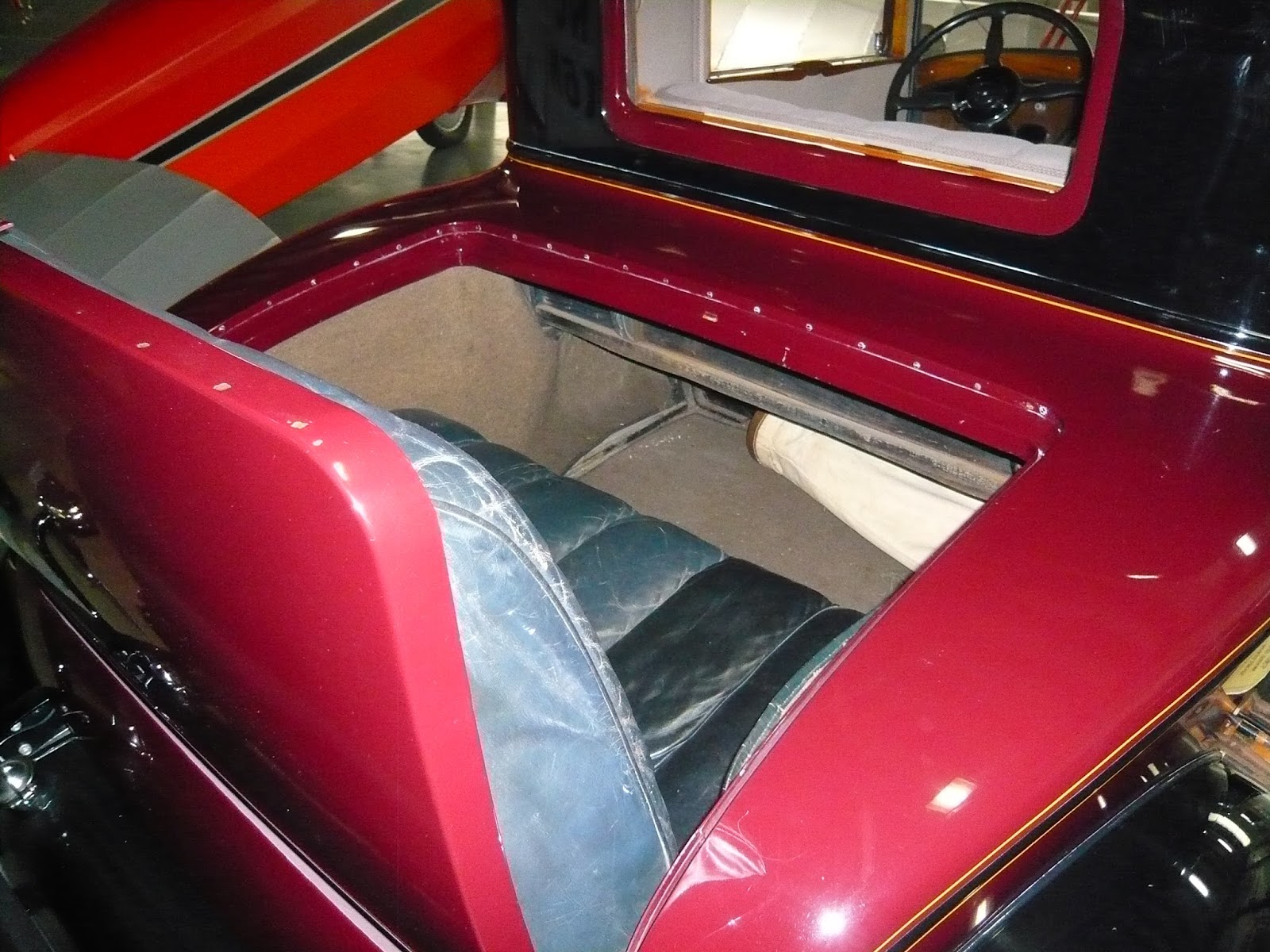
Earle Anthony dealerships actually sold this car twice, as it was traded in by the original owner and sold as a used car to the second owner who kept the car for over thirty years. This remarkable car is on it fourth owner in 87 years. Much of the car is original but it has been repainted in its attractive maroon and black finis with dark yellow pinstriping. Note that there is not a separate compartment for the golf bag; rather the bag rests in the footwell of the rumble seat.   


The other Packard in the WAAAM collection is this spectacular 1935 Packard twelve-cylinder convertible coupe, finished in dark blue with gold pinstriping.


The 473 cubic inch V-12 engine has aluminum heads with hydraulic valve lifters and produced 160 horsepower. Unlike the 1929 Sport Coupe, this Packard has been totally restored.


Reportedly there were just 788 Packard Twelves built during the 1935 model year at the height of the Great Depression. One can easily imagine a  movie star or wealthy playboy behind the wheel of this magnificent Packard.   

Monday, September 19, 2016


A confusing 1955 Chevrolet Bel Air convertible
 
photo by the author

Recently the author toured the Pack Automatable Museum owned by Dallas Texas mega-car dealer Sam H. Pack  The museum contained many beautiful cars that included sports cars, hot rods, customs, muscle car race cars, and cars of the fifties. There was one car which left the author puzzled - this black 1955 Chevrolet Bel Air convertible that sported replica Indianapolis '500' Pace Car graphics- except it is black.

The car was purchased by Mr. Pack at the Barrett-Jackson Scottsdale auction in 2011, and the information card with the cars stated “this tribute car was commissioned by the Indianapolis 500 Festival Race Committee to celebrate the 50th Anniversary of the small block Chevrolet V8. The car was restored to exact specification of the track-ready cars built in 1955 with one great exception, the track cars were painted two-tone cream and red whereas this car is painted black and is stunning.”
 
 
Charles Keating and Anton 'Tony' Hulman in a posed shot with the pace car.
Note the unique Firestone "500" tires
photo courtesy of the Indianapolis Motor Speedway collection
 in the IUPUI University Library Center for Digital Studies
 
The Chevrolet Pace Car heads the field before the start of the 1955 '500'
photo courtesy of the Indianapolis Motor Speedway collection
 in the IUPUI University Library Center for Digital Studies
 
The original “track cars” were not cream and red but were painted Gypsy Red and India Ivory, For years the author has heard stories of an original turquoise and white 1955 ‘500’ Pace Car but this is the first time he has seen one in black.  It appeared to be a very nicely restored car, with the “Official Pace Car” graphics on the rear quarter panel changed from black to white and the lower slogan “500 mile race” in red. Pack’s car also sported rear fender skirts which with the pace car driven by Chevrolet Sales Manager, Thomas Keating, was not equipped.

The author has been unable to confirm that this car was, as claimed, commissioned by the ‘500’ Festival Inc. in 2005 - can any readers clear up this mystery?