Showing posts with label NASCAR. Show all posts

Tuesday, October 20, 2020

Chip Ganassi to be Featured Speaker during Online Race Industry Week


Chip Ganassi to be 

Featured Speaker 

during Online Race Industry Week


photo courtesy of CGR


Chip Ganassi, one of the most successful as well as innovative race team owners anywhere in the world, has joined the impressive, growing list of featured webinar speakers during EPARTRADE.com Online Race Industry Week, scheduled for November 30 to December 4.

Chip Ganassi Racing (CGR) teams have won nineteen championships since 1990 including six of the seven most iconic races in the world of auto racing  - with wins in the Indianapolis 500 (4), Daytona 500 (1), the Brickyard 400 (1), 24 Hours of Le Mans (1), Rolex 24 At Daytona (8) and the 12 Hours of Sebring (1). 

"We are putting together several webinars with subjects about the state of the racing industry today, and we're honored and excited to get the insights of someone like Chip Ganassi for Online Race Industry Week," said Judy Kean, co-founder of EPARTRADE. "This is going to be a jam-packed week for racing professionals!"

There is no charge to attend. Follow this link to register for the week of Zoom meetings: 

https://us02web.zoom.us/webinar/register/WN_TdoGM04ZRxq6Ze3MPeInbQ

Tuesday, October 6, 2020

NASCAR racer Gary Gaulding to help fight COVID19 with his ROVAL™ Xfinity entry


NASCAR racer Gary Gaulding to help fight COVID19 with his ROVAL™ Xfinity entry


Standout Management Group (SMG) and NASCAR driver Gray Gaulding are pleased to announce Visit North Carolina and Count On Me NC (COMNC) as the new primary sponsor for the upcoming Drive for the Cure 250 Xfinity race to be held Saturday, October 10th. The No. 74 COMNC Chevrolet Camaro will be provided by Mike Harmon Racing (MHR) for the race on the ROVAL™, NASCAR’s newest track located at Charlotte Motor Speedway.

“Being both an active NASCAR driver and proud resident of North Carolina, I feel that with everything that has happened this year with COVID-19, we need to continue to help keep each other safe and make sure we reduce any risk of spread. I know by taking the Count On Me NC pledge and following the guidelines are a great way for all of us including myself to make a difference,” said Gray.

Count On Me NC is a public health initiative built on evidence-based training for businesses and a play-it-safe pledge for the public. Count On Me NC is a public health initiative by Visit NC designed to help businesses operate as safely as possible, signal their commitment to best practices with signage, and enlist consumers to do their part to curb the spread of COVID-19. A collaboration led by the N.C. Restaurant and Lodging Association in partnership with Visit North Carolina, the N.C. Department of Health and Human Services and NC State Extension, the initiative centers on evidence-based training with specific guidance for sanitation and service that goes beyond the stringent health requirements that were in place before the pandemic. 

Participation is voluntary and free of charge, and training is available in English and Spanish. Thousands of hotels, restaurants, attractions, and other businesses display the sea-green Count On Me NC logo that signifies completion of the training. Visit CountOnMeNC.org for more information.  

Visit NC Director Wit Tuttell welcomed Gray as a champion of the cause to fight the spread of COVID-19, said. “We’re beyond excited about Gray’s commitment to Count On Me NC,” said Tuttell. “He’s an exciting young talent with the kind of determination it takes to win at the track and also to help put COVID-19 in the rear-view mirror. Gray’s followers will be inspired to follow his lead when he talks about the importance of wearing masks, washing their hands, and waiting at a distance when they’re out in public. They’ll also connect the sea-green Count On Me NC logo on Gray’s car to certificates and signage displayed at thousands of hotels, restaurants and other North Carolina businesses that have completed the training in advanced sanitation and service measures.”

In addition to Count On Me NC being the primary sponsor, Panini America, the Official Trading Card of NASCAR will be riding along Saturday afternoon as an associate sponsor and will return Sunday as the primary NASCAR Cup Series sponsor of the No. 27 Chevrolet Camaro for the Bank of America ROVAL 400. Count On Me NC will also be returning to the track with Gray on Sunday as an associate sponsor. Make sure to catch all the race action for both races on NBC starting at 3:30 PM Eastern Time on Saturday, October 10th and 2:30PM Eastern Time on Sunday, October 11th.

Tuesday, August 11, 2020

Jennifer Jo Cobb Set for 200th NASCAR Gander RV & Outdoors Truck Series Start


Jennifer Jo Cobb Set for 200th NASCAR Gander RV & Outdoors Truck Series Start


On Sunday, August 16, the NASCAR Gander RV & Outdoors Series will have two significant milestones – the series will make its debut on the historic Daytona International Speedway Road Course and Jennifer Jo Cobb, driver of the No. 10 Fastener Supply Company Chevrolet Silverado, will make her 200th series start.

Cobb made her series debut in 2008 at her home track of Kansas Speedway before forming her own team in 2010.  She has entered every race since 2010 as a team owner, also fielding trucks for other drivers as a teammate.  

Fastener Supply Company will also launch a rebranded logo, after more than 60 years, placing it on the prestigious hood location of the No. 10 Truck as part of this special event.  The new logo design is by Paradigm Multimedia Marketing, the parent company of Paradigm Racing, also a partner with Jennifer Jo Cobb Racing (JJCR). 

Fastener Supply Company, a fastener solutions provider based in Charlotte, N.C. with a total of five locations throughout the Southeast, will be a full-time sponsor of Cobb’s team for the rest of the 2020 NASCAR Gander RV & Outdoors Truck Series season.

“We are very excited to be aligning with Jennifer Jo Cobb Racing for the rest of this year, and hopefully to continue doing so in the future,” said Donnie Shrum, President of Fastener Supply Company.  “This partnership adds value to both of our organizations, and we have the ultimate respect for Jen and her team.  Her accomplishments in the NASCAR Gander RV & Outdoors Series would be impressive for any driver, but especially so for a woman who helped set the stage for other females to enter the profession.  We are so proud to have her represent our company. 

Stacy Mears, Director of Marketing, added “We are also very thankful to Aaron Farrier and Paradigm Multimedia Marketing for the work that he has done on our rebranding project.  We think that our new logo helps us better define our brand, which is to provide innovative fastener solutions to our customers.  We adapt and change with the times in order to best support their requirements.”

“To have our partners working together and pledging more support to JJCR during this very special year is amazing,” Ms. Cobb said. “This year we have this great new sponsor in Fastener Supply Company, a new Crew Chief (Brian Keselowski) and spotter (Clayton Hughes) and it just seems like there is a renewed effort and positive momentum taking place for our team.”

Watch for Jennifer Jo Cobb and the No. 10 Fastener Supply Company Chevrolet in the NASCAR Gander RV & Outdoors Truck Series Race on Sunday, August 16 at 12:30 pm ET on FS1  

Information and graphics for this article provided by Aaron Farrier JJCR.              

Thursday, October 31, 2019


A close look at a NASCAR Whelen™ Modified at PRI 2018


The NASCAR (National Association of Stock Car Racing) booth at the 2018 Performance Racing Industry (PRI) trade show displayed the #46 Goodie Racing 2018 Chevrolet NASCAR Whelen™ modified driven by Craig Lutz and sponsored by Riverhead Building Supply. Goodie Racing is owned by Riverhead Building Supply owners Russell and Jeff Goodale with crew chief Douglas Ogiejko. 


The 106-inch wheelbase LFR Enterprises chassis built in West Boylston Massachusetts is powered by a 610-horsepower NASCAR-spec  364-cubic inch Robert Yates Racing engine  based on  GM LS2 block  with LS2 CNC ported heads fed by an 830 CFM (cubic feet per minute) Holley carburetor. The Spec engine is not “sealed” and NASCAR rules do allow teams to assemble, disassemble and rebuild the engine but no modifications to the components are allowed. 


Craig Lutz from Miller Place New York finished in fifth place in the 2018 NASCAR Whelen™ modified tour points in his first full season with Goodie Racing.  With three races completed in the 17-race 2019 NASCAR Whelen tour Lutz is in 14th place in the standings with one top ten finish.

 Check out the NASCAR Whelen™ site at https://hometracks.nascar.com/regional/whelen-modified-tour/ and LFR Enterprises at https://www.lfrchassis.com/

Sunday, December 23, 2018

Toyota Supra display 
at SEMA 2018 traced 
the history of 
the Toyota Supra in America


At the 2018 SEMA (Specialty Equipment Market Association) show in Las Vegas, Toyota USA showed off the 2019 NASCAR (National Association of Stock Car Racing) Xfinity Series Toyota Supra which will debut at Daytona International Speedway in February, although the street version will be sold by Toyota as a 2020 model after 22 years away from the market.  


The fifth-generation Supra Xfinity race car developed by Toyota Racing Development (TRD) and Calty Design Research (a Toyota subsidiary based in Southern California) was shown alongside the four Toyota Supra passenger cars and presented an interesting history of the development of the Supra from 1979 through 1998.


 The original Supra debuted in 1978 and was introduced in the United States in 1979. The first Supra featured a longer wheelbase and was wider than the Celica it was based upon and was equipped with a 4ME inline six-cylinder 2.6-liter (158 cubic inches). Fitted with fuel-injection and a single overhead camshaft the 4ME engine developed 110 horsepower transmitted to either a five-speed manual or four-speed automatic transmission. By the time the first-generation Supra left production in 1982, it was equipped with the 2.8-liter (170 cubic inch) 5ME engine that developed 116 horsepower. 


The second-generation Celica-based Supra debuted in 1982 powered by a 145- horsepower 5M-GE DOHC (double overhead camshaft) 2-valve per cylinder inline 6-cylinder engine that displaces 170 cubic inches. The Supra featured MacPherson strut front suspension and independent rear suspension and the P-level Supra featured Recaro seats.   For the final model years of the Supra from 1984 to 1986, the engine power had increased to 160 horsepower transmitted to either a five-speed manual or four-speed automatic transmission.


The third generation Supra introduced in 1986 was stand-alone design powered by the 183-cubic inch 7M-GE six-cylinder engine which developed 200 horsepower, while the turbocharged version, the 7M-GTE produced 276 horsepower. Sold until 1992, this was the first Supra available with electronically controlled suspension dampening.


The fourth-generation Supra was powered by the 183-cubic inch 2JZ straight six-cylinder engine with Sequential Electronic Fuel Injection and an aluminum 4 valves per cylinder head that produced 220 horsepower or 320 horsepower in the twin turbocharged version mated to an optional six-speed manual transmission. The turbocharged version could reach 60 miles per hour (MPH) in 4.6 seconds and run the 1/4-mile in 13.1 seconds with a top speed of close to 180 MPH.  While it was an awesome performer, sales in the United States were never strong, and after 1996 the turbocharged Supra was only sold in the United States with a 4-speed automatic transmission until Toyota ended sales in the United States in 1998.
   
All photos by the author 


Thursday, October 11, 2018


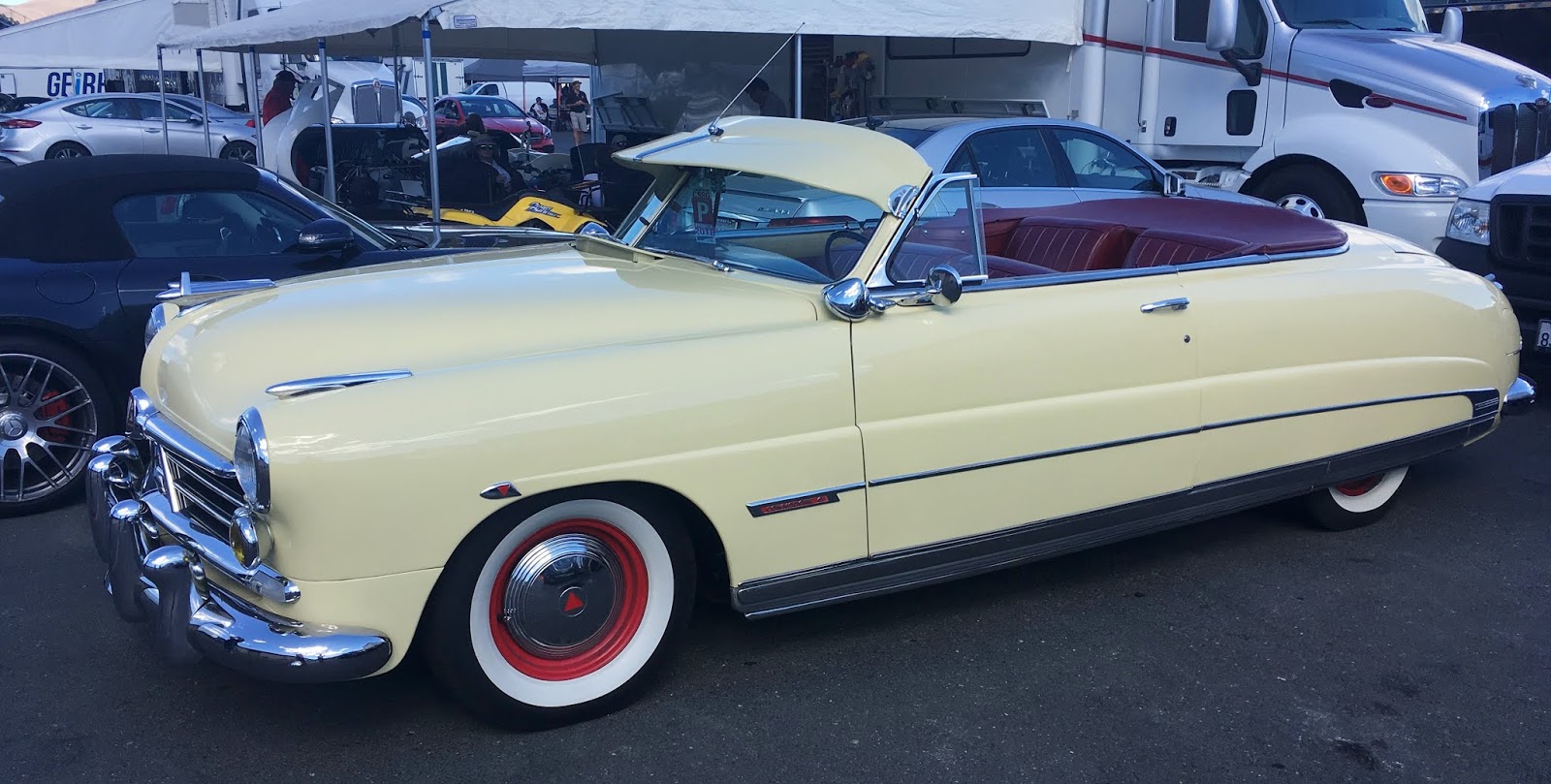
1950 Hudson Commodore 6 
convertible brougham


While walking through the paddock at the CSRG Charity Classic vintage race at Sonoma Raceway, the author spied this gorgeous 1950 Hudson Commodore 6 Convertible Brougham.


The Hudson Motor Car Company based in Detroit, was named after Joseph Hudson, the Detroit department magnate and one of the company’s early investors. The first Hudson automobile, the model 20, was sold as a 1910 model. 

Through the ensuing years, Hudson built a public reputation as an innovative quality mid-range brand and it was third-bestselling car in America before the Great Depression. The company suffered during the Depression and never regained its place as one of the top-selling brands. 

The Commodore introduced in 1941 was the largest and most luxurious Hudson offered to the motoring public, and this 1950 model is the third final generation of the nameplate. Introduced in late 1947, the new 1948 Hudsons featured the ground breaking “step down” design penned by long-time Hudson stylist Frank Spring and his team.

The 1948 Hudson Commodore was almost the car that never was, as Mr. Spring had originally proposed the “step down” design in 1941 but at that time it was rejected by Hudson president Edward Barit, who thought the car was too low. After World War 2 ended, Mr. Spring modified the “step down” design and Mr. Barit gave the okay for “step down” production after he drove the prototype.


The new Hudson design used unit body on boxed frame construction which Hudson called “Monobilt,” with deep frame rail sections and a heavy cowl structure to create an extremely rigid chassis.  The frame rails passed outboard of the rear wheels, and this unique chassis configuration provided a lower center of gravity all while maintaining interior headroom. In addition to the feeling of a safer and smoother ride, the “Monobilt step down” concept created the widest rear seat in the industry but at the cost of a narrow forward section of the trunk compartment.


This excerpt from period Hudson sales literature shows the key feature of the “Monobilt step-down” design: the floor pan was not attached to the top of the frame rails as with a conventional design, but to the bottom of the structure. Passengers stepped down into the passenger compartment that featured a lower roof height but the same interior headroom.  At just over 60 inches tall, the 1948 Hudson roofline was four to seven inches lower than its Buick, Plymouth, and Oldsmobile competitors.

The 1948 Hudson line offered customers four body styles - four-door sedan, two-door brougham, two-door club coupe and the convertible with two available levels of trim, either Super or Custom. Two engines were available - an inline 262-cubic inch side-valve six-cylinder 123 horsepower engine or an inline eight-cylinder engine that displaced 254 cubic inches and developed 128 horsepower.  

The new dramatic low-slung Hudson design was a sales hit – with 143,697 units sold in the 1948 model year, 142,462 cars were sold in 1949 and 143,006 in 1950, the year that Hudson introduced a third lower-cost trim level, the Pacemaker series.  


Hudson’s “step down” convertible models were built in a novel cost-cutting manner. Club Coupe bodies were pulled from the production line and wheeled to separate area of the factory where workers cut off the roof and added nearly 250 pounds of additional steel body reinforcement, which pushed the convertible’s curb weight to over 3800 pounds.  To maintain cowl stiffness, Hudson convertibles featured a characteristic nine-inch section of sheet metal for the header area above the windshield.

The reason for Hudson’s novel method of convertible body construction was because convertible sales were never a large percentage of overall Commodore sales. At most, Hudson built only a few thousand convertibles each model year - in 1950, for example just over 1125 convertibles were built, with most (700) as eight-cylinder models which makes the Hudson seen at Sonoma a rare machine.


The Sonoma 1950 Hudson was a heavily optioned 1950 Commodore 6 built on a 124-inch wheelbase, powered by the high compression (6.7 to 1) 262 cubic inch flathead six-cylinder with dual carburetors that developed 123 horsepower and Hudson laid claim to the most powerful six-cylinder engine sold in America.  

New features for the 1950 Hudson Commodore series included non-rotating push-button streamlined door handles, larger high-visibility taillights, and rectangular parking lights integrated into the front lower grille bar.  The convertible Commodore series featured a hydraulic operated top and window lifts as standard equipment.   


Our feature car sports the optional Hudson “Supermatic” semi-automatic transmission (a $199 option - supplied by General Motors), twin spotlights, twin fog lights, a sun visor and an optional Weather Master heater.  The car is finished Hudson color N-37 known in Hudson sales literature as ‘Cornish Cream’ with a deep red leather interior; this color combination was featured in the 1950 Hudson sales brochure.   

The car’s current owner related to me that he bought the car from the widow of a collector that he had known so he was familiar with the car. While the car was being fitted with a new convertible top, the car was in a minor accident and the body was damaged which led to a complete restoration. Since the restoration was completed, it has been driven cross-country and has accumulated 10,000 trouble free miles.

Hudson dropped the Commodore badge after the 1952 model year, after which Hudson cars were sold with the Hornet nameplate, which traded off that model name’s tremendous racing successes in AAA and NASCAR stock car racing circuits. Between 1951 and 1954, “Fabulous Hudson Hornet” stock cars won 80 NASCAR races and the 1952 NASCAR and AAA stock car championship, the 1953 NASCAR championship and 1954 AAA stock car championship.

Despite the name change, in an era when automobile manufacturers restyled their models every two years, the Hudson semi-unit body construction bodies meant the styling changed very little. Another problem for Hudson sales was that the “step down” design could not support a station wagon body style, which created left off the list for the growing market of suburban buyers.

By 1954, the once-daring Hudson “step down” design was six years old and considered dated, and Commodore sales across all three series fell to 121,000 units during the model year despite price cuts. The Hudson “step down” platform needed a complete redesign, but the company could not afford new tooling due its rapidly collapsing financial state. Hudson had invested heavily in the compact ‘Jet’ model introduced in the middle of the 1953 season and was a sales flop. Hudson reported a loss of more than $10 million for the fiscal year of 1953 compared to an $8 million profit the prior year.

On May 1, 1954, the Hudson Motor Car Company officially merged with the Nash-Kelvinator Corporation to form the American Motors Corporation, at the time the largest corporate merger in American history. Hudson assembly ended in Detroit, and the Hornet and Jet series were discontinued at the end of the 1954 model year. Over two years in exchange for its investment in the ‘Jet’ series of over $15 million, only 35,367 ‘Jet” cars were built. 

The new cars in Hudson showrooms from 1955 through 1957 were mildly re-styled Nash Rambler or Statesman models fitted with Hudson ‘Jet’ engines; those new Hudsons were known derisively by motoring enthusiasts as "Hashes.” Dealers also sold the imported Metropolitan during the 1954 model year.

Hudson sales continued to decline with 20,321 units sold in 1955, then just 10,371 were built in 1956. The last car bearing the Hudson nameplate rolled off the Kenosha assembly line on June 25,1957, the last of 3,108 cars built that year. The planned 1958 Hudson Hornet was re-badged as the all-new Rambler Ambassador.     

Hudson collectors are a small but enthusiastic lot, with the national Hudson-Essex-Terraplane Owners Club. There have been few Hudson cars featured in motion pictures, by far the most famous was the animated Cars franchise which featured ‘Doc’ Hudson voiced by Paul Newman. Actor Steve McQueen owned a pair of Hudson, a 1953 Hornet and a 1950 Hudson Commodore 6 Convertible Brougham which was fitted with a later Hudson Hornet engine and painted in a non-original two-tone paint scheme.    

Color photos by the author

Wednesday, April 11, 2018


Ford 427 SOHC “Cammer” at SEMA 2017


At the first NASCAR (National Association of Stock Car Racing) Grand National series race of 1964, the Daytona 500, the Chrysler teams debuted the 426-cubic inch hemispherical cylinder head “Hemi” V-8 engine.  Contrary to contemporary legend, NASCAR did not require the new engines to be sold in factory-assembled cars, but had to be available “over the counter” at dealerships. The “Hemi” engine immediately became a dominant force in NASCAR. 


In order to beat the “Hemi” motors over a ninety-day period Ford Motor Company engineers developed the Single Overhead Camshaft (SOHC) “Cammer” engine based on the 427-cubic inch Ford FE block, the regular version of which was being used by Ford NASCAR teams. The overhead camshaft cylinder heads required a different oiling system from the standard 427, so the oil supply had to be routed through a gallery along the left side of the block which led to theses becoming known as the “side oiler” block.

In testing fitted with a single four barrel carburetion the “Cammer” engine produced more than 600 horsepower.  Unfortunately, NASCAR President “Big Bill” France increased the number of units that had to be manufactured to homologate engines so the new Ford engine could not be used in NASCAR.  Ford instead raced the “Cammer” engines in NHRA (National Hot Rod Association) drag racing competition in a number of classes. The Ford “Cammer” engine was never installed in production cars, but they were available over the counter at dealerships.   


Jim Ring's 1964 “Pro Street” style Galaxie 500 shown in the Vibrant Performance booth at the 2017 SEMA (Specialty Equipment Market Association) show is an example of the final year of this body style which had been in use since 1960. Mid-year during the 1963 model year, Ford had introduced a fastback or "sports hardtop" roofline was added mid-year to make the cars more competitive on the high-speed NASCAR tracks, and were introduced a “1963½” model an industry first. 


Ring’s car, built by Bones Fabrication in Camarillo, California, is powered by a Ken Duttweiler-built all-aluminum 427 cubic inch “Cammer” engine. The engine sourced from Robert Pond Engines was enlarged to 482 cubic inches and is fed by a pair of 76mm Precision turbochargers which draw air through the inner headlight buckets in the grille. The Holley Terminator EFI system makes this car which develops over 1000 horsepower tame enough to be driven on the street.  

The Galaxie’s front end uses an Art Morrison front clip outfitted with JRI coil-over shock absorbers with tubular control arms. The 9-inch Ford rear end is suspended via a 3-link setup and JRI coil-over shock absorbers. The car rides on polished KWC Forged wheels with Mickey Thompson tires – 18-inch diameter by 6 inches wide at the front and 20-inch diameter by 15 inches wide in the rear.

All photos by the author


Monday, January 15, 2018


How competitive was the Chili Bowl?
A snapshot of championship diversity


By now, most racing fans know that Christopher Bell a member of the powerful Keith Kunz Motorsports/Toyota Racing Development team successfully defended his title as the 2018 Chili Bowl Nationals champion. Bell took the victory after his teammate and fellow NASCAR star Kyle Larson suffered an engine failure midway through the 55-lap feature race.
KKM Toyota -powered Spike chassis entries won three of the four 2018 Chili Bowl preliminary night features and Bell’s win is KKM’s fourth consecutive Chili Bowl win since 2015. KKM was dominant on Saturday as in addition to claiming the feature win, all three steps of the podium went to KKM drivers – Rico Abreu was second and Spencer Bayston was third.
With such domination by one team, some may ask the question with 345 entries in 2018, how competitive and diverse is the Chili Bowl? Consider the starting field for the first of two C-Main 15 lap features which included Tanner Thorson the 2016 USAC (United States Auto Club) National Midget Champion and  2017 National Midget Driver of the Year, 2008 ARCA stock car champion Justin Allgaier who finished third in the 2017 NASCAR Xfinity series, and Steve Buckwalter, who has over 30 wins on the tough ARDC (American Racing Drivers Club) midget circuit and was their 2010 series champion.
That trio was joined by multi-time ASCS (American Sprint Car Series) Northwest division champion Roger Crockett, three-time POWRi midget series champion Zach Daum, World of Outlaws late model series champion and 2006 Chili Bowl champion Tim McCreadie, and multi-time USAC Southwest sprint car champion RJ Johnson.
As if that is not a tough enough field, it also included two-time USAC National Sprint Car champion Brady Bacon, Sprint Car Challenge Tour (SCCT) sprint car series star Colby Copeland, CJ Leary who won four USAC National sprint car features in 2017 USAC/CRA multi-time winner Jake Swanson, three-time King of West sprint car champion Kyle Hirst and USAC National Sprint car series star Thomas Meseraull who was the 2004 BCRA (Bay Cities Racing Association) Midget series champion.  
Of the twenty cars and drivers in the first C-Main race, only the top six advanced to the tail of the first B-main race – Thorson, Allgaier, local driver Ace McCarthy who races with the POWRi series, Daum, Bacon and Leary. Of those six drivers only one -Tanner Thorson-was able to advance to the night’s 55-lap feature where he finished fourth behind his three former teammates, as for 2018, Thorson drives for the Dooling-Hayward Motorsports/Richard Childress Racing team.  


Monday, January 8, 2018


Earnhardt Jr. won his 
15th consecutive
NASCAR  
Most Popular Driver Award
 
Dale Earnhardt Jr., who retired from full-time competition in the NASCAR (National Association of Stock Car Racing) Monster Energy Cup Series at the conclusion of the 2017 season, was named the National Motorsports Press Association's (NMPA) Most Popular Driver for the 15th consecutive year.

Earnhardt, 43, the driver of the No. 88 Chevrolet for Hendrick Motorsports, was named on nearly 68 percent of the votes cast by fans - the Most Popular Driver Award is the only major NASCAR award determined solely by fan vote. It has been presented annually since 1953 - the recipients were originally determined by a poll of the competitors but it became a fan-driven program in 1984 under the auspices of the NMPA.

Earnhardt is one of eight drivers to receive the award on multiple occasions. Other multiple-time Most Popular Driver award winners include Lee and Richard Petty, Bobby Allison, David Pearson, Fred Lorenzen, and Darrell Waltrip.  

Only one driver, Bill Elliott, has won the award more times than Earnhardt Jr.  Elliott was named the series’ most popular driver 16 times between 1984 and 2002. Dale Earnhardt Sr. broke Elliott’s stranglehold from 1991 to 2001, when he won the Most Popular Driver award for the only time in 2001.

In addition to hosting the voting platform for the Monster Energy NASCAR Cup Series Most Popular Driver award, fans voted to determine the Most Popular Driver in the NASCAR XFINITY and Camping World Truck Series also hosted on NASCAR.com.

 Elliott Sadler, who finished second in the XFINITY Series championship battle won the NASCAR XFINITY Series Most Popular Driver award and Sunoco Rookie of the Year Chase Briscoe was voted the Camping World Truck Series Most Popular Driver by fans.
 
Information for this article was provided by NMPA, of which the author is a member.

Monday, October 23, 2017

IOWA SPEEDWAY ANNOUNCES
2018 SEASON TICKET PACKAGES


Ticket packages start
at just $99 for a six-race season


Wednesday, February 1, 2017

Good Guys 1963 1/2 Giveaway Galaxie


The Good Guys Rod & Custom Association booth at the 2016 SEMA (Specialty Equipment Market Association) show in Las Vegas featured the Good Guys 2017 Giveaway car, a custom 1963 ½ Ford Galaxie Fastback.


This body style with a sporty roof line and no post was introduced by Ford Motor Company mid-way through the 1963 model year known officially as the “Sports Hardtop.”  By changing the roofline, the improved aerodynamics made it more competitive in high-speed NASCAR (National Association of Stock Car Racing) competition.


Reportedly testing revealed that a 1963 ½ Ford Galaxie Sports Hardtop required 100 fewer horsepower to maintain 160 miles per hour around the Daytona Motor Speedway 2 ½-mile oval than did a 1963 Ford Galaxie “notchback.”  As a bonus to Ford, the fastback body style proved to be a winner in the showroom as well as the race track, and was far and away the most popular 1963 Ford Galaxie body style

The Good Guys Giveaway car designed by Eric Brockmeyer http://www.brockmeyerdesign.com/ and built by Legens Hot Rods of Martin Tennessee http://www.legenshotrod.com/ is finished in a custom mixed PPG tan paint, matte bronze plating of the bumpers and trim and a brown custom leather interior.


Under the hood the Galaxie features a Ford Racing Performance Coyote 5.0 liter V-8 engine and a Tremec transmission nestled in a Roadster Shop chassis with Roadster Shop suspension parts.  The custom Greening Auto Company wheels are finished to match the matte bronze finish of the rest of the trim on the Galaxie.


The Galaxie will be given away during the 20the annual Good Guys PPG Nationals in Columbus Ohio in July of 2017. Check out the link for a free chance to enter at https://www.good-guys.com/promos/ford-galaxie

Photos by the author