Showing posts with label convertible. Show all posts

Tuesday, November 6, 2018


1949 Frazer Manhattan convertible


In the years that followed the Second World War, automotive consumers In the United States were starved for new cars, as the last cars off the assembly lines had been 1942 models. Many drivers held onto their old cars through the war and survived scrap drives and the rationing of gasoline and tires and now that the war was over, they were more than ready for something new. Enter Henry J. Kaiser.


Kaiser had amassed a fortune as a contractor as his firm had built the Hoover, the Bonneville and Grand Coulee Dams and he had built an empire of construction material companies. With the onset of the war with Japan and Germany, Kaiser with no prior shipbuilding experience established seven shipyards on the West Coast that produced ships faster than previously imagined using faster construction techniques such as welding instead of riveting and the use of sub-assemblies. 

Long-time automobile executive Joseph Frazer, a young college graduate, started his career in the auto industry as a mechanic’s assistant in a Packard dealership before he moved into sales. Frazer then jumped to General Motors (GM) where he helped establish General Motors Acceptance Corporation (GMAC) that pioneered automotive financing. 

While at GM he met Walter P Chrysler, and followed Walter to Willys-Overland then to Maxwell, which later became Chrysler Motors. While at Chrysler, Frazer convinced Walter P. to start a lower-priced line of cars called Plymouth.

Frazer eventually got his own chance to turn around a struggling automaker at Graham-Paige Motors, and he planned to change the name to Frazer, but he needed financing. Frazer met Henry J. Kaiser, a larger than life super-successful businessman well known to the public who had an interest in the auto industry as well as a $10 million line of credit from Bank of America.

It seemed to be a marriage made in heaven – Henry Kaiser had ideas on how to streamline automobile manufacturing but needed an industry insider knowledgeable about sales and marketing, and Joseph Frazer needed financing and the notoriety of a respected public figure. The Kaiser-Frazer Corporation was born in July 1945, obtained the assets of Graham-Paige in a stock deal and set up shop in the massive Willow Run Michigan B-24 bomber factory, then the largest building in the world. An initial stock offering raised $54 million for the Kaiser-Frazer Corporation.

In early 1946, the company debuted two prototypes at the New York Auto Show, a front-wheel drive Kaiser and the conventional Frazer sedan. The front-wheel drive design never went into production due to engineering hurtles, and the 1947 production Kaiser and Frazer sedans were all but identical. 


The new cars styled by Howard “Dutch” Darrin were conventional with two new concepts – all-welded construction, a wider rear seat that was between the wheels as the result of moving the rear wheels behind the passenger compartment. a large luggage compartment, curved wraparound bumpers, dual horns, twin sun visors, automatic dome lights, and large, hydraulic self-centering brakes.   

Mechanically the new Kaiser and Frazer cars were quite conventional for its time, with a pre-war design L-head 6-cylinder 226-cubic inch Continental ‘Red Seal’ engine which developed just 100 horsepower with a single Carter carburetor, while dual Carter carburetors boosted output to 112 horsepower at 3600 revolutions per minute (RPM).  The slow-turning Continental engine was prone to overheating and failing head gaskets, and coupled to a manual three-speed transmission with overdrive, a Frazer sedan typically accelerated from 0 to 60 miles per hour (MPH) in 19 seconds with a top speed of 85 mph.

Due to production delays, the first production Kaiser and Frazer automobiles did not roll out of the Willow Run factory until May 29, 1946, and were shipped to dealers in mid-June, registered as 1947 models. In a hot market, Kaiser-Frazer ultimately sold 70,474 Kaisers and 68,775 Frazers during the 1947 model year, giving the company the best market share (4%) of any of the American independent manufacturers.

The Frazer line which was billed as “America’s Largest-Selling Fine car” was led by the luxurious Manhattan, in addition to the Standard and Deluxe models. Kaiser-Frazer sales remained strong through in 1948 despite relatively high prices, for example, a Frazer Manhattan had a manufacturer’s list price for $27 higher than a Cadillac Series 62 sedan.

In late 1948 at a Kaiser-Frazer board meeting, Henry Kaiser pushed for an increase in production for 1949, which was opposed by Joseph Frazer. Although sales had increased slightly and the company maintained 4% of the market in 1948, profits had dropped. The board voted with Kaiser and Frazer resigned his presidency, but remained with company for more three years a sales consultant.


In 1949, Kaiser introduced the “Virginian,” a faux convertible built on the 123-inch wheelbase sedan chassis which featured a nylon top over a steel roof.  Frazer on the other hand that year introduced a hand-built convertible based on the Manhattan sedan body, but not without some problems. Edgar Kaiser, son of the founder, who took over the Frazer presidency after Frazer’s resignation ordered engineers to not add reinforcement after they cut the roof off the sedan. Edgar eventually had to admit his error, and the production car’s boxed frame was reinforced with a giant X-brace. 


The additional bracing took the car’s curb weight up to over 3700 pounds, and the anemic Continental engine was no match for the car’s bulk.  To add more rigidity, the Manhattan’s window frames and the “B” pillar between the front and rear doors remained fix in place and were not retractable, so this car cannot be considered a true “convertible.” Experts differ on production numbers, as some of the unsold Manhattan convertibles were re-badged as 1950 models, but this car’s owner states that only 62 1949 Manhattan convertibles were sold.  


Joseph Frazer’s instincts were proved correct, as the “Big Three” brought their new models to market which fed the public’s appetite for new cars. Kaiser-Frazer’s original body style looked dated, and the lack of performance and durability of the Continental engine did not help. Kaiser-Frazer sales dropped to just over 100,000 units (2% market share) and at the end of the 1949 model year, there were 20,000 leftover cars which the company was forced to re-brand as 1950 models. For 1949 the Kaiser-Frazer Corporation posted a loss of nearly $30 million dollars. 


After Joseph Frazer’s departure, the Frazer nameplate was soon dropped, and the 10,000 1951 Frazers sold that were leftover actually 1950 models that used up the company’s remaining stock of bodies and high-end upholstery materials. In 1952, the company changed its name to the Kaiser Corporation and began selling Manhattans as a luxurious  member of the Kaiser line. 

In 1953 Kaiser bought Willys-Overland and its Jeep brand. Although Kaiser stopped building its eponymous nameplate in the United States in 1955 after total 1954 sales of only 7,000 units, it continued to build Jeeps until it sold the brand to the American Motors Corporation in 1970. 

The 1949 Frazer Manhattan as displayed at the Automotive Driving Museum in El Segundo California is one of the few examples remaining and is resplendent finished in Indian Ceramic with a black top and interior set off by the gleaming chrome trim.
    
All photographs by the author

Monday, October 22, 2018


1957 Lincoln Premiere Convertible

On a recent visit to the Automobile Driving Museum for an event hosted by The Racing History Project hosted by Doug Stokes, the author spied a beautiful 1957 Lincoln Premiere convertible on display.


The Lincoln Premiere nameplate was added to the Lincoln Motor Division of Ford Motor Company lineup in 1956 as a mid-level model, positioned below the hand-built Continental Mark II and above the Capri.  The Premiere was available in four body styles- the Landau four-door hardtop, the concealed pillar four-door sedan, the two-door coupe, and the convertible. All but the convertible body style was available with factory air conditioning, a ground-breaking system with a trunk mounted condenser and blower with a pair of clear overhead ducts in the passenger cabin.


Lincolns featured an elaborate paint system: a dip in a chrome-phosphoric acid followed by two coats of primer which was hand sanded before two coats on enamel paint, then baked in a temperature-controlled oven to create a gleaming finish “built to live and last outdoors.”   Although our feature car is finished in Presidential Black super enamel paint, the exterior color palate for the mid-century Lincolns was typical of the era with two shades of pink -Flamingo or Bermuda Coral, Taos Turquoise, a pastel Summit Green and in 1956 a purple color known as Wisteria.

The 1956 and the 1957 Lincoln Premiere offerings can be immediately distinguished as the 1957 model features stacked Quadra-lite grille with four headlights and integrated road lights. Out back the 1957 features exaggerated tail fins which Lincoln literature referred to as “canted rear blades with massive taillights” and large integrated “double width powerful backup lights” in the bumper and hidden exhausts. Lincoln claimed that this all added up to “long low beautiful body lines that meet and merge in a clean sweep of steel.” 


The 1957 Lincoln Premiere line featured a choice of four styles of interior – “buttons and biscuits,” rollover pleats, pleated headrests, and the tri-tone “pleated buckets” which added a sports car note.” Our featured car has the pleated buckets in flamingo, black and white. Safety features in the interior include padded sun visors, safety door locks, a double wide ball-bearing mounted rear view mirror, remote outside left side mirror, nylon safety belts and a foam-padded instrument panel.


The 1957 Lincoln Premiere is powered by a 368-cubic inch Y-block V-8 that reportedly developed 300 horsepower linked a tree-speed automatic transmission. However, mounted in a chassis with a 125-inch wheelbase and nearly 19 feet long with a curb weight of 4800 pounds, the Premiere was not a performance car, with 0-60 time estimated at nine seconds with a top speed of 117 miles per hour.

The Lincoln Motor Division sold over 41,000 vehicles in the 1957 model year, and Premiere was a big part with over 35,000 cars sold, and 3676 1957 Premieres were convertibles, which dwarfed the Continental Mark II which sold only 444 of the hand-built machines. 

A 1957 Lincoln Premiere convertible appears in the third Elvis Presley movie, as Elvis’ character "Vince Everett" bought a white convertible with his first royalty check. Elvis owned a 1956 Premiere convertible for a few weeks before he traded it in on a Continental Mark II.

The 1957 body style was replaced for 1958 with the third generation Premiere - a massive unibody design that featured canted quad headlights and was over 19 feet long. The Lincoln line continued to be offered in three price ranges - the Continental, Premiere and Capri – but the design was poorly received by the buying public and between 1958 and 1960, the Lincoln Division reportedly lost $60 million.


For 1961, the Capri and Premiere nameplates were dropped, and the redesigned fourth-generation 1961 Lincoln was sold only as the Continental as either a four-door sedan of four-door convertible. In our next car feature, we'll look back at an earlier 4-door convertible - a 1949 Frazer Manhattan, also in the ADM collection.

Photos by the author   


Thursday, October 11, 2018


1950 Hudson Commodore 6 
convertible brougham


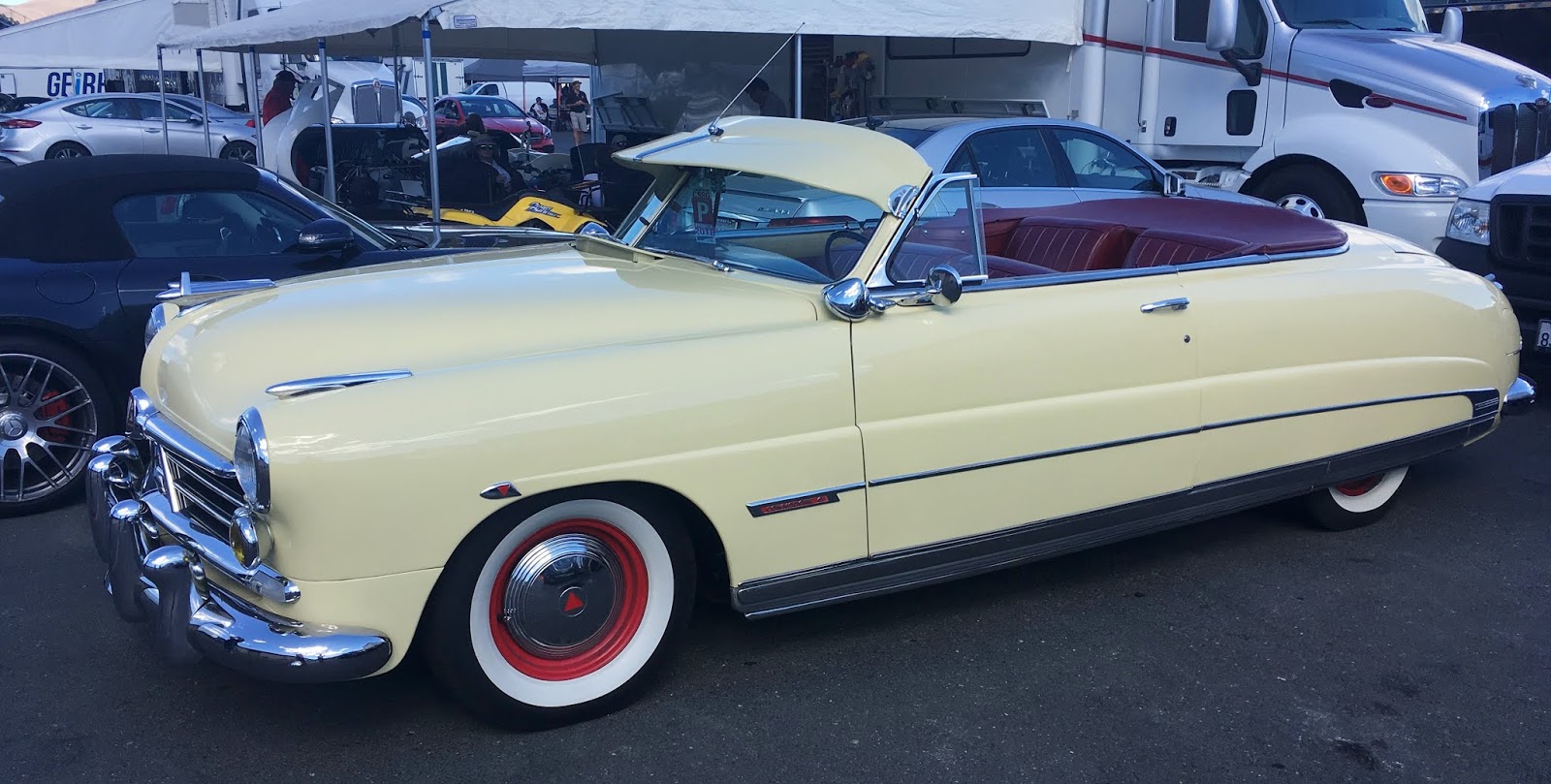
While walking through the paddock at the CSRG Charity Classic vintage race at Sonoma Raceway, the author spied this gorgeous 1950 Hudson Commodore 6 Convertible Brougham.


The Hudson Motor Car Company based in Detroit, was named after Joseph Hudson, the Detroit department magnate and one of the company’s early investors. The first Hudson automobile, the model 20, was sold as a 1910 model. 

Through the ensuing years, Hudson built a public reputation as an innovative quality mid-range brand and it was third-bestselling car in America before the Great Depression. The company suffered during the Depression and never regained its place as one of the top-selling brands. 

The Commodore introduced in 1941 was the largest and most luxurious Hudson offered to the motoring public, and this 1950 model is the third final generation of the nameplate. Introduced in late 1947, the new 1948 Hudsons featured the ground breaking “step down” design penned by long-time Hudson stylist Frank Spring and his team.

The 1948 Hudson Commodore was almost the car that never was, as Mr. Spring had originally proposed the “step down” design in 1941 but at that time it was rejected by Hudson president Edward Barit, who thought the car was too low. After World War 2 ended, Mr. Spring modified the “step down” design and Mr. Barit gave the okay for “step down” production after he drove the prototype.


The new Hudson design used unit body on boxed frame construction which Hudson called “Monobilt,” with deep frame rail sections and a heavy cowl structure to create an extremely rigid chassis.  The frame rails passed outboard of the rear wheels, and this unique chassis configuration provided a lower center of gravity all while maintaining interior headroom. In addition to the feeling of a safer and smoother ride, the “Monobilt step down” concept created the widest rear seat in the industry but at the cost of a narrow forward section of the trunk compartment.


This excerpt from period Hudson sales literature shows the key feature of the “Monobilt step-down” design: the floor pan was not attached to the top of the frame rails as with a conventional design, but to the bottom of the structure. Passengers stepped down into the passenger compartment that featured a lower roof height but the same interior headroom.  At just over 60 inches tall, the 1948 Hudson roofline was four to seven inches lower than its Buick, Plymouth, and Oldsmobile competitors.

The 1948 Hudson line offered customers four body styles - four-door sedan, two-door brougham, two-door club coupe and the convertible with two available levels of trim, either Super or Custom. Two engines were available - an inline 262-cubic inch side-valve six-cylinder 123 horsepower engine or an inline eight-cylinder engine that displaced 254 cubic inches and developed 128 horsepower.  

The new dramatic low-slung Hudson design was a sales hit – with 143,697 units sold in the 1948 model year, 142,462 cars were sold in 1949 and 143,006 in 1950, the year that Hudson introduced a third lower-cost trim level, the Pacemaker series.  


Hudson’s “step down” convertible models were built in a novel cost-cutting manner. Club Coupe bodies were pulled from the production line and wheeled to separate area of the factory where workers cut off the roof and added nearly 250 pounds of additional steel body reinforcement, which pushed the convertible’s curb weight to over 3800 pounds.  To maintain cowl stiffness, Hudson convertibles featured a characteristic nine-inch section of sheet metal for the header area above the windshield.

The reason for Hudson’s novel method of convertible body construction was because convertible sales were never a large percentage of overall Commodore sales. At most, Hudson built only a few thousand convertibles each model year - in 1950, for example just over 1125 convertibles were built, with most (700) as eight-cylinder models which makes the Hudson seen at Sonoma a rare machine.


The Sonoma 1950 Hudson was a heavily optioned 1950 Commodore 6 built on a 124-inch wheelbase, powered by the high compression (6.7 to 1) 262 cubic inch flathead six-cylinder with dual carburetors that developed 123 horsepower and Hudson laid claim to the most powerful six-cylinder engine sold in America.  

New features for the 1950 Hudson Commodore series included non-rotating push-button streamlined door handles, larger high-visibility taillights, and rectangular parking lights integrated into the front lower grille bar.  The convertible Commodore series featured a hydraulic operated top and window lifts as standard equipment.   


Our feature car sports the optional Hudson “Supermatic” semi-automatic transmission (a $199 option - supplied by General Motors), twin spotlights, twin fog lights, a sun visor and an optional Weather Master heater.  The car is finished Hudson color N-37 known in Hudson sales literature as ‘Cornish Cream’ with a deep red leather interior; this color combination was featured in the 1950 Hudson sales brochure.   

The car’s current owner related to me that he bought the car from the widow of a collector that he had known so he was familiar with the car. While the car was being fitted with a new convertible top, the car was in a minor accident and the body was damaged which led to a complete restoration. Since the restoration was completed, it has been driven cross-country and has accumulated 10,000 trouble free miles.

Hudson dropped the Commodore badge after the 1952 model year, after which Hudson cars were sold with the Hornet nameplate, which traded off that model name’s tremendous racing successes in AAA and NASCAR stock car racing circuits. Between 1951 and 1954, “Fabulous Hudson Hornet” stock cars won 80 NASCAR races and the 1952 NASCAR and AAA stock car championship, the 1953 NASCAR championship and 1954 AAA stock car championship.

Despite the name change, in an era when automobile manufacturers restyled their models every two years, the Hudson semi-unit body construction bodies meant the styling changed very little. Another problem for Hudson sales was that the “step down” design could not support a station wagon body style, which created left off the list for the growing market of suburban buyers.

By 1954, the once-daring Hudson “step down” design was six years old and considered dated, and Commodore sales across all three series fell to 121,000 units during the model year despite price cuts. The Hudson “step down” platform needed a complete redesign, but the company could not afford new tooling due its rapidly collapsing financial state. Hudson had invested heavily in the compact ‘Jet’ model introduced in the middle of the 1953 season and was a sales flop. Hudson reported a loss of more than $10 million for the fiscal year of 1953 compared to an $8 million profit the prior year.

On May 1, 1954, the Hudson Motor Car Company officially merged with the Nash-Kelvinator Corporation to form the American Motors Corporation, at the time the largest corporate merger in American history. Hudson assembly ended in Detroit, and the Hornet and Jet series were discontinued at the end of the 1954 model year. Over two years in exchange for its investment in the ‘Jet’ series of over $15 million, only 35,367 ‘Jet” cars were built. 

The new cars in Hudson showrooms from 1955 through 1957 were mildly re-styled Nash Rambler or Statesman models fitted with Hudson ‘Jet’ engines; those new Hudsons were known derisively by motoring enthusiasts as "Hashes.” Dealers also sold the imported Metropolitan during the 1954 model year.

Hudson sales continued to decline with 20,321 units sold in 1955, then just 10,371 were built in 1956. The last car bearing the Hudson nameplate rolled off the Kenosha assembly line on June 25,1957, the last of 3,108 cars built that year. The planned 1958 Hudson Hornet was re-badged as the all-new Rambler Ambassador.     

Hudson collectors are a small but enthusiastic lot, with the national Hudson-Essex-Terraplane Owners Club. There have been few Hudson cars featured in motion pictures, by far the most famous was the animated Cars franchise which featured ‘Doc’ Hudson voiced by Paul Newman. Actor Steve McQueen owned a pair of Hudson, a 1953 Hornet and a 1950 Hudson Commodore 6 Convertible Brougham which was fitted with a later Hudson Hornet engine and painted in a non-original two-tone paint scheme.    

Color photos by the author

Monday, February 5, 2018


A quick look at the
2019 Corvette ZR1 Convertible


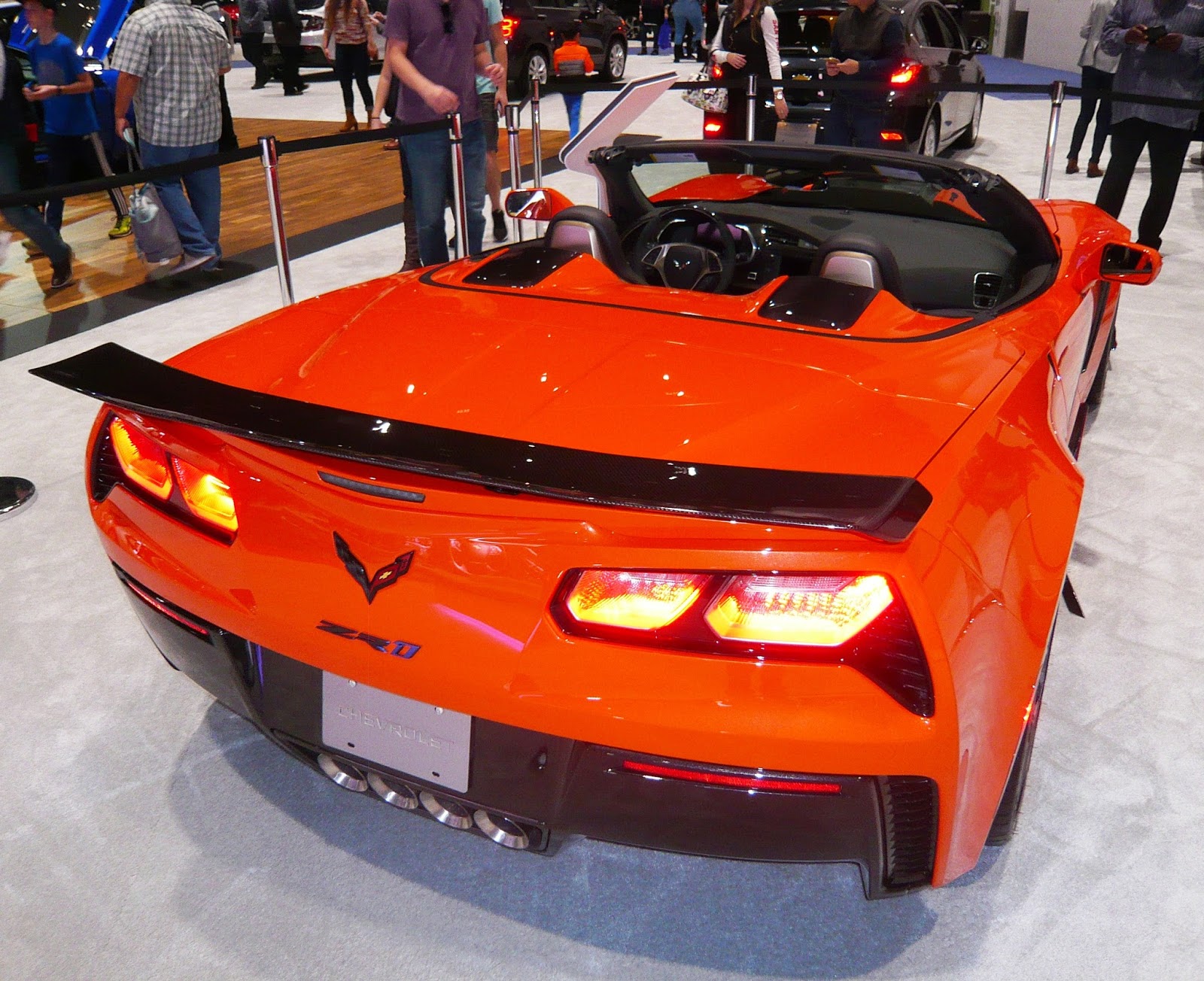
The Chevrolet display area at the 2018 Silicon Valley Auto Show featured this “Sebring Orange” 2019 Corvette ZR1, the first Corvette convertible available since 1970 with the ZR1 designation. Powered by an Eaton twin-scroll supercharged LT5 V-8 engine with a SAE-certified output of 755 horsepower and 715 pound-feet of torque, the ZR1 convertible carries a manufacturer's suggested retail price of $123,995, which makes the ZR1 convertible the most expensive Chevrolet passenger car in history.

The engine has a couple of interesting construction details - such as a dual fuel injection system, with a primary direct injection system supplemented with port injection at higher output situations. The two-stage exhaust system uses active and passive elements with what Chevrolet describes as the "loudest and aggressive sounding Corvette in history."  Due the high power output, the Corvette ZR1 utilizes thirteen (13) heat exchangers and a hood cutout.      


Chevrolet promises zero-to-60-mph times of less than three seconds and a quarter-mile time “under 11.0 seconds” and a top speed of “over 200 miles per hour.” Those who desire more on-track performance can specify the $2,995 ZTK Performance package which includes a higher profile adjustable carbon fiber rear wing, and carbon fiber front splitter.
 

Photos by the author  

Monday, September 19, 2016


A confusing 1955 Chevrolet Bel Air convertible
 
photo by the author

Recently the author toured the Pack Automatable Museum owned by Dallas Texas mega-car dealer Sam H. Pack  The museum contained many beautiful cars that included sports cars, hot rods, customs, muscle car race cars, and cars of the fifties. There was one car which left the author puzzled - this black 1955 Chevrolet Bel Air convertible that sported replica Indianapolis '500' Pace Car graphics- except it is black.

The car was purchased by Mr. Pack at the Barrett-Jackson Scottsdale auction in 2011, and the information card with the cars stated “this tribute car was commissioned by the Indianapolis 500 Festival Race Committee to celebrate the 50th Anniversary of the small block Chevrolet V8. The car was restored to exact specification of the track-ready cars built in 1955 with one great exception, the track cars were painted two-tone cream and red whereas this car is painted black and is stunning.”
 
 
Charles Keating and Anton 'Tony' Hulman in a posed shot with the pace car.
Note the unique Firestone "500" tires
photo courtesy of the Indianapolis Motor Speedway collection
 in the IUPUI University Library Center for Digital Studies
 
The Chevrolet Pace Car heads the field before the start of the 1955 '500'
photo courtesy of the Indianapolis Motor Speedway collection
 in the IUPUI University Library Center for Digital Studies
 
The original “track cars” were not cream and red but were painted Gypsy Red and India Ivory, For years the author has heard stories of an original turquoise and white 1955 ‘500’ Pace Car but this is the first time he has seen one in black.  It appeared to be a very nicely restored car, with the “Official Pace Car” graphics on the rear quarter panel changed from black to white and the lower slogan “500 mile race” in red. Pack’s car also sported rear fender skirts which with the pace car driven by Chevrolet Sales Manager, Thomas Keating, was not equipped.

The author has been unable to confirm that this car was, as claimed, commissioned by the ‘500’ Festival Inc. in 2005 - can any readers clear up this mystery?

Tuesday, February 16, 2016

A short history of vinyl automotive tops


Why do hearses have padded vinyl tops and landau bars?


Over the weekend, the author caught a few seconds of the video of the hearse that carried the remains of Supreme Court Justice Antonin Scalia as it left a resort in rural Texas enroute to the funeral home. The silver hearse appeared to be a recent vintage Cadillac complete with a matching padded vinyl top and landau bars, which brought a question to mind – why do hearses typically have padded vinyl tops and fake landau bars? This question led the author to research the history of vinyl tops on automobiles.
 
Drawing of a landau carriage
 
Stylistically early automobiles were little more than self-propelled versions of horse-drawn carriages, and two styles of carriages featured retractable canvas (or leather) tops- the landau which usually had front and rear facing seats with a fully retractable top, and landaulet, which the canvas top covered only the rear passenger section. Both types of carriage shared one immediately visible feature, the large s-shaped scroll hinge, or landau bar, to support the folding top.

Rear-facing front seats do not work for a passenger car for obvious reasons, so landau style automobiles typically featured two rows of forward facing seats. As a less costly version of the landau, the phaeton body style offered a canvas top with no side curtains or windows.   As automotive production increased, steel replaced wood in the manufacturer of bodies, and fully retractable top automobiles became known as a convertible or landau. The landaulet top style faded from popular use during the 1920’s, although it is still in occasional use on custom-built official state cars used by dignitaries.   
 
1928 Ford Model A Sport Coupe
In 1928 Ford introduced the Model A which included a top of the line version of the two-door coupe known as the 40- A Sport Coupe which appeared to have a convertible top, but was in fact a fixed coupe with a canvas top and landau bars. Ford also offered its model 60-A, the leatherback Fordor (four-door sedan) beginning in late 1928 which used an artificial leather roof trim that mimicked a landau top but omitted landau bars.

The faux landau tops fell out of favor as cars became more streamlined and flowing in appearance and less like carriages, but meanwhile builders of American automobile hearses began to install non-functional landau bars on the rear of hearses. This is thought to be a nod to early horse-drawn carriages although the author has been unable to find any instances of landaulet tops used on horse-drawn hearses. Over the years the landau bars became as ingrained in the public’s mind as a symbol of a funeral car so most hearse manufacturers still tack on stylized S-shaped scrolls as traditional.
 
1951 Kaiser Virginian

In 1951, the second series of Kaiser-Frazer cars began to offer padded tops on their Manhattan, Dragon, Virginian sedans, but while Kaiser-Frazer sales were low, the “Big Three” took notice.
 
1951 Lincoln Lido
Ford’s Lincoln-Mercury Division offered the Cosmopolitan Capri and Lincoln Lido models in 1951 with optional vinyl tops, but these did not prove popular and were soon dropped. In 1956, the Cadillac Eldorado Seville came with a “Vicodec” top which wasn’t vinyl but a water-resistant nylon fabric similar to convertible top material.

In 1962, Ford Motor Company offered a vinyl roof option on the Thunderbird with landau bars, and the other Detroit automakers took notice, and soon all the automakers in the 1960’s and 1970’s had vinyl roof options on most of their models. Buyers were willing to pay extra for the vinyl top which cost little to install and added profit to the manufacturer’s bottom line.   
Chrysler Mod Top

Mercury Cougar houndstooth
 
During the mid-70’s Chrysler offered “Mod Tops” on Dodges and Plymouth with a paisley or floral design, and in 1970 Mercury offered a houndstooth pattern top option on the Cougar.  In addition to different simulated grain choices, there were many styles of vinyl tops offered by the Detroit automakers often in concert with that other 1970’s fad, opera windows.
 
Camaro halo top
 
The vinyl top style was designed to enhance the car’s lines and included the full top (from drip rail to drip rail), halo (with an inch or so of paint showing above the doors and windshield), canopy (front half), landau (back half) just to name a few.  For 1975, Cadillac introduced the padded vinyl top which further mimicked the look of a convertible top, and all the other car manufacturers quickly added padding to their option list. Somehow the smooth padded vinyl top became de rigueur for hearses.


The big problem was what was going on underneath that vinyl tops – RUST, particularly with cars that sat outside because the vinyl was not waterproof which allowed moisture to become trapped between the vinyl top and the roof of the car to attack the steel.  Oftentimes restorers of cars with vinyl tops find the roof panel of the car severely rusted once the old top is peeled away.  

The paisley pattern for a 1970 Plymouth Gran Coupe


The author’s observation as a young man in the 1970’s was that your father was either a “vinyl top guy” or “non vinyl top guy.” In addition to just looking good, vinyl top advocates claimed that it kept the interior of the car cooler and quieter. The author’s father always owned vinyl topped cars which included a 1970 Plymouth Fury Gran Coupe with a full paisley top (explained as a mistake because the car was bought at night), and a 1974 Ford Pinto with a landau vinyl top. The last vinyl-topped car the author recalls that his family owned was a halo-style 1979 Dodge Magnum.

Vinyl tops became rarer through the 1990’s as passenger cars became more rounded and aerodynamic, and Lincoln is credited with offering the last factory vinyl top in 2002. Although the manufacturers no longer offer vinyl tops, there appears to be a healthy aftermarket for vinyl tops added to contemporary cars, as apparently a vinyl top remains a status symbol for those who can afford a car so equipped.  Many limousines utilize a vinyl roof, probably because the vinyl top covers up less than perfect metalwork beneath; perhaps this is also why most hearses still have vinyl tops.  

Perhaps someday, “retro” vinyl tops will come back into vogue for the mass passenger car audience.