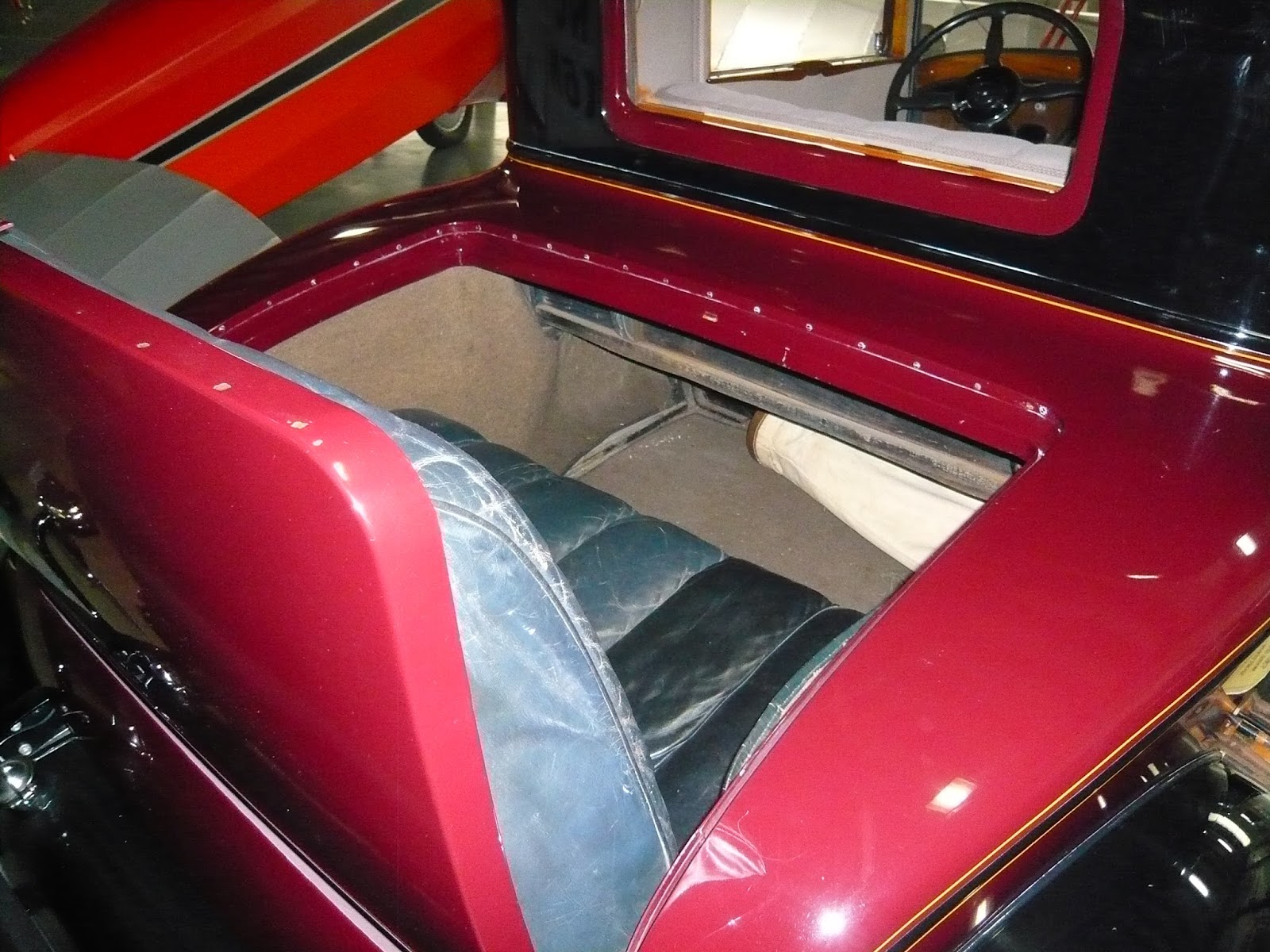
The forgotten marque- the 1928 Whippet

In 1908 Elmira New York Overland automobile dealer John
North Willys (pronounced Will-is) bought the struggling Indianapolis, Indiana
Overland factory and quickly turned the company’s fortunes around around. The
following year Willys purchased the Marion Motor Car Company from Marion Ohio
and the bankrupt Pope-Toledo Motor Car Co. in Toledo, Ohio and consolidated the
base of operations for his Willys-Overland Motor Company in Toledo.
In 1913, Willys acquired the license to build Charles
Knight's sleeve-valve engine which was used in cars that bore the Willys-Knight
nameplate. With his diverse line of automobiles in the period from 1912 to
1918, Willys-Overland became the second-largest producer of automobiles in the
United States after Ford Motor Company. In 1925, John Willys bought out the Stearns
Company of Cleveland and added the Stearns-Knight luxury car to his array of
offerings.

In 1926 John N. Willys discontinued sales of cars with the
Overland nameplate, and introduced a new economical type of car which he called
the Whippet, after a mid-sized breed of racing dog smaller than a greyhound
often called "the poor man's racehorse." The 1927 Overland-Whippet was introduced to
the American public on June 26 1926, and later in Britain, Canada and
Australia. The Whippet was powered by a four-cylinder side-valve engine that displaced
134 cubic inches and produced 31 horsepower, which was plenty of power as the largest
Whippet, the 12-foot long sedan, weighed little more than a ton.

The new Whippet featured 4-wheel brakes, a rear fuel tank, ‘Chadwick
type” replaceable main engine bearings, Tryon spring shackles, water pump
cooling and pressurized oil lubrication - all features not included on the Ford
Model T. Whippet advertising touted the car’s European styling of a compact (100-inch
wheelbase) yet roomy body, to combine good looks with good performance, handling,
and economy. Early Whippet magazine advertisements quoted John Willys “Never
before such beauty and quality for so little money.”

The 1928 Whippet Model 96 such as the one on display at the
Western Antique Aeroplane and Automobile Museum (WAAAM) in Hood River Oregon
was offered in one of six body styles. The
low-price leader was the “touring car” a phaeton style body with a canvas top
but no side windows which sold from the factory for $455.

Next up the Whippet price
ladder came the roadster with rumble seat for $525, then the enclosed coupe and
coach body styles which each sold for $535. The stylish Whippet Cabriolet Coupe
(convertible) sold for $545 and the Model 96 passenger car line was topped by
the four-door sedan as shown at WAAAM which sold for $585.

Whippets were advertised as fast, durable, and economical and
the factory proved that to the car-buying public with a number of performance tests.
Best known is the effort of famed long-distance driver Erwin George “Cannon
Ball” Baker who drove a Whippet touring car from Los Angeles to New York in
late 1926. Baker who drove in the 1922 Indianapolis ‘500,’ covered the distance
of 3,539.8 miles in 14 ½ days under the close observation of AAA (American
Automobile Association) officials.
The test began with Carl Laemmle Junior, assistant manager
of the Universal Picture Corporation witnessing the start at midnight on
November 26 1926. A motorcycle escort led Baker and his official AAA ride-along
observer, pioneering early race car driver Joe Nikrent (veteran of the 1913 Indianapolis
500), out of Los Angeles. Baker and
Nikrent followed the Southern transcontinental highway route as they passed through
Arizona, New Mexico through El Paso and Dallas. Texas, then headed north to
Memphis and Indianapolis and finally east in snowy weather through Philadelphia
to the finish in New York City.
George Lewis, the Universal Pictures western silent film
star and John N. Willys welcomed the pair at the end of the grueling economy
test at noon on December 10 1926. The
Whippet touring car used 82 ¼ gallons of gasoline for the trip with an average
fuel consumption of 43.28 miles to the gallon (MPG) which exceeded the advertised
fuel economy of the Whippet by 13.28 MPG. At one point during the trip on December
1st between Sweetwater and Dallas Texas the Whippet’s fuel mileage peaked at
the remarkable rate of 53.6 MPG.
110,344 Whippets were sold during the 1927 model year, and
for the 1928 model year sales nearly doubled despite the introduction in late
1927 of the all-new Ford Model A. During 1928 Whippet added a 40 horsepower 178-cubic
inch six-cylinder powered model, known as the Model 98, which sold alongside
the four-cylinder model. Sales continued
to be strong and Willys-Overland ended 1929 in third place in US car sales
behind Ford and Chevrolet.
As the Great Depression deepened, Willys-Overland discontinued
the Whippet nameplate in the United States at the end of the 1930 model year after
just four model years in favor of the Willys Six and Willy Eight. The company staved off its creditors until
World War II during which it built 363,000 “Jeeps” and returned to profitability.
For the first few years after the war, Willys-Overland chose to concentrate on
Jeeps and Jeep-based vehicles instead of passenger cars.
In 1953, a subsidiary of the upstart car manufacturer Kaiser
Manufacturing Corporation purchased the assets of Willys-Overland and changed its
name to Willys Motors Incorporated. U.S.
production of Kaiser and Willys passenger cars ceased during 1955, but he
company continued Jeep production and changed its name to Kaiser-Jeep in 1963. Kaiser-Jeep was sold to American Motors
Corporation (AMC) in 1970 as Kaiser Industries finally left the automobile
business. Chrysler Corporation purchased
AMC and the Jeep nameplate in 1987; now a wholly owned subsidiary of Fiat
Chrysler Automobiles (FCA) Jeep vehicles continues to be built in Toledo.