Monday, January 30, 2017


The King automobile  
America's second production V-8 engine


The Western Antique Aeroplane and Automobile Museum (WAAAM) has an extremely rare and highly significant car, a 1917 King Model EE ‘Foursome’ on display.  This car is historically significant because King Motor Car Company was the second manufacturer to introduce a production V-8 engine, only a month after the introduction of the Cadillac Model 51 which used the first production V-8 engine.

Charles Brady King finished building his first automobile on March 6, 1896, and legend has it this King drove the first gasoline-powered “horseless carriage” on the streets of Detroit, reportedly followed on a bicycle by his friend Henry Ford. After he worked for several auto manufacturers, Charles formed the King Motor Car Company in February 1911 to sell a new car the “Silent 36” which was powered by a four-cylinder engine rated at 36 horsepower.

The King Motor Car Company outgrew its first factory location and moved into the original Hupp Motor Car Company plant located at the corner of Jefferson Avenue and Concord Street in Detroit. However the King company grew too quickly, got into financial troubles and King lost control of the company the assets of which were purchased by Artemas Ward who installed his son Artemas Ward Junior as the King Motor Car Company’s new  President and General Manager.

Artemas Ward the great-grandson and namesake of the famous Revolutionary War General was born May 20, 1848 in New York City. After the Civil War Ward moved to Philadelphia and entered import/export business and later became renowned as an advertising genius. In 1899 Ward gained control of the platform advertising and vending machine rights on the New York Elevated Railroad and later in 1904 the Subway lines.

Ward Senior held the patent for a “coin-controlled vending machine” that released a gum ball after a person deposited a penny in the slot and pulled the operating handle.  The value of Ward's exclusive contracts skyrocketed with the fortunes of the subway system and Ward bought both chocolate and chewing gum factories to fill his vending machines.  Ward’s gross earnings for the decade from 1904 to 1914 were reportedly $11.4 million which is equivalent to $270 million in 2016.

Under the control of Ward Junior, the “King Eight” powered by the new V-8 engine that displaced 283 cubic inches and developed 60 horsepower was introduced in October 26, 1914 priced at $1,350. By the 1916 model year, the King “Silent Six” line was phased out and all King cars were 8-cylinder models.  


The 1917 Model EE Foursome on display at WAAAM was one of four body styles offered for 1917. In addition to the Foursome, King offered a 7-passenger Touring car, and a Roadster, which each sold for $1,585 as well as a 7-passenger Sedan that sold for $2,150. After more than 3000 V-8 cars were sold the first year, sales dropped rapidly and by October 1923, Ward voluntarily let the company enter receivership.  The King Motor Car Company’s assets were sold again and the new owner moved to the factory to Buffalo New York but King went bankrupt again quickly and was out of business for good in early 1924.

All photos by the author

Tuesday, December 13, 2016

High-tech inspection at PRI 2016
Approved body components specified under the INDYCAR aero kit rules are off limits to alterations by the Verizon Series teams, but if you are at all like the author you have wondered “how do officials know what is legal or not?”
 
Online Resources Inc. demonstrated the system on the PRI show floor
using Ed Carpenter's Fuzzy's Vodka DW12 INDYCAR
 

At the 2016 Performance Racing Industry (PRI) show in Indianapolis, Online Resources Incorporated demonstrated their Creaform Handyscan 700 scanner, Surfcam and Geomagic software which is used to create a 3D model as an inspection and quality-control service for INDYCAR.


“A laser line is reflecting over the car and cameras built into the scanning unit are capturing the position,” said Jay Schaumberg, president of Online Resources Inc.  "The Geomagic Capture compares the scanned results to the files provided by INDYCAR with different colors on the monitor used to represent tolerances accepted or outside the rules."

The laser scanning inspection complements areas measured and weighed during the technical and safety inspection process during INDYCAR race weekends.
 

Photos by the author

Saturday, October 29, 2016


A beautiful pair of Packards in Oregon
 
This past week, the author had the opportunity to visit the Western Antique Aeroplane and Automobile Museum (WAAAM) in Hood River Oregon, and we will feature several of the most interesting automobiles in their excellent collection. Today, we’ll share a couple of Packards, one of the most respected brands of luxury cars during the nineteen twenties and thirties. The Packard advertising slogan was “Ask the man who owns one.”
 
 
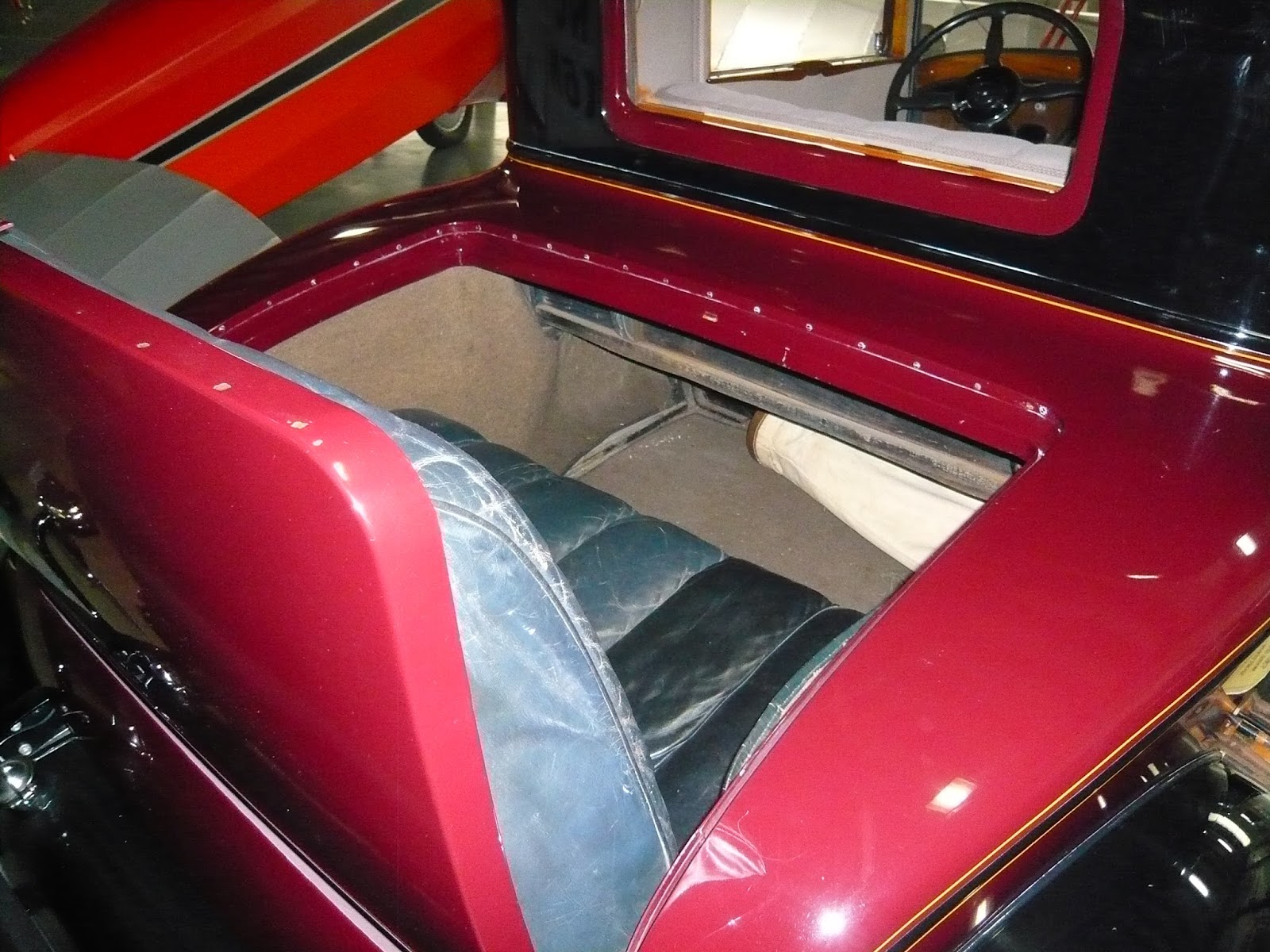
The first car featured is a 1929 Packard Model 626 Sport Coupe which was originally sold by the Earle C. Anthony, the Packard distributor for the state of California, initially it was used a demonstrator for the optional wooden artillery wheels, which proved to be unpopular, as customers thought the wooden wheels looked “old fashioned” and preferred solid disk wheels. The Packard 626 series car introduced in 1929 was powered by 320 cubic inch straight eight engine that produced 90 horsepower but was a very smooth-running powerplant.


Earle Anthony dealerships actually sold this car twice, as it was traded in by the original owner and sold as a used car to the second owner who kept the car for over thirty years. This remarkable car is on it fourth owner in 87 years. Much of the car is original but it has been repainted in its attractive maroon and black finis with dark yellow pinstriping. Note that there is not a separate compartment for the golf bag; rather the bag rests in the footwell of the rumble seat.   


The other Packard in the WAAAM collection is this spectacular 1935 Packard twelve-cylinder convertible coupe, finished in dark blue with gold pinstriping.


The 473 cubic inch V-12 engine has aluminum heads with hydraulic valve lifters and produced 160 horsepower. Unlike the 1929 Sport Coupe, this Packard has been totally restored.


Reportedly there were just 788 Packard Twelves built during the 1935 model year at the height of the Great Depression. One can easily imagine a  movie star or wealthy playboy behind the wheel of this magnificent Packard.   

Monday, September 19, 2016


A confusing 1955 Chevrolet Bel Air convertible
 
photo by the author

Recently the author toured the Pack Automatable Museum owned by Dallas Texas mega-car dealer Sam H. Pack  The museum contained many beautiful cars that included sports cars, hot rods, customs, muscle car race cars, and cars of the fifties. There was one car which left the author puzzled - this black 1955 Chevrolet Bel Air convertible that sported replica Indianapolis '500' Pace Car graphics- except it is black.

The car was purchased by Mr. Pack at the Barrett-Jackson Scottsdale auction in 2011, and the information card with the cars stated “this tribute car was commissioned by the Indianapolis 500 Festival Race Committee to celebrate the 50th Anniversary of the small block Chevrolet V8. The car was restored to exact specification of the track-ready cars built in 1955 with one great exception, the track cars were painted two-tone cream and red whereas this car is painted black and is stunning.”
 
 
Charles Keating and Anton 'Tony' Hulman in a posed shot with the pace car.
Note the unique Firestone "500" tires
photo courtesy of the Indianapolis Motor Speedway collection
 in the IUPUI University Library Center for Digital Studies
 
The Chevrolet Pace Car heads the field before the start of the 1955 '500'
photo courtesy of the Indianapolis Motor Speedway collection
 in the IUPUI University Library Center for Digital Studies
 
The original “track cars” were not cream and red but were painted Gypsy Red and India Ivory, For years the author has heard stories of an original turquoise and white 1955 ‘500’ Pace Car but this is the first time he has seen one in black.  It appeared to be a very nicely restored car, with the “Official Pace Car” graphics on the rear quarter panel changed from black to white and the lower slogan “500 mile race” in red. Pack’s car also sported rear fender skirts which with the pace car driven by Chevrolet Sales Manager, Thomas Keating, was not equipped.

The author has been unable to confirm that this car was, as claimed, commissioned by the ‘500’ Festival Inc. in 2005 - can any readers clear up this mystery?

Saturday, August 20, 2016


Tony Hulman’s Beechcraft 18 airplane


While researching the recent “500” Platolene gasoline story, the author found an interesting letter written in February 1972 by the company’s general manager, J.W. Connelly, to the chairman of the Carmi Illinois airport expansion committee. Originally based in Hulman’s hometown of Terre Haute Indiana, at the time Platolene 500 headquarters was based in Carmi a small Illinois town 125 miles southeast Terre Haute.

Platolene 500 Inc. was one of many local businesses that supported the long-overdue extension of the city’s airport runway to 4,000 feet. Mr. Connelly’s comment was “two of our partners in this company, Henry Smith and Tony Hulman of Terre Haute Indiana, each have Beechcraft 18 airplanes. In the past they have used our present runway but they are very reluctant to do so because of only 2,700 feet of pavement.” It is worth noting that the recommended ground roll landing distance for a Beechcraft 18 was 2,800 feet. So what is the story behind Tony Hulman’s airplane?

The Beechcraft 18

The Beech Aircraft Company of Wichita Kansas began to produce the Beechcraft Model 18 in 1937, a “tail-dragger” design all-metal semi-monocoque construction and twin tail fins similar in appearance to the larger Lockheed Electra powered by that used twin radial engines.
Beech advertised to businessmen
Intended for use as a small airliner or as an executive aircraft, sales were slow and at the time of the United States’ entry into World War II in December 1941, only 39 Model 18's had been sold. As part of the war effort, more than 4,500 military versions of the Beechcraft 18 were built during WW II. Some sources state that over 90% of United States Army Air Force (USAAF) bombardiers and navigators during World War II were trained in Beech 18-type aircraft.

Tony Hulman’s plane

A typical Beech D18S cabin


Tony Hulman’s plane was a Beechcraft Model D18S, the first post-World War II version that debuted in October 1945 and featured seating for two pilots and six passengers with 5 feet of headroom in the cabin. The plane was powered by twin Pratt & Whitney 985 “Wasp Junior” nine-cylinder radial engines with gear-driven single-speed centrifugal type superchargers. The engines were rated at 450 horsepower each and used 99-inch constant speed propellers. The Beechcraft Model 18 typically cruised at 170 MPH, with a ceiling of 20,000 feet and a range of over 500 miles.
A Pratt & Whitney 985 in a Beech 18
A Pratt & Whitney 985 data plate

There were 1,035 Beech D18S planes built; the plane which would become Hulman’s was serial number A-223 completed on May 29 1946, the day before the first Indianapolis 500-mile race under Tony Hulman’s ownership of the Indianapolis Motor Speedway. The mirror-like polished aluminum bodied plane was sold through dealer Interstate Airmotive to the Trailmobile Company of Cincinnati Ohio.  The company which built over-the-road semi-truck trailers since 1915 kept the Beechcraft in the company’s hangar at Cincinnati’s historic Lunken Field until 1954.  

During July 1954 the Beech 18 A-223 was sold to the Electric Auto-Lite division of Willys Corporation which manufactured 400 different automotive parts, including generators, lamps, horns, hubcaps, wiring, and seat adjustors. Electric Auto-Lite based in Toledo, Ohio the largest independent manufacturer of automotive electrical equipment was purchased by Ford Motor Company in 1961 after which Ford changed the division name to simply “Autolite.”

Under Ford’s ownership, the Autolite division expanded into auto racing particularly with spark plugs.  Lloyd Ruby drove Lindsey Hopkins’ “Autolite Special” Offenhauser powered Epperly laydown roadster to an eighth place finish in the 1961 Indianapolis ‘500.’  In 1962, Autolite spark plugs won the Daytona GT Continental, the Daytona ‘500,’ and then swept the top three finishing positions in the Indianapolis ‘500’ as Rodger Ward and Len Sutton finished one-two for Bob Wilke with Eddie Sachs in third place in Al Dean’s ‘Autolite Special.’
Tony's plane restored


The Willys Electric Auto-Lite division sold Beechcraft D18S tail number N80242 to the Mead Corporation of Dayton Ohio in October 1954. Pilot Lloyd Fuller went along with the plane, just as he had with the previous owner as he had flown Beech A-223 since it was completed in 1946 at the Wichita factory. During Mead’s ownership, Tony Hulman flew on the plane, although according to an article in the October 1971 issue of Flying magazine, Fuller said Hulman “really didn’t care for flying.”  
The tail of Tony's plane


In December 1963 the Mead Corporation sold the plane to Hulman & Company, pilot Fuller relocated to Terre Haute, and Hulman & Company built a new hangar on Hunt Road adjacent to Hulman Field (now known as Terre Haute International Airport). Under Hulman’s ownership, the tail number of the Beech was changed to N500 which remained until 1973 when it was predesignated N5QQ. Hulman & Company sold the highly-polished Beech D18S with blue trim in the fall of 1989. The plane’s current owner keeps the restored plane in Henderson Nevada.  

Thursday, August 11, 2016


“500” Platolene gasoline
 

Recently on an episode of the History Channel "reality" program 'American Pickers,' during a visit to Southern Indiana, one of the two protagonists bought a large old porcelain service station sign that read “500 Platolene” which used a checkered flag  The owner of the sign mumbled something about the people that ran the Indianapolis ‘500’ had owned this service station chain. Hearing that, the author had a new research project, namely where did that name come from?

Anton “Tony” Hulman Junior, who bought the Indianapolis Motor Speedway from Eddie Rickenbacker in 1945, was born in Terre Haute Indiana the only child of grocery magnate Anton Hulman and his second wife Ada Grace Smith Hulman.  Ada’s family owned the Princeton Mining Company and the Deep-Vein Coal Company both bituminous coal mining operation as well as Princeton Farms all in the vicinity of Princeton Indiana about 80 miles due south of Terre Haute.

Henry P. Smith Junior operated those businesses after the death of his father as well as the RJ Oil and Refining Company which in addition to its refinery RJ operated 100 service stations in Illinois, Indiana and Kentucky. Henry’s cousin, Tony Hulman was a partner in RJ Oil and Henry’s son, Donald Smith (later a Hall of Fame racing promoter) was RJ Oil’s sales manager.

In 1953 RJ Oil undertook a one million dollar expansion of its refinery that was completed in August 1953. The refinery was the first such plant in the area that used a new process developed by Universal Oil Products of Des Plaines Illinois known as “platforming”

In an article published in the Terre Haute Tribune,  Smith promised motorists that the company '500' service stations  will have “the most powerful, cleanest burning, most economical gasoline that has even been refined” because of “the specially developed catalyst in this secret new process.” The process used “precious platinum, a metal more costly than gold;” in 1953 an ounce of platinum cost $70 compared to $40 for an ounce of gold.  The name of the new gasoline was “Platolene” - the “gasoline made with platinum.” The name and logo ‘500 Platolene’ was trademarked in 1953.   
 
A matchbook from the author's collection combines two
Tony Hulman businesses - 500 Platolene and the
Meadows Shopping Center (Terre Haute's first mall)
 
 
Today the Smith and Hulman family business interests remained intertwined. Tony George, Tony Hulman's only grandson, recently re-installed as chairman of Hulman & Company currently sits on the board of directors of First Financial Bank N.A. (once run by Don Smith), Deep Vein Coal Company, Princeton Mining Company, and R.J. Oil Company.  

Postscript


There is one final racing connection to this story. In the early nineteen seventies Universal Oil Products (UOP) developed a new process known as ‘CCR platforming’ that allowed refineries to produce high-octane lead-free gasoline. To help promote their new process, in August 1971, UOP signed a sponsorship deal with Don Nichols’ Advanced Vehicle Systems.
The series of sinister black race cars in the SCCA Can-Am and Formula One series were known as “UOP Shadows.” The UOP Shadow DN4A driven by Jackie Oliver and powered by a 494-cubic inch Chevrolet engine powered by lead-free gasoline won the 1974 SCCA Can-Am championship.   

Postscript 2

Tony Hulman became a partner with RJ Smith in the Princeton Farms the primary product of which was popcorn. Around 1940 Smith and Hulman hired the former Vigo County Farm Bureau extension agent to run the Princeton Farms. The agent who ran the Farms for 12 years later became world-famous for marketing his own brand of popcorn: Orville Redenbacher.


Monday, May 16, 2016


“It’s a new track record!”
A commentary with historical perspective

By now, you have probably heard or read that all the grandstand tickets for the 100th running of the Indianapolis 500-mile race on May 29 are sold out. After a week of practice, the entrants will qualify for the starting field this weekend.
It will be interesting to see if attendance at the two days of time trials exceeds the weak turn-out for the Angie’s List Grand Prix of Indianapolis which was run on the Indianapolis Motor Speedway road course on May 14.
The author recalls that during the nineteen seventies and eighties, the crowd at the Indianapolis Motor Speedway for the first day of time trials rivaled the crowd for the ‘500’ itself. The likelihood of that happening in 2016 is between slim and none - for one reason: lack of speed due to the stifling of innovation by the current INDYCAR rules package.  
Instead of innovation, INDYCAR established a set of rules to create a level of perceived excitement for time trials by forcing racers to run twice to qualify for the '500.' 


The qualifying procedure for the 2016 Indianapolis ‘500’ courtesy of the IndyCar website:

Saturday Qualifying – Will determine all 33 positions in the field based on the fastest four-lap averages. All entries are guaranteed at least one four-lap attempt to qualify. The fastest nine entries advance to the “Fast Nine Shootout.”

Sunday Qualifying – Held Sunday early afternoon to determine positions 10-33 in the field based on fastest four-lap average. All times from Saturday are erased and cars will run in reverse order based on Saturday qualification speeds. All cars must complete another four-lap attempt to determine their starting position.

“Fast Nine Shootout” – Held Sunday afternoon after Positions 10-33 have been determined. The top nine cars will run in reverse order based on Saturday’s qualification times. All cars are required to make at least one attempt. At the end of the session, the cars are ranked 1-9 based on their four-lap average during the segment.


The current 4-lap track record at the Indianapolis Motor Speedway of 235.986 miles per hour was set by Arie Luyendyk on May 12, 1996. You read that right- the current track record was set over twenty years ago!  There is little probability that the current crop of be-winged DW12 chassis will approach Luyendyk’s record, and that's a problem in the author's view.

The longest previous period between new track records was twelve years during the Speedway’s dark ages of Eddie Rickenbacker’s  “Junk Formula” rules package from 1928 to 1939. There have been four times when four years passed between records being broken- in the immediately postwar period of 1946 to 1950, after the tragic events of 1973, the cars were slowed until 1977, then for another four-year period after Tom Sneva broke the magic 200 MPH barrier in 1978, and four years after Roberto Guerrero set the standard of 232 MPH in 1992.   

Looking back to events of 1996, which was the first year of the Championship Auto Racing Teams CART-Indy Racing League (IRL) split - the CART teams boycotted the ‘500,’ and the new stock-block powered IRL cars were not ready, so teams competed with a mix of older Lola and Reynard chassis.
On the first day of qualifying, first Davy Jones, then rookie driver Tony Stewart broke Guerrero’s four year old track record. Arie Luyendyk then set a new four-lap standard of 233.350 MPH, but his run was disqualified after the track closed when his Reynard 95I was found to be seven pounds underweight.   

Luyendyk returned the next day, May 12, and re-qualified and set a new one-lap record on each of the successive laps with his best lap of 237.498 MPH and a four-lap average of 236.986 MPH in a run that took just over 2-1/2 minutes to complete. Because his run came on the second day, Luyendyk started twentieth, and he finished the ‘500’ in sixteenth place after being involved in an accident.

The current Indianapolis Motor Speedway track record is so old, that all of the drivers in the race, except the 1995 ‘500’ winner Buddy Lazier and pole-sitter Tony Stewart are retired and Stewart hasn't appeared at the Speedway in an INDYCAR since 2001.  
It is past time for INDYCAR to prove how technologically advanced the series can be by opening up the rulebook to innovation, which will bring new track records and big crowds for time trials.