Monday, May 16, 2016


“It’s a new track record!”
A commentary with historical perspective

By now, you have probably heard or read that all the grandstand tickets for the 100th running of the Indianapolis 500-mile race on May 29 are sold out. After a week of practice, the entrants will qualify for the starting field this weekend.
It will be interesting to see if attendance at the two days of time trials exceeds the weak turn-out for the Angie’s List Grand Prix of Indianapolis which was run on the Indianapolis Motor Speedway road course on May 14.
The author recalls that during the nineteen seventies and eighties, the crowd at the Indianapolis Motor Speedway for the first day of time trials rivaled the crowd for the ‘500’ itself. The likelihood of that happening in 2016 is between slim and none - for one reason: lack of speed due to the stifling of innovation by the current INDYCAR rules package.  
Instead of innovation, INDYCAR established a set of rules to create a level of perceived excitement for time trials by forcing racers to run twice to qualify for the '500.' 


The qualifying procedure for the 2016 Indianapolis ‘500’ courtesy of the IndyCar website:

Saturday Qualifying – Will determine all 33 positions in the field based on the fastest four-lap averages. All entries are guaranteed at least one four-lap attempt to qualify. The fastest nine entries advance to the “Fast Nine Shootout.”

Sunday Qualifying – Held Sunday early afternoon to determine positions 10-33 in the field based on fastest four-lap average. All times from Saturday are erased and cars will run in reverse order based on Saturday qualification speeds. All cars must complete another four-lap attempt to determine their starting position.

“Fast Nine Shootout” – Held Sunday afternoon after Positions 10-33 have been determined. The top nine cars will run in reverse order based on Saturday’s qualification times. All cars are required to make at least one attempt. At the end of the session, the cars are ranked 1-9 based on their four-lap average during the segment.


The current 4-lap track record at the Indianapolis Motor Speedway of 235.986 miles per hour was set by Arie Luyendyk on May 12, 1996. You read that right- the current track record was set over twenty years ago!  There is little probability that the current crop of be-winged DW12 chassis will approach Luyendyk’s record, and that's a problem in the author's view.

The longest previous period between new track records was twelve years during the Speedway’s dark ages of Eddie Rickenbacker’s  “Junk Formula” rules package from 1928 to 1939. There have been four times when four years passed between records being broken- in the immediately postwar period of 1946 to 1950, after the tragic events of 1973, the cars were slowed until 1977, then for another four-year period after Tom Sneva broke the magic 200 MPH barrier in 1978, and four years after Roberto Guerrero set the standard of 232 MPH in 1992.   

Looking back to events of 1996, which was the first year of the Championship Auto Racing Teams CART-Indy Racing League (IRL) split - the CART teams boycotted the ‘500,’ and the new stock-block powered IRL cars were not ready, so teams competed with a mix of older Lola and Reynard chassis.
On the first day of qualifying, first Davy Jones, then rookie driver Tony Stewart broke Guerrero’s four year old track record. Arie Luyendyk then set a new four-lap standard of 233.350 MPH, but his run was disqualified after the track closed when his Reynard 95I was found to be seven pounds underweight.   

Luyendyk returned the next day, May 12, and re-qualified and set a new one-lap record on each of the successive laps with his best lap of 237.498 MPH and a four-lap average of 236.986 MPH in a run that took just over 2-1/2 minutes to complete. Because his run came on the second day, Luyendyk started twentieth, and he finished the ‘500’ in sixteenth place after being involved in an accident.

The current Indianapolis Motor Speedway track record is so old, that all of the drivers in the race, except the 1995 ‘500’ winner Buddy Lazier and pole-sitter Tony Stewart are retired and Stewart hasn't appeared at the Speedway in an INDYCAR since 2001.  
It is past time for INDYCAR to prove how technologically advanced the series can be by opening up the rulebook to innovation, which will bring new track records and big crowds for time trials.    


Friday, March 4, 2016


“No one ever regretted buying quality”
the Hinchman story
 
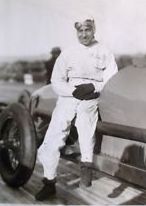
Hinchman Racing Uniforms started the race suit industry in 1925 when  Peter DePaolo, who drove the winning Duesenberg in the 1925 Indianapolis 500-mile race wore the first Hinchman uniform.
 
This photo from the author's collection shows
Peter DePaolo is his Hinchman suit

 
In the past 90 years, Hinchman innovations have included:
The wrap around buttoned collar, first used by Hinchman, was developed after Eddie Sachs complained that the wind made the collars flap. Later  buttons were replaced by Velcro®

In 1966 Hinchman became the first racing suit manufacturer to use Nomex® in their suits, and In 1999 Hinchman was the first company to use the new fire resistant material called Carbon-X®.

 In 2004 Hinchman introduced their new lining called “Comfort Tech” which creates a 3-layer suit that is lighter, thinner, comfortable and more protective than most 2-layer suits.

In 2011, a Hinchman Racing Suit that was worn by actor Steve McQueen in the classic racing film LeMans fetched $984,000 at auction.

In 2013, Hinchman introduced its new 'Hinchman Performance' liner in its new HTO line of racing uniforms, and included it in the new "HP Series" in 2015.

Hinchman believes customer support after the sale is vital and is committed to customer satisfaction, just ask any racer wearing a Hinchman driving suit.

For more details visit their website at http://www.hinchmanracewear.com
 
Information for this article provided by Hinchman

Tuesday, February 16, 2016

A short history of vinyl automotive tops


Why do hearses have padded vinyl tops and landau bars?


Over the weekend, the author caught a few seconds of the video of the hearse that carried the remains of Supreme Court Justice Antonin Scalia as it left a resort in rural Texas enroute to the funeral home. The silver hearse appeared to be a recent vintage Cadillac complete with a matching padded vinyl top and landau bars, which brought a question to mind – why do hearses typically have padded vinyl tops and fake landau bars? This question led the author to research the history of vinyl tops on automobiles.
 
Drawing of a landau carriage
 
Stylistically early automobiles were little more than self-propelled versions of horse-drawn carriages, and two styles of carriages featured retractable canvas (or leather) tops- the landau which usually had front and rear facing seats with a fully retractable top, and landaulet, which the canvas top covered only the rear passenger section. Both types of carriage shared one immediately visible feature, the large s-shaped scroll hinge, or landau bar, to support the folding top.

Rear-facing front seats do not work for a passenger car for obvious reasons, so landau style automobiles typically featured two rows of forward facing seats. As a less costly version of the landau, the phaeton body style offered a canvas top with no side curtains or windows.   As automotive production increased, steel replaced wood in the manufacturer of bodies, and fully retractable top automobiles became known as a convertible or landau. The landaulet top style faded from popular use during the 1920’s, although it is still in occasional use on custom-built official state cars used by dignitaries.   
 
1928 Ford Model A Sport Coupe
In 1928 Ford introduced the Model A which included a top of the line version of the two-door coupe known as the 40- A Sport Coupe which appeared to have a convertible top, but was in fact a fixed coupe with a canvas top and landau bars. Ford also offered its model 60-A, the leatherback Fordor (four-door sedan) beginning in late 1928 which used an artificial leather roof trim that mimicked a landau top but omitted landau bars.

The faux landau tops fell out of favor as cars became more streamlined and flowing in appearance and less like carriages, but meanwhile builders of American automobile hearses began to install non-functional landau bars on the rear of hearses. This is thought to be a nod to early horse-drawn carriages although the author has been unable to find any instances of landaulet tops used on horse-drawn hearses. Over the years the landau bars became as ingrained in the public’s mind as a symbol of a funeral car so most hearse manufacturers still tack on stylized S-shaped scrolls as traditional.
 
1951 Kaiser Virginian

In 1951, the second series of Kaiser-Frazer cars began to offer padded tops on their Manhattan, Dragon, Virginian sedans, but while Kaiser-Frazer sales were low, the “Big Three” took notice.
 
1951 Lincoln Lido
Ford’s Lincoln-Mercury Division offered the Cosmopolitan Capri and Lincoln Lido models in 1951 with optional vinyl tops, but these did not prove popular and were soon dropped. In 1956, the Cadillac Eldorado Seville came with a “Vicodec” top which wasn’t vinyl but a water-resistant nylon fabric similar to convertible top material.

In 1962, Ford Motor Company offered a vinyl roof option on the Thunderbird with landau bars, and the other Detroit automakers took notice, and soon all the automakers in the 1960’s and 1970’s had vinyl roof options on most of their models. Buyers were willing to pay extra for the vinyl top which cost little to install and added profit to the manufacturer’s bottom line.   
Chrysler Mod Top

Mercury Cougar houndstooth
 
During the mid-70’s Chrysler offered “Mod Tops” on Dodges and Plymouth with a paisley or floral design, and in 1970 Mercury offered a houndstooth pattern top option on the Cougar.  In addition to different simulated grain choices, there were many styles of vinyl tops offered by the Detroit automakers often in concert with that other 1970’s fad, opera windows.
 
Camaro halo top
 
The vinyl top style was designed to enhance the car’s lines and included the full top (from drip rail to drip rail), halo (with an inch or so of paint showing above the doors and windshield), canopy (front half), landau (back half) just to name a few.  For 1975, Cadillac introduced the padded vinyl top which further mimicked the look of a convertible top, and all the other car manufacturers quickly added padding to their option list. Somehow the smooth padded vinyl top became de rigueur for hearses.


The big problem was what was going on underneath that vinyl tops – RUST, particularly with cars that sat outside because the vinyl was not waterproof which allowed moisture to become trapped between the vinyl top and the roof of the car to attack the steel.  Oftentimes restorers of cars with vinyl tops find the roof panel of the car severely rusted once the old top is peeled away.  

The paisley pattern for a 1970 Plymouth Gran Coupe


The author’s observation as a young man in the 1970’s was that your father was either a “vinyl top guy” or “non vinyl top guy.” In addition to just looking good, vinyl top advocates claimed that it kept the interior of the car cooler and quieter. The author’s father always owned vinyl topped cars which included a 1970 Plymouth Fury Gran Coupe with a full paisley top (explained as a mistake because the car was bought at night), and a 1974 Ford Pinto with a landau vinyl top. The last vinyl-topped car the author recalls that his family owned was a halo-style 1979 Dodge Magnum.

Vinyl tops became rarer through the 1990’s as passenger cars became more rounded and aerodynamic, and Lincoln is credited with offering the last factory vinyl top in 2002. Although the manufacturers no longer offer vinyl tops, there appears to be a healthy aftermarket for vinyl tops added to contemporary cars, as apparently a vinyl top remains a status symbol for those who can afford a car so equipped.  Many limousines utilize a vinyl roof, probably because the vinyl top covers up less than perfect metalwork beneath; perhaps this is also why most hearses still have vinyl tops.  

Perhaps someday, “retro” vinyl tops will come back into vogue for the mass passenger car audience.