Sunday, March 29, 2020


Worth another look


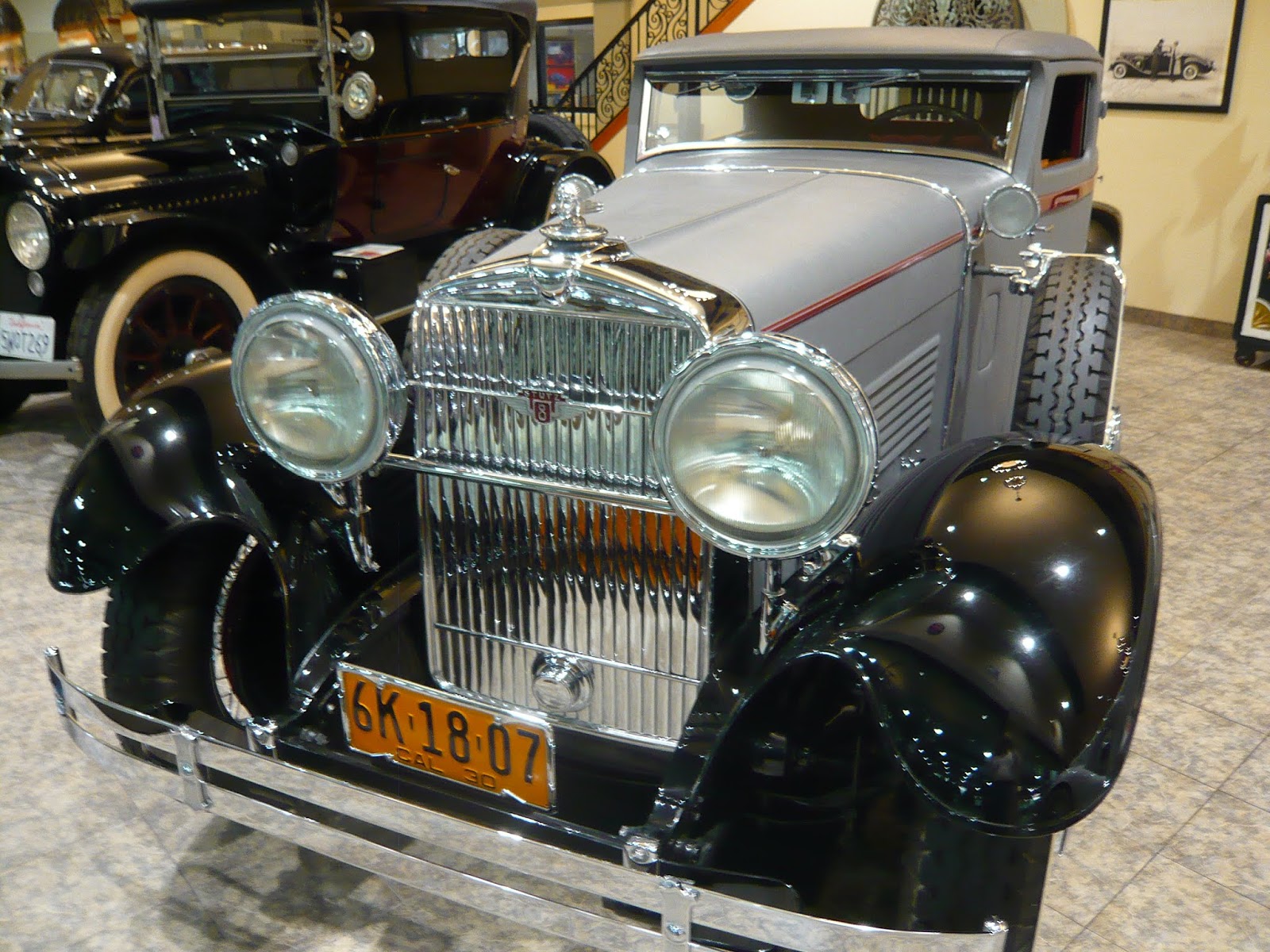
The Automotive Driving Museum located in El Segundo California (near the LAX airport) has several spectacular nineteen thirties luxury cars, including this Weymann bodied 1930 Stutz Monte Carlo, a four-door sedan produced decades before Chevrolet’s coupe of the same name. We featured this car several years ago, but it’s worth another look.   


This four-door Stutz Monte Carlo Sedan is powered by a 287-cubic inch "Vertical Eight" 8-cylinder engine mounted in a chassis equipped with four-wheel hydraulic brakes. This car one of three built sold for $4,495 when new in 1930.

The Weymann body was a patented design system that used a jointed wood frame covered in fabric. It was popular because the body system reduced the usual squeaks and rattles of metallic bodies and improved performance because of the body's lighter weight.  


After World War I French test pilot Charles Weymann who held dual American and French citizenship (both his parents were American citizens) used his knowledge of aircraft manufacturing techniques learned when he worked for Nieuport  and developed a patented system for fabric covered automobile bodies. 

He opened his first factory in Paris in 1921 and through the roaring twenties the market for Weymann fabrics bodies grew quickly and Weymann licensed his system to many of Europe's most prestigious manufacturers. Weymann opened a factory in Indianapolis Indiana in 1928 that was devoted to building custom bodies for Stutz automobiles.


Early in the new decade of the nineteen thirties, the automobile buying public tastes shifted to high-gloss painted bodies and the Weymann fabric bodies with their matte finish fell out of fashion. Weymann's Paris factory closed in 1930 followed by the Indianapolis factory in 1931 making this 1930 Stutz one of the last of its breed.

All photos by the author


Monday, March 2, 2020


Mazda's first "rotary rocket" 


On display at the Blackhawk Museum in Danville is a stunningly restored example of a 1968 Mazda Cosmo 110 A Series 1 coupe, the first car produced by the Japanese automaker that used the eccentric rotary design Wankel engine which the company made famous.

The Wankel rotary engine was envisioned German engineer Felix Wankel, who patented his engine design in 1929 and produced his first working prototype in 1957. Wankel’s creation offered the advantages of compact design and lighter weight over conventional connecting rod/crankshaft reciprocating engine designs. Wankel’s employer, the German car manufacturer NSU built the first Wankel powered car but also licensed the engine design to Mazda in 1961.


Mazda introduced the prototype Cosmo coupe at the Tokyo Motor Show in 1964, and after solving reliability problems with the engine production began in 1967. The first Cosmos were powered by a twin-rotor engine that developed 110 horsepower (thus the name of the car 110A), but in 1968 introduced the Cosmo series 2 which was fitted with a more powerful rotary engine that developed 126 horsepower. All Cosmos featured manual transmissions, the series 1 cars, a 4-speed box and the series 2 cars equipped with five-speed transmissions.

Mazda raced the 110A Cosmo Series 1 in only one race, the 1968 Marathon de la Route 84-hour endurance race on the torturous German Nürburgring circuit. Two Cosmos were entered to prove the rotary engine’s durability. One car, driven by an all-Japanese team, did not finish after an axle broke, but the second car piloted by a team of Belgian drivers finished the 84-hour grind in fourth place, albeit 12 laps behind the winning Porsche 911.       

The car shown at Blackhawk is a rare series 1, one of only 343 series 1 cars produced. The car is white with a black trimmed interior with black and white hounds-tooth cloth seat inserts and right-hand drive. The car was “resto-modded” in Japan in 2008; while it appears stock on the exterior, this car has an upgraded RX-7 engine, transmission and disc brakes and is fitted with aftermarket 15-wheel alloy wheels.

By the time Mazda ended production of the 110A Cosmo in the Fall of 1972, 1,176 of the hand-built cars had been built.  Mazda would go on to build nearly 2 million rotary powered cars and use a rotary powered car to win the 24 hours of LeMans in 1991 but produced its last RX-8 sports car in 2012.  

photos by the author   


Monday, February 24, 2020


The House of Kolor Drag Strip

At the 2018 SEMA show, the theme of the House of Kolor booth was nostalgia drag racing.


Henry Jaded


Dave Shuten of Galpin Auto Sports built this gasser-themed 1952 Kaiser-Frazer Henry J for owner Daniel Nelson. The car is powered by a Chevrolet Performance 572 crate engine bored out to 585 cubic inches by QMP Racing and is fed by a Holly 1150 carburetor atop a Chevrolet Performance ZZ572 intake manifold. The paint is a mix of House of Kolor Orion Silver with Teal Kandy Koncentrate, with the leaf and striping work done by Pete Finlan.


Dr. Moon’s Rage


This 1948 Anglia gasser owned and driven by Howard Moon is powered by a supercharged and injected 427 cubic inch Chevrolet engine, connected to a 2-speed Powerglide transmission and a nine-inch Ford rear end. The car is finished in House of Kolor Violet Shimrin Designer Pearl with the striping and lettering by “flea.”


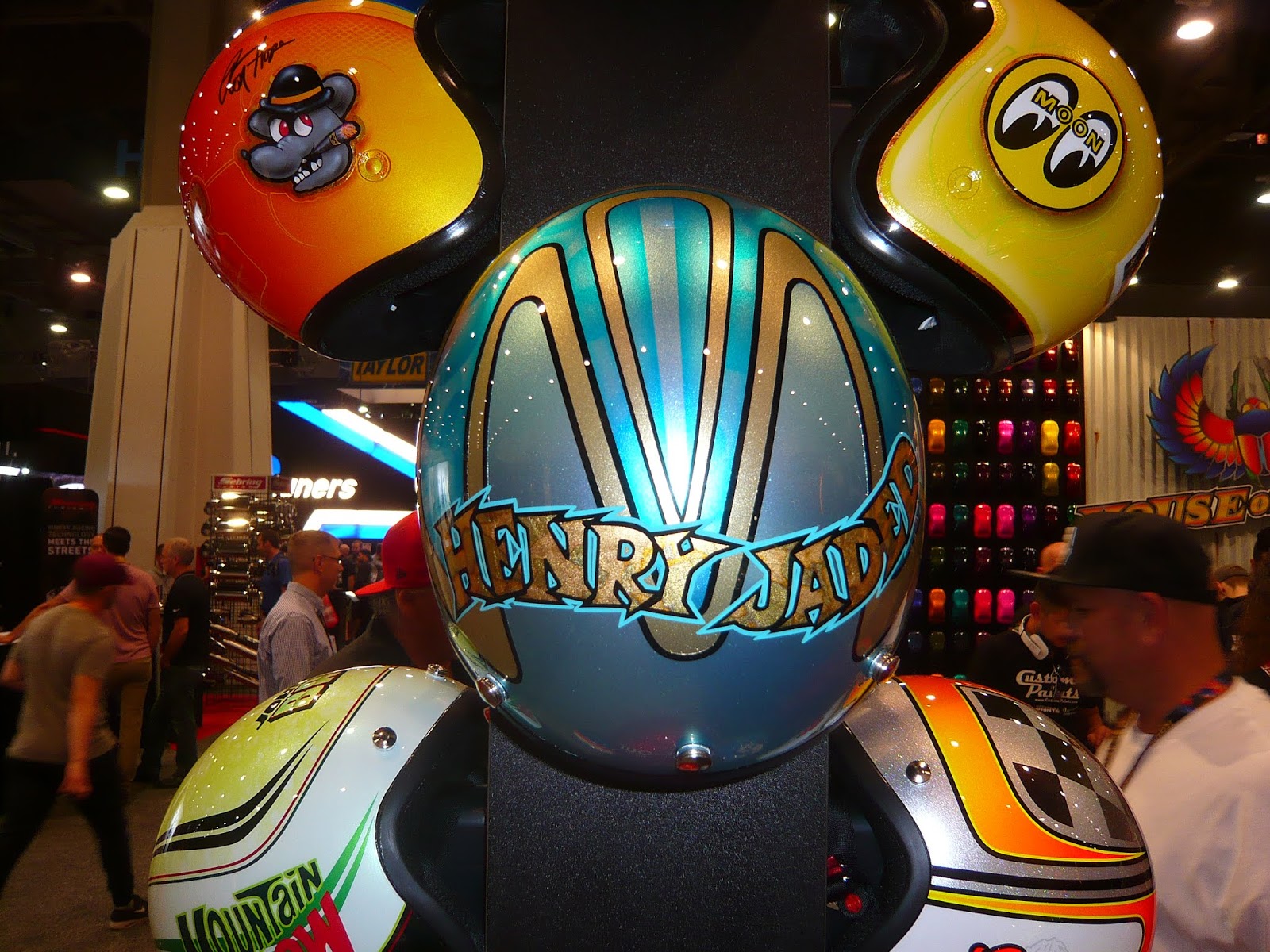
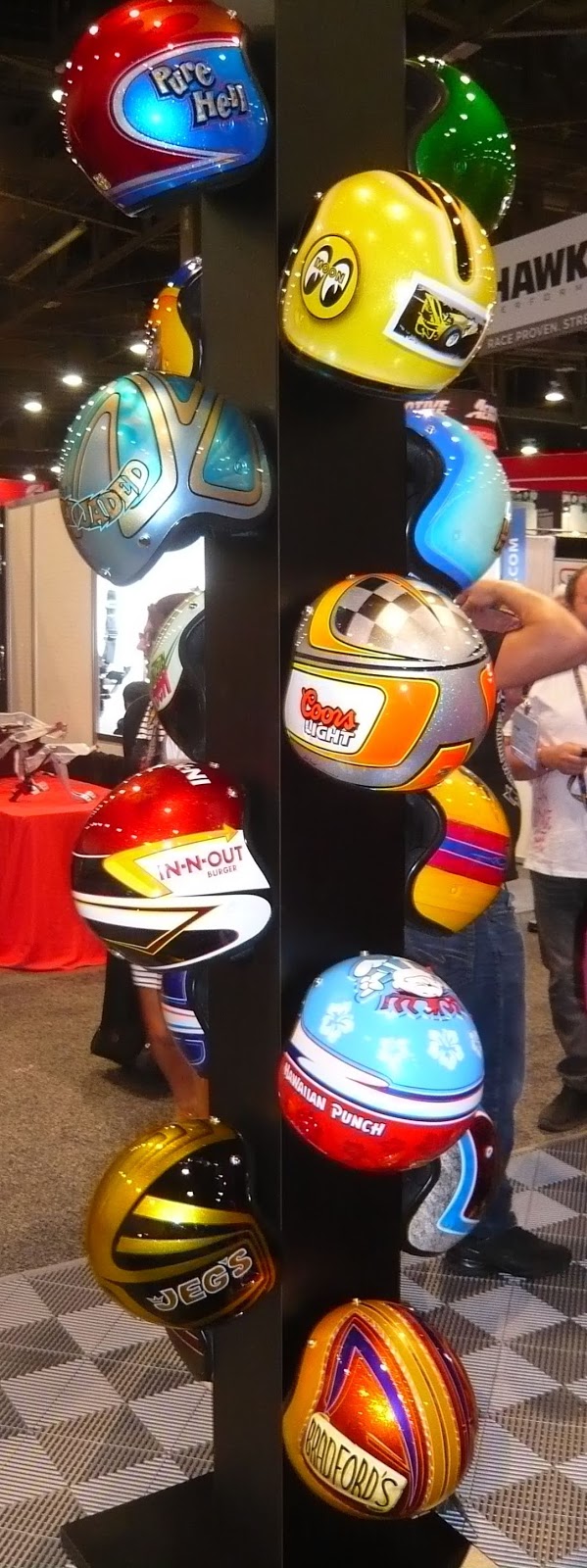
Helmet display

The House of Kolor booth also had several displays of nostalgia-themed racing helmets.


Photos by the author


Monday, February 17, 2020


The Jeep J6 concept

Jeep showed off their J6 concept vehicle at the 2019 SEMA (Specialty Equipment Market Association) show in Las Vegas. The Jeep Design team started with a 2020 Jeep Gladiator Rubicon then modified it into this two-door concept with a six-foot bed to maintain the same wheelbase, then painted the truck in Brilliant Blue Metallic paint that recalls the 1978 Jeep Honcho two-door pickup.


In addition to custom parts, many of the items on the Jeep such as the winch, lights and interior accessories came straight from the Jeep Performance parts catalog.  The Jeep J6 which received a two-inch lift kit rides on custom 17-inch beadlock wheels with a brass finish set off by the silver bead lock ring wrapped in 37-inch BF Goodrich Mud-Terrain T/A tires.  


The pickup bed features a prototype roll bar with LED lights and a prototype spare tire carrier with a color-matched sprayed-in bed liner.


The interior features color-matched panel inserts and Kaztkin custom leather seats with accenting blue stitching.
All photos by the author


Wednesday, January 29, 2020


Fourth-generation 2020 Dodge Drag Pak Challenger debuts at SEMA 2019


It might be hard for enthusiasts to believe, but the current Dodge Challenger is more than 11 years old, and the featured vehicle in the MoPar Performance area at the 2019 SEMA (Specialty Equipment Market Association) show in Las Vegas is the fourth generation of the Drag Pak package, with previous versions in 2008, 2010 and 2015.


The 2020 Dodge Drag Pak which made its debut at SEMA is built as a track-only machine to compete in NHRA (National Hot Rod Association) and NMCA (National Muscle Car Association) drag racing events against the COPO Camaro and the Mustang Cobra Jet.

The Drag Pak starts with a Body-in-White from the Brampton Ontario assembly plant, with an SFI Foundation Inc.-certified 7.50-second 25.5D roll cage added. The Strange Inc. rear axle assembly features 4-link suspension with adjustable coil over shocks and adjustable anti-roll bar.   Up front, the front Bilstein struts are double adjustable, and the car rolls on special lightweight Weld wheels and Mickey Thompson tires.


The heart of the beast is the 354-cubic inch supercharged HEMI® engine that develops over 1000 horsepower coupled to a T400 3-speed transmission with a Quickshift shifter. The body features a hood and front and rear fascia from the Challenger SRT Hellcat, and the car shown at SEMA was covered with a red white and blue nostalgic scheme that harkens back to Dodge Pro Stock cars of the nineteen seventies.

MoPar will only build and sell 50 of these potent machines, which means it is rarer than a McLaren Senna sports car so we can expect lots of collector car auction sales of these cars in the coming years.   

Photos by the author


Thursday, January 16, 2020


What’s it like in there? 
A night at the Chili Bowl


Fans who haven't been frequently ask the author what it is like for a crew working on a midget race car at the famous Chili Bowl in Tulsa Oklahoma. To help answer that question, the author embedded with a crew for one evening at the 34th annual Lucas Oil Chili Bowl Midget Nationals presented by General Tire. 


The team the author choose to follow on the third qualifying night for 2020 is the happy folks who work on the gorgeous #22x is owned by Ray Williams. The car's primary sponsorship is provided by his family business, City Vending of Fort Worth, Texas, which is in its 58th year of vending services in the Dallas-Fort Worth metroplex area. 

Ray is a second generation racer - his father raced sprint cars, top fuel funny cars and top fuel drag boats, For several years, Kevin Ramey drove for Ray Williams, followed by Payton, Ray's son through the 2018 season. 

Based on the draw earlier on Wednesday afternoon, driver Steven Shebester from Mustang Oklahoma was scheduled to start the Stanton SR 11 powered Triple X chassis machine from the fourth position in the fourth of eight 8-lap heat races.

The City Vending Chili Bowl volunteer crew comprised of Williams’ and Shebester’s friends and family - Rusty, Wes, George, Len, Gina, Susan, T Dale and Mellissa – all were very warm and welcoming as the author observed and they answered every silly question.

Shebester drove for Williams last year at the Chili Bowl and the “Red Rocket,” as the car is affectionately known, blew its engine as Steven was leading his qualifier race which ended the team’s efforts at the 2019 Chili Bowl. For 2020, Williams upgraded to the Stanton powerplant.  


At the end of the first lap of the heat race, Shebester had slipped to fifth place, but quickly rebounded back to fourth position when the yellow caution flag flew on lap two. When the green flag reappeared, the #22x worked the low and middle sections of the race track but was unable to move forward and when the checkered flag flew the order was Jesse Colwell, Colby Copeland, Blake Hahn and Shebester.

As he started and finished in the same position, Shebester did not earn any bonus passing points in the heat race.
After the race Steven noted that the car was a bit free on exit. He noted that he ‘got hung on the high side until the first caution, then moved down, but there were not a lot of passing opportunities.” Car owner Williams remarked that he “hoped the track stays like this and we get to the qualifier race, rather than having to run the C-main races.”

While they waited for the lineups to be posted by the Chili Bowl officials, the crew cleaned up the car and used a grinder to clean up and unseal the rubber on the rear tires, but later mounted two new rear tires and moved the right rear wheel in towards the center of the car. 


Shebester and the #22x was scheduled to roll off from the eighth position in the first qualifier race. The starting field for the 10-lap race was stout, as it included five-time Chili Bowl champion Sammy Swindell, Rico Abreu, back to back winner in 2015 and 2016, 2006 Chili Bowl champion Tim McCreadie, and Blake Hahn.      

While the City Vending crew was working on the race car, the Chili Bowl track crew had worked on the high side of the track surface and watered the surface before the surface was rolled in by the track's push trucks. 

At the drop of the green flag it was evident that the #22x did not the forward bite and drop of other cars in the race, and Shebester adjusted his driving style but as he dove into the third turn on lap 2, he ran into the back of another ace and spun to a stop.

Shebester restarted the red City Vending Special at the tail of the field, but despite experimenting with various lines, could only advance to ninth place behind the winning quartet of Hahn, Clinton Boyles, Swindell and Abreu.

As the crew waited for the seeding for their next race of the evening, they changed the rear tires with a new left rear tire and moved in the right rear wheel in a bit further with 6-1/2 inches of stagger (the difference on diameter between the two rear tires) and raised the nose the car.  


As the crew finished their preparation, the line-up for night’s B-main races, with the Steven and the Red Rocket scheduled to start ninth in the second B-main race. Unlike the earlier races in the evening, racers are not looking to accumulate points; in the B main, if the car does not finish in the top four, the night is over, then the team waits for their draw for Saturday night.

At the start of the 15-lap race, Shebester caught a break as two racers ahead him in the field collided in the second turn which sent the #40 of Eric Wilkins in the wall and eliminated the #50 of Daniel Adler. The retirement of these two cars moved the #22x up to seventh place for the restart. While the field circulated under the caution flag, the #2L of Landon Simon had electrical or mechanical troubles rolled to a stop and could not restart.

When the green flag flew again with 15 laps to go, Shebester on the bottom of the track engaged in a three-car battle for fifth place, but lap ten Steven moved to top groove of the track. On lap 13, the #2T of Keith Martin hooked the turn one wall which moved Shebester into fifth place, but unfortunately, he could not close the gap to threaten for fourth place, and at the finish the cars of Tyler Thomas, Parker Price-Miller, Karsyn Elledge and Chase Jones advanced to the tail of the night’s A-main race as  the Red Rocket finished one position short of advancing.  


Their night done, the crew returned to their pit area and got the car ready for the following day’s maintenance, which included re-mounting all four wheels off the car. As they worked, everyone kept one eye on the big screen television with the the A-main feature race on track while they talked about the evening’s races and enjoyed a few adult beverages.

No one in the pit area seemed depressed, as everyone knew that the team had given their best effort and fell just a bit short on this night - everyone had a good time and the car rolled into the trailer.    As Ray Williams told the author “we may not win every race, but we’ve never lost a party,”

As with any racing operation, the City Vending team relies of the support of vendors and sponsors. In addition to the vendors mentioned earlier, the car is equipped with an Ultrashield full containment seat, Simpson belts, and a Max Papis Innovations steering wheel. The City Vending Special uses Schure Built Suspensions shock absorbers, Wilwood brakes, Rod End Supply heim joints, Keizer Aluminum wheels and a Winters rear end.

The powder coating of the chassis was provided by Eagle Powder Coating and Fabrication, and the wrap designed and applied by Five 1 Seven Designs. The City Vending #22x also carries associate sponsorship from Performance Transmissions, Paul Cook Racing, EJ’s Towing, Verhey Farms, and Melray Oil and Gas.   

Postscript: The Williams crew spent Thursday cleaning and shining up the Red Rocket in preparation for Saturday afternoon as the car has been seeded into one of the E Main races based on points earned Wednesday night.

All photos by the author 


Wednesday, January 1, 2020


NFL player Jimmy Graham’s
“Safari” 1984 Porsche 911 Carrera at SEMA


MOMO (MOretti MOnza) was founded in 1964 after racer Gianpiero Moretti had a local craftsman make a custom steering wheel for his racing car. The new MOMO steering wheel caught the attention of Ferrari Formula One driver, John Surtees, who wanted to mount it on his single-seater car, and the MOMO company was born. In the years since  years MOMO added seats, safety harnesses, road wheels and tires to their product line.


The MOMO booth at the 2019 SEMA (Specialty Equipment Market Association) showed off a Kelly-Moss Road & Race shop built matte black 1982 Porsche 911 3.2- liter Carrera “Safari” owned by the NFL Green Bay Packers tight end Jimmy Graham (38- in your programs).  

A 911 “Safari” build such as this one evokes the styling cues of the 1984 Dakar Rally winning Porsche 953, and Graham’s car uses MOMO equipment throughout.  


Inside the 911, Graham grips a 10-inch MOMO Prototipo steering wheel while seated in MOMO Super Cup seats held in place by MOMO six-point racing harness.


The Porsche rides on MOMO Heritage Six wheels shod with MOMO M-Trail M8 AT tires. The six-spoke wheels are made using revolutionary dual-way flow forming process that creates a rim area with similar strength and impact ratings to forged wheels with a 15% weight reduction over alloy wheels through a unique combination of heat, pressure and rotation.


The all-new MOMO M-TRAIL M8 AT is a versatile and rugged all-terrain tire designed to handle on and off-road adventures with a tread pattern that utilizes step block edges to provide biting grip in rough terrain and complex siping for enhanced traction in inclement weather.

All photos by the author