Wednesday, May 6, 2020

Penske Racing's 3D printing partner 
at SEMA 2019


At Team Penske the phrase "Effort Equals Results" is ingrained in the culture, as evidenced by eighteen (18) Indianapolis 500-mile race pole positions starts and eighteen (18) Indianapolis 500-mile race wins. Remarkable. 


One of the ways that Team Penske has remained on top at Indianapolis is to embrace technology, and an example is the use of Stratasys® 3D printing. According to Team Penske’s Matt Gimbel, they first used 3D printing in the early 2000’s to support their wind tunnel model program, but it has grown into much much more.


Team Penske signed a multi-year partnership with Stratasys in 2017 to further the advancement of additive manufacturing into their racing programs. Penske is not alone, as Schmidt Peterson Motorsports and Andretti Autosport also use Stratasys® technology and equipment for prototyping.  

3D printing allows Team Penske to update cars as fast as possible with multiple iterations of new ideas. According the Tim Cindric, “Stratasys® helps us get to the next solution quicker.”  An example is the fueling probe handle for INDYCAR that debuted in 2017.  


photo courtesy of Stratasys


The 3D printed carbon fiber fueling handle improved on the former all-metal design and Team Penske believed that it shaved a couple tenths of a second off the refueling time -  critical at Indianapolis where the cars travel at over 300 feet per second.  

For the probe handle project, Penske printed the master pattern tooling for the composite components using Ultem™ 1010 resin high-strength high-performance thermoplastic and ST-130 soluble material for the sacrificial tooling core to laminate the housing structure, and Nylon 12  to make a connector housing on the probe handle frame.

Team Penske uses both Stratasys® FDM® and PolyJet™ technology to produce smooth, accurate parts, prototypes and tooling. PolyJet™ additive manufacturing provides microscopic layer resolution and accuracy down to 0.014 mm, and can produce thin walls and complex geometries using the widest range of materials available with any technology.

FDM (Fused Deposition Modeling), which Stratasys® invented more than 20 years ago, uses specialized 3D printers and production-grade thermoplastics to build strong, durable and dimensionally stable parts with the best accuracy and repeatability of any 3D printing technology to build parts layer-by-layer from the bottom up by heating and extruding thermoplastic filaments.


Stratasys' Amy Teal poses with the F370 printer 


Stratasys® had a top-of-the-line high-capacity F370 Industrial FDM printer on display at the 2019 SEMA (Specialty Equipment Market Association) show. This printer which supports a build size up to 14 inches by 10 inches by 14 inches, includes support for TPU-92A elastomer and PC-ABS, ABS-M30 and PLA thermoplastic materials with tolerances of .002 inch. The cost of the printer is around $50,000.


For more than 25 years, Stratasys Limited (https://www.stratasys.com/) has been an innovator and dominant player in shaping the way things are made. The company headquartered in Minneapolis, Minnesota has more than 2,700 employees with over 1,200 granted or pending manufacturing patents.


Photos by the author except where noted 


Monday, May 4, 2020

How OEM manufacturers see the electric future of hot rodding

How OEM manufacturers see the electric future of hot rodding 


There were a pair of battery–powered vehicles shown at original equipment manufacturers stands at the 2019 Specialty Equipment Market Association (SEMA) show. Are these the leading edge of hot rodding's electric future?


Chevrolet’s “E-10 Concept” demonstrated General Motors’ vision of the future of hot rodding with a 1962 C-10 pickup truck powered by an electric Connect & Cruise concept crate propulsion package offering approximately 450 horsepower, using proven components from the Chevrolet Bolt EV.

The E-10’s Connect & Cruise concept propulsion system is composed of a double stack of Chevrolet Performance concept electric crate motors (eCrate), two 400-volt batteries and a conventional SuperMatic™ 4L75-E automatic transmission. The double stack eCrate motor replaces the truck’s original gas engine under the hood and is connected to the automatic transmission, which transfers torque to the rear axle. Power to the drive stack comes from the pair of independent Chevrolet Bolt EV power electronics and two production Bolt EV battery packs. Mounted in the truck’s bed, each offers 60 kWh of usable energy under a hard tonneau cover.


With an estimated 450 horsepower to the rear wheels, the concept electric propulsion system helps the E-10 deliver 0-60 mph times of around 5 seconds; and quarter mile times in the high 13 second range. To help this modern hot rod have “that sound,” the E-10 has a sound emulator with three speakers - one that simulates induction sound in the front and two to replicate that growl  of V-8 engine in the back of the vehicle with the sounds automatically adjust to the changing of the gears to mimic an internal combustion engine.


The Ford 2019 SEMA display featured the Mustang Lithium powered by a Phi-Power dual-core electric motor and dual power inverters – all powered by an 800-volt Webasto® battery system with EVDrive Technology. 800 volts is twice the voltage of most electric cars on the road today. This allows the system to be lighter, more powerful and generate less heat, and more electric force.  

Photo courtesy of Ford Motor Company 


The Mustang Lithium features a manual transmission - the Getrag MT82 6-speed transmission with billet internals to handle the 900 horsepower and 1,000 foot/pounds of torque. Ford Performance half shafts and Super 8.8 Torsen® differential help supply power to the road via lightweight 20-inch Forgeline wheels wearing Michelin® Pilot® Sport 4S tires.


Additional features include the Ford Performance Track Handling Pack and strut tower brace, Brembo six-piston front brakes from the Shelby GT350R, Sankuer Composite Technologies side splitters and rear diffuser, plus a  custom Webasto hood with see-through polycarbonate windows, TurboDX charging solution and TurboCord level 2 portable charger.

Photo courtesy of Ford Motor Company 


Mustang Lithium features a unique set of drive modes that apply a controlled amount of torque for different driving scenarios including: Valet, Sport, Track and Beast, and are accessed via the in-dash 10-inch touchscreen display.

Photos by the author except as noted. 


Thursday, April 30, 2020

A variety of open-wheel race cars 
at the 2019 PRI show


The 2019 Performance Racing Industry trade show features every conceivable type of race car on display, but today we focus on short-track open-wheel cars 

Zeb Wise's USAC midget was at the Z-Max booth 


Justin Grant's NOS Energy midget was at the USAC Racing booth 


Logan Seavey's 2018 USAC Championship winning midget 
at the Mobil 1 oils booth. This Toyota-powered  car also won the 2018 
USAC car owner title  for Keith Kunz Motorsports/Curb/Agajanian racing


This Toyota Racing Development winged sprint car at the 
Mobil 1 display was the focus of the TRD announcement 
of their development of an engine for the Word of Outlaws 


Kyle Steffens' USAC Silver Crown car 
in the Performance Plus Global Logistics booth.
Not only is P Plus his sponsor, Kyle is the Global Sales Director 


All photos by the author 

Saturday, April 25, 2020


WELD® Racing Funny Car wheels


WELD® Wheels had a massive exhibit at the 2019 SEMA show, and the author took a close look at the WELD® wheels fitted to the John Force Racing Chevrolet Camaro SS NHRA Funny Car on display. 


The rear wheels are WELD® Delta-1 black anodized 1-piece forged aluminum wheels with titanium bead lock hardware which weigh less than 19 pounds each. WELD® advertises that these are the lightest, strongest, and stiffest 16-inch x 16-inch double beadlock SFI Foundation standard 15.4 Certified (Top Fuel and Funny Car Drag Race Drive Beadlock Wheels) drag wheels available and sell for approximately $2800 each.  There is only one other SFI 15.4 Certified manufacturer, Sander Engineering.


The Delta-1 wheels are fitted with Goodyear 36.0x17.5-16  D-2H compound tires with 115-inch circumference that weigh 48 pounds each. In competition, these tires carry 7 PSI pressure which is the minimum allowed by Goodyear engineers.


The front wheels on the John Force NHRA Funny Car Camaro SS are 17-inch SFI Foundation standard 15.2 Certified (Drag Race Front Wheels) black-anodized WELD® Magnum Frontrunner one-piece forged 6061 aluminum wheels mounted directly to the Strange® spindles and retail for approximately $850 each.   


The WELD® Racing Magnum Frontrunner wheels are mounted with Goodyear Frontrunner 22.0x4.0-17 hard compound tires that are typically inflated to 40 PSI in competition.   

All photos by the author 


Wednesday, April 22, 2020


BorgWarner boosts every INDYCAR®


The BorgWarner booth at the 2019 PRI (Performance Racing Industry) trade show in Indianapolis featured the NTT Data – sponsored Dallara INDYCAR® driven by rookie Felix Rosenqvist in the 2019 NTT IndyCar Series shown in the road/street course configuration.


Owned by Chip Ganassi Racing, the Dallara is powered by the Honda Indy V-6 double-overhead camshaft all-aluminum engine which displaces 134 cubic inches fitted with twin BorgWarner EFR (Engineered for Racing) turbochargers. Boost pressure is regulated at 18 PSI (pounds per square inch) on super speedways except for 20 PSI boost is allowed for Indianapolis 500 qualifying. 21 ½ PSI is allowed on short ovals and road or street courses, and the push to pass feature temporarily increases boost pressure to   24 PSI for 15 to 20 seconds depending on the road or street course.


As the exclusive supplier of the NTT INDYCAR® Series, BorgWarner EFR 7136 turbochargers boost every car on the starting grid. Each EFR 7136 features gamma titanium turbine wheels with mixed-flow blade design and forged milled compressor wheels contained inside a stainless steel turbine housing. The dual ceramic ball bearing cartridges ride in aluminum bearing housings, and the turbochargers include integrated high-flow waste gate with boost control solenoid valve and compressor recirculation valve.

Information provided by BorgWarner
Please click to enlarge 

Felix Rosenqvist scored six top-five finishes in 17 starts in 2019, with one pole position start at the 2019 INDYCAR® Grand Prix on the Indianapolis Motor Speedway road course. Felix a native of Sweden wound in sixth in the end-of-season drivers points tally and was named the 2019 NTT INDYCAR® SERIES Rookie of the Year.

All photos by the author 

Monday, April 20, 2020

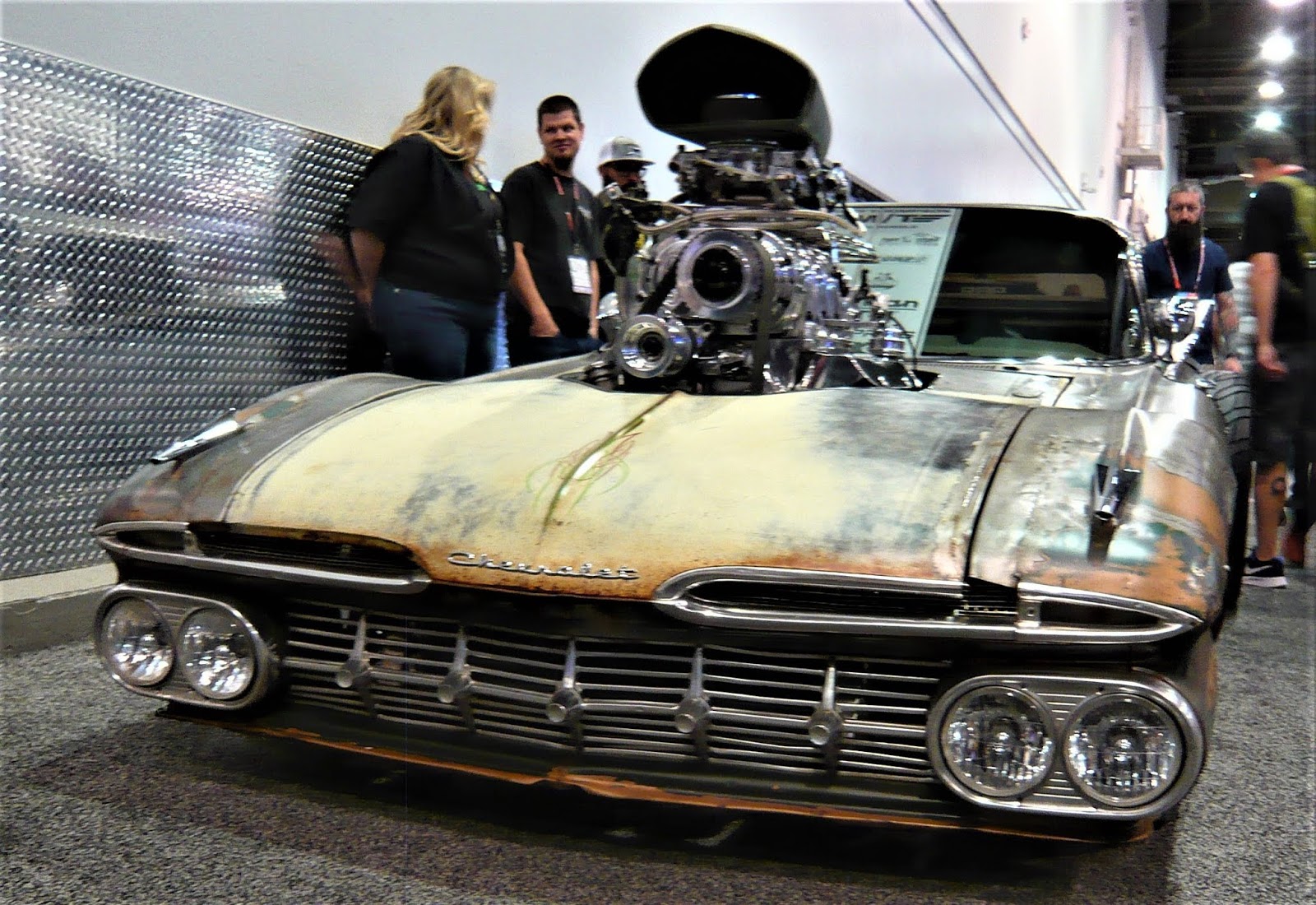
THE OUTRAGEOUS "HULK CAMINO"


In The Weeds Hot Rods, LLC- better known as ITW Hot Rods - showed their radical 2015 build named “Hulk Camino” at the 2019 SEMA show in Las Vegas. 


“Hulk Camino” is the creation of hot rod and rat rod master builder, Chris Walker of North Branch, Minnesota. Walker is also the builder of similar caricature "rat rod" creations as  "CanTANKerous", a 1937 Dodge fuel truck, "NOmad,” 1957 Chevy station wagon Built in 2013 " and "Bugly" a 1964 Volkswagen Beetle built in 2014.


“Hulk Camino” is powered by an 800-horsepower engine built around a 400-cubic inch Dart block filled with a Callies crankshaft and Diamond pistons, topped by a BDS 671 supercharger. The power is sent to the Strange® Dana 60 rear end via a Monster® R4 transmission.


The rat rod rides on American Racing wheels wrapped in Mickey Thompson tires backed with Wilwood brakes.


For the 2020 SEMA show Walker plans to debut his next creation, “Roughcut” another 1957 Chevrolet station wagon

Check them out on the web at https://itwhotrods.com


Friday, April 17, 2020


Full-size Hot Wheels at SEMA 2019

The Hot Wheels booth at the 2019 Specialty Equipment Market Association (SEMA) show featured a huge display of wild custom cars but of most interest where two Hot Wheels cars come to life.


The “Python” was one of the sixteen cars released in the original 1968 Hot Wheels series, based on the "Dream Car" show car built in 1963 by Bill Cushenbery for show promoter Bob Larivee.  The “Dream Car” first appeared as a drawing in Car Craft magazine in October 1961, and later it was restyled as the “Tiger Shark.”


This modern roadster version of the “Python” started with a custom frame fitted with 1996 Corvette front suspension and Jaguar independent rear suspension. The little roadster is powered by a modular 4.6-liter (280-cubic inch) aluminum V-8 engine sourced from a Lincoln Town Car fitted with a custom intake and valve covers.  

Paul Jurewicz built the body using parts from 28 different cars, which included an Audi Quattro, 1953 Studebaker Hawk, 1960 Pontiac Catalina, 1963 Chevrolet Corvair and a 1959 Ford Thunderbird.


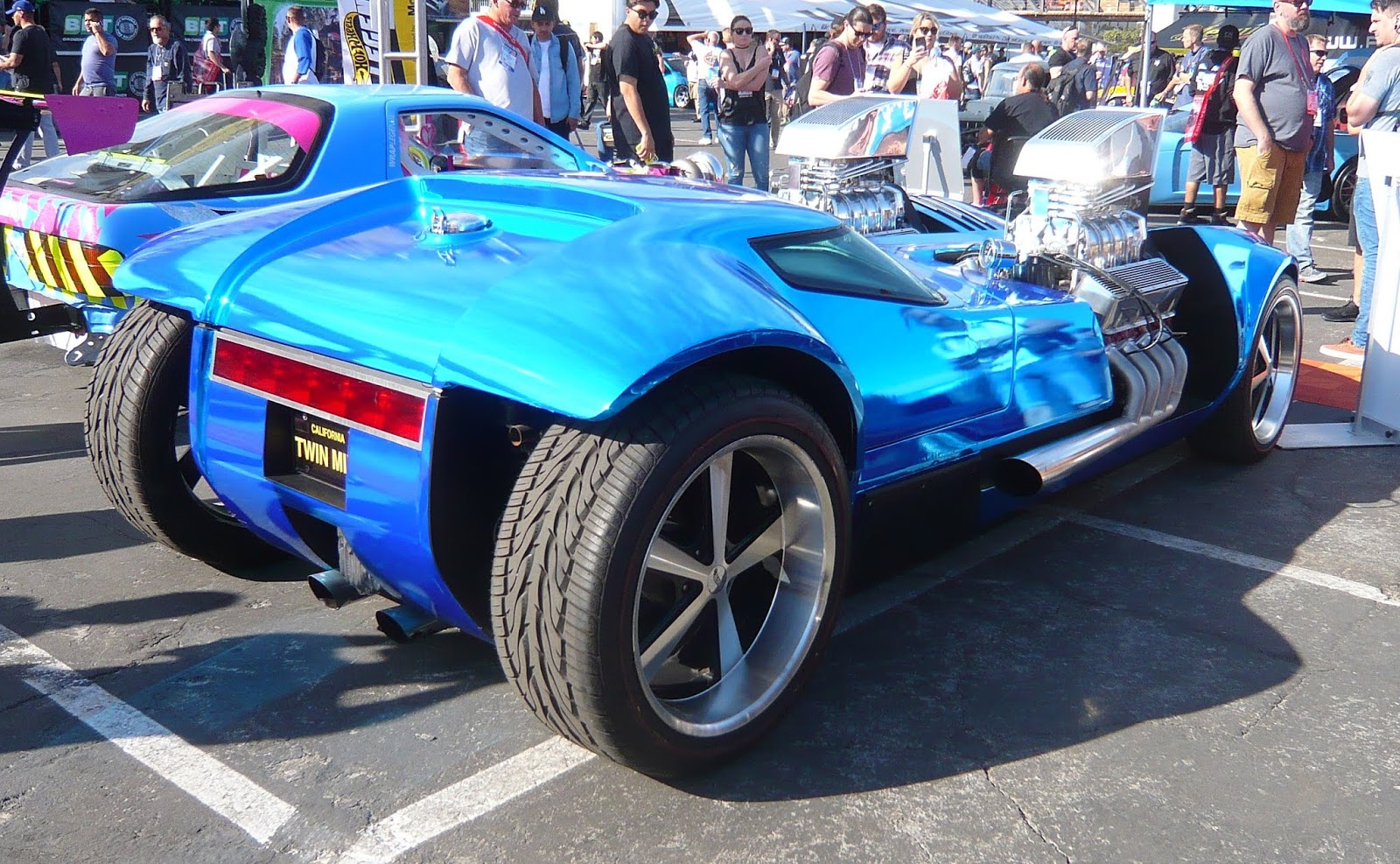
Designed by Ira Gilford the “Twin Mill” first introduced in 1969 is one of the most popular of all the Hot Wheels cars, and there have been four additional versions built – the “Twin Mill II,” “Twin Mill III,” the “Twin Mill Hardnoze” and the “Twin Mill Gen-E.”


This full-size version debuted at the SEMA show in 2001 features a fiberglass body over a custom frame powered by two supercharged 502-cubic inch Chevrolet engines said to develop a total of 1,400 horsepower. The cockpit of the “Twin Mill,” built by Action Vehicle Engineering in Chatsworth California, is accessed by raising the top with hydraulic rams.


Photos of the full-size replicas by the author