Monday, April 13, 2020


A 1955 Thunderbird gasser at SEMA 2019


The Arc Audio outdoor booth at the 2019 Specialty Equipment Market Association (SEMA) featured an unusual subject for a “gasser” style build, a 1955 Ford Thunderbird, built by Street Toys Mexico, based in Ciudad Juárez in the state of Chihuahua.


This heavily flaked candy gold metallic painted beauty converted into a roadster style body with shaved door handles and a chopped yellow Plexiglas windscreen. The bumpers are removed with a Moon-style tank out front. 
  

The Thunderbird is powered by a supercharged Chevy small block engine that sports Cobra valve covers and white painted fender well headers visible under the clear plastic hood.


The Spartan white and black trimmed interior is dominated by the lightning-rod style Kilduff shifter connected to the TH350 transmission.


The car maintains its gasser stance perched atop ribbed five spoke chrome wheels with pie-cut slicks from Coker Tires.

Founded by owner and CEO Demitrios Karabinis in 1988, Arc Audio specializes in car audio amplifiers, speakers, subwoofers, sound processors, equalizers, and electronic crossovers.  ARC Audio has more than 80+ USA designed products in their product lineup. Check them out at https://www.arcaudio.com/


Thursday, April 9, 2020


Dodge “Lowliner” concept truck


At the 2019 Specialty Equipment Market Association (SEMA) show in Las Vegas, Mopar exhibited the “Lowliner” 1968 Dodge D200 Sweptline custom concept truck.


Photo courtesy of FCA LLC


The 1968 D200 ¾ ton pickup was the fourth year of the second generation of the Dodge “D” series trucks; the second generation introduced with passenger car styling that featured a 3-inch lower cab. The “Sweptline” designation was applied to the trucks with the straight-side pickup box. Customers responded favorably with over 183,000 D Series trucks sold for the 1968 model year, Dodge’s highest pickup truck production total to date.


advertisement courtesy of FCA LLC


 The builders of the “Lowliner” moved the front axle four inches forward, which extended the wheelbase to 132 inches and gave the truck  air suspension on all four corners. The truck has three different air suspension settings - parked, drive, and "drive plus" for driveway access.


Author photo 


The truck's immaculate bodywork is finished in Dodge Candy Delmonico Red with “Dodge” ghosted on the tailgate, with Dairy Cream accents for the bumpers, grille, and 22-inch 'smoothie' style wheels.


Author photo 


The highlight of the build is under the power tilt front end, the mighty vintage Cummins 24V 5.9-liter (358 cubic inch) diesel engine with Holset turbocharger that produces an estimated 300 horsepower and 600 foot/pounds of torque which is transmitted through  a six-speed manual transmission to the 11-inch wide rear wheels.  


Photo courtesy of FCA LLC 


The custom interior is trimmed in “Blazing Saddle Tan” distressed leather  with a custom engine-turned aluminum gauge panel with seven Mopar gauges and the restored 1968 steering wheel. The floor-mounted Hurst shifter has a custom translucent shift ball with the Cummins logo.  


Thursday, April 2, 2020


1924 Voisin C4S Sport Tourisme


In 1922, French aviation pioneer turned luxury automaker Gabriel Voisin produced a small lightweight car the C4 as opposed to his first cars the huge V-12 powered C2 or its follow-up the C3. Due to its size, the C4 was nicknamed the 
"petit voisine" or "little neighbor."


Like all the other Voisin automobiles, it was powered by a sleeve-valve engine, but in this case a four-cylinder 1328 CC (81 cubic inch) displacement engine with the dynamo/starter motor mounted directly to the front of the crankshaft.

The starter motor is visible directly below the grille shell which is topped with the characteristic Voisin radiator mascot a stylized art deco version of the figure of the winged Egyptian goddess Isis.

This Voisin C4S Sport Toursime shown at the Blackhawk Museum is fitted with a miles per hour speedometer as it was ordered United States delivery and was shown at the New York Automotive Salon at the Hotel Commodore in Manhattan in either in 1924.  
This C4S Sport Tourisme, with its patented disappearing top and trademark Ecossaise (plaid) paint scheme is one of just two known to exist. The C4S was only built through 1925, with perhaps 900 built in total.  The company produced a number of striking designs and innovations through the years, but Avions Voisin, described as "the most idiosyncratic of marques," dropped out of the automotive market in 1939 after limited production of the C30.
Photos by the author


Sunday, March 29, 2020


Worth another look


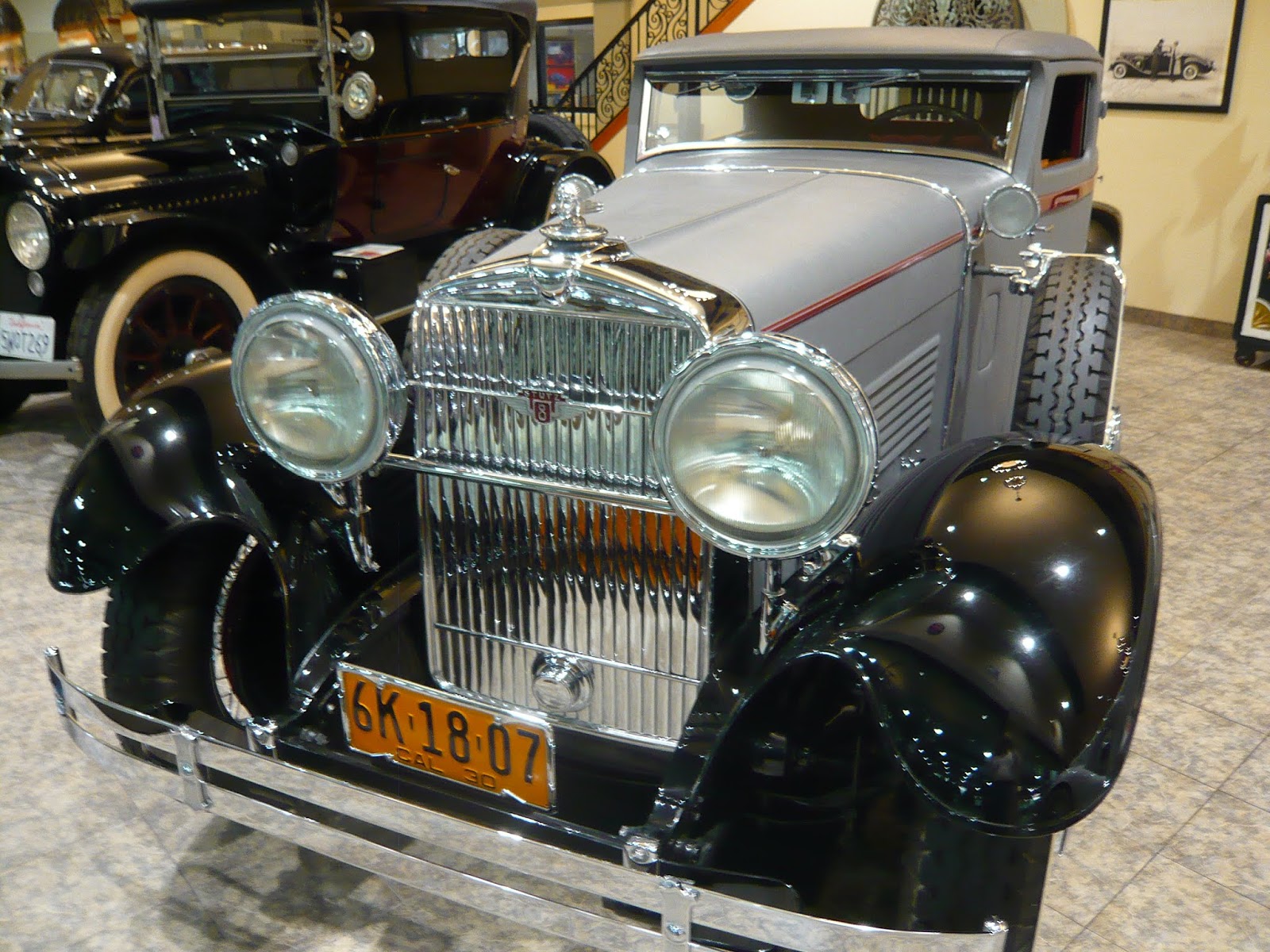
The Automotive Driving Museum located in El Segundo California (near the LAX airport) has several spectacular nineteen thirties luxury cars, including this Weymann bodied 1930 Stutz Monte Carlo, a four-door sedan produced decades before Chevrolet’s coupe of the same name. We featured this car several years ago, but it’s worth another look.   


This four-door Stutz Monte Carlo Sedan is powered by a 287-cubic inch "Vertical Eight" 8-cylinder engine mounted in a chassis equipped with four-wheel hydraulic brakes. This car one of three built sold for $4,495 when new in 1930.

The Weymann body was a patented design system that used a jointed wood frame covered in fabric. It was popular because the body system reduced the usual squeaks and rattles of metallic bodies and improved performance because of the body's lighter weight.  


After World War I French test pilot Charles Weymann who held dual American and French citizenship (both his parents were American citizens) used his knowledge of aircraft manufacturing techniques learned when he worked for Nieuport  and developed a patented system for fabric covered automobile bodies. 

He opened his first factory in Paris in 1921 and through the roaring twenties the market for Weymann fabrics bodies grew quickly and Weymann licensed his system to many of Europe's most prestigious manufacturers. Weymann opened a factory in Indianapolis Indiana in 1928 that was devoted to building custom bodies for Stutz automobiles.


Early in the new decade of the nineteen thirties, the automobile buying public tastes shifted to high-gloss painted bodies and the Weymann fabric bodies with their matte finish fell out of fashion. Weymann's Paris factory closed in 1930 followed by the Indianapolis factory in 1931 making this 1930 Stutz one of the last of its breed.

All photos by the author


Monday, March 2, 2020


Mazda's first "rotary rocket" 


On display at the Blackhawk Museum in Danville is a stunningly restored example of a 1968 Mazda Cosmo 110 A Series 1 coupe, the first car produced by the Japanese automaker that used the eccentric rotary design Wankel engine which the company made famous.

The Wankel rotary engine was envisioned German engineer Felix Wankel, who patented his engine design in 1929 and produced his first working prototype in 1957. Wankel’s creation offered the advantages of compact design and lighter weight over conventional connecting rod/crankshaft reciprocating engine designs. Wankel’s employer, the German car manufacturer NSU built the first Wankel powered car but also licensed the engine design to Mazda in 1961.


Mazda introduced the prototype Cosmo coupe at the Tokyo Motor Show in 1964, and after solving reliability problems with the engine production began in 1967. The first Cosmos were powered by a twin-rotor engine that developed 110 horsepower (thus the name of the car 110A), but in 1968 introduced the Cosmo series 2 which was fitted with a more powerful rotary engine that developed 126 horsepower. All Cosmos featured manual transmissions, the series 1 cars, a 4-speed box and the series 2 cars equipped with five-speed transmissions.

Mazda raced the 110A Cosmo Series 1 in only one race, the 1968 Marathon de la Route 84-hour endurance race on the torturous German Nürburgring circuit. Two Cosmos were entered to prove the rotary engine’s durability. One car, driven by an all-Japanese team, did not finish after an axle broke, but the second car piloted by a team of Belgian drivers finished the 84-hour grind in fourth place, albeit 12 laps behind the winning Porsche 911.       

The car shown at Blackhawk is a rare series 1, one of only 343 series 1 cars produced. The car is white with a black trimmed interior with black and white hounds-tooth cloth seat inserts and right-hand drive. The car was “resto-modded” in Japan in 2008; while it appears stock on the exterior, this car has an upgraded RX-7 engine, transmission and disc brakes and is fitted with aftermarket 15-wheel alloy wheels.

By the time Mazda ended production of the 110A Cosmo in the Fall of 1972, 1,176 of the hand-built cars had been built.  Mazda would go on to build nearly 2 million rotary powered cars and use a rotary powered car to win the 24 hours of LeMans in 1991 but produced its last RX-8 sports car in 2012.  

photos by the author   


Monday, February 24, 2020


The House of Kolor Drag Strip

At the 2018 SEMA show, the theme of the House of Kolor booth was nostalgia drag racing.


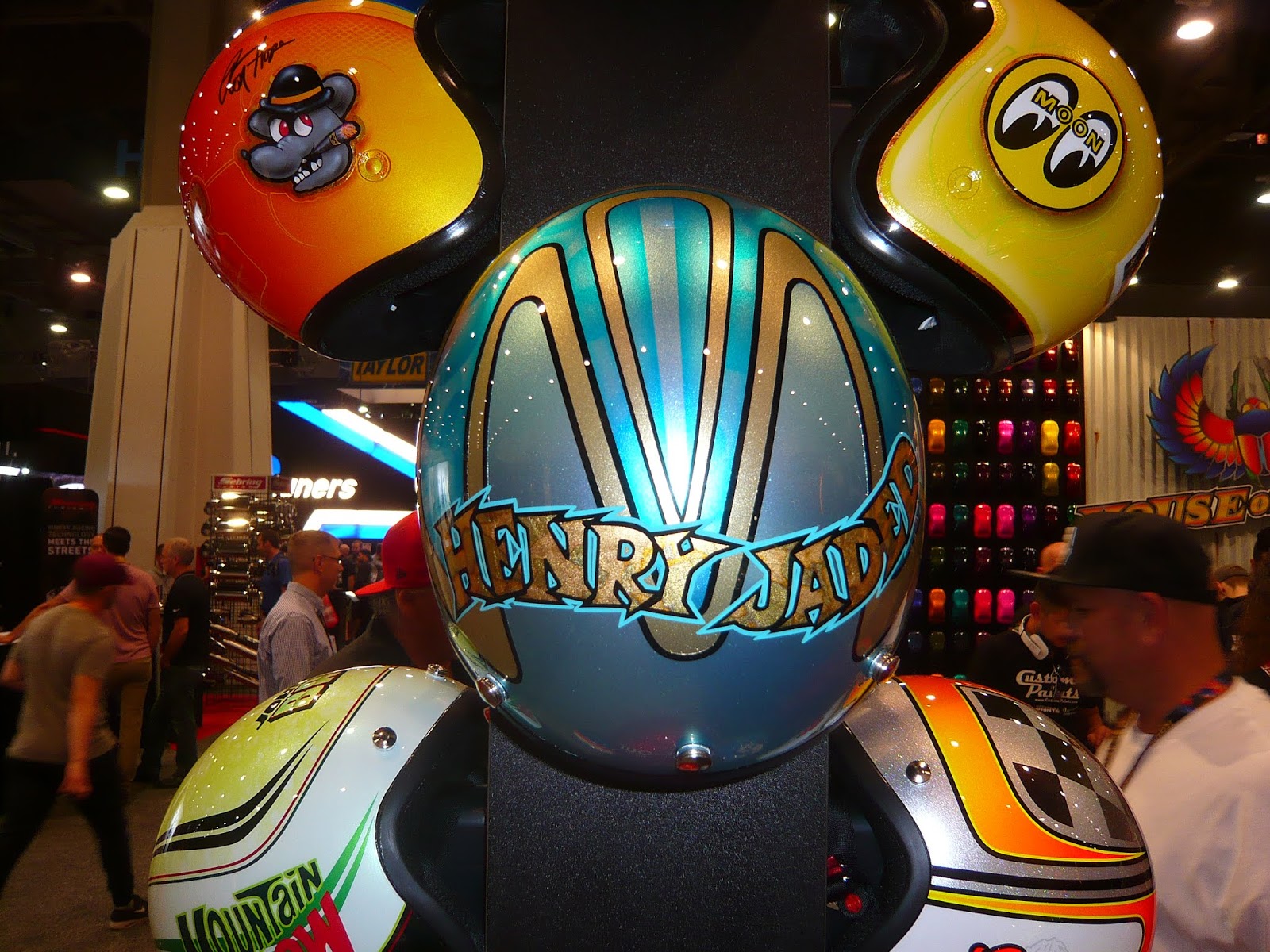
Henry Jaded


Dave Shuten of Galpin Auto Sports built this gasser-themed 1952 Kaiser-Frazer Henry J for owner Daniel Nelson. The car is powered by a Chevrolet Performance 572 crate engine bored out to 585 cubic inches by QMP Racing and is fed by a Holly 1150 carburetor atop a Chevrolet Performance ZZ572 intake manifold. The paint is a mix of House of Kolor Orion Silver with Teal Kandy Koncentrate, with the leaf and striping work done by Pete Finlan.


Dr. Moon’s Rage


This 1948 Anglia gasser owned and driven by Howard Moon is powered by a supercharged and injected 427 cubic inch Chevrolet engine, connected to a 2-speed Powerglide transmission and a nine-inch Ford rear end. The car is finished in House of Kolor Violet Shimrin Designer Pearl with the striping and lettering by “flea.”


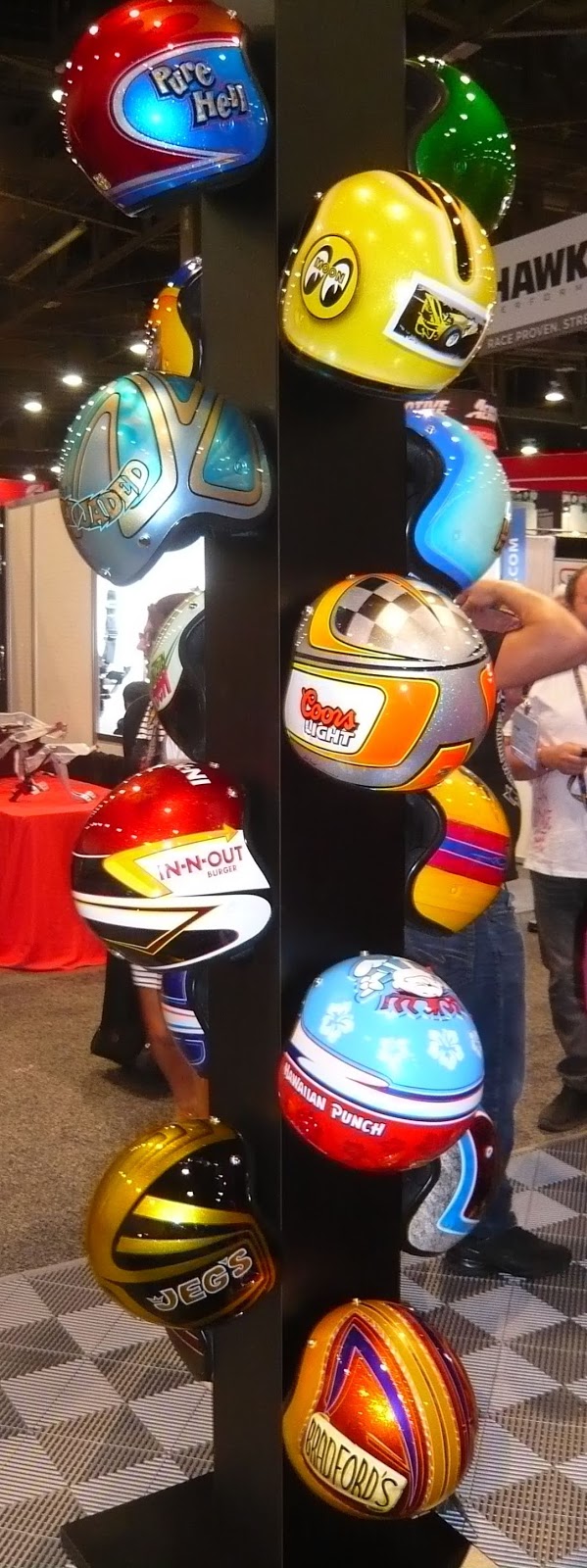
Helmet display

The House of Kolor booth also had several displays of nostalgia-themed racing helmets.


Photos by the author


Monday, February 17, 2020


The Jeep J6 concept

Jeep showed off their J6 concept vehicle at the 2019 SEMA (Specialty Equipment Market Association) show in Las Vegas. The Jeep Design team started with a 2020 Jeep Gladiator Rubicon then modified it into this two-door concept with a six-foot bed to maintain the same wheelbase, then painted the truck in Brilliant Blue Metallic paint that recalls the 1978 Jeep Honcho two-door pickup.


In addition to custom parts, many of the items on the Jeep such as the winch, lights and interior accessories came straight from the Jeep Performance parts catalog.  The Jeep J6 which received a two-inch lift kit rides on custom 17-inch beadlock wheels with a brass finish set off by the silver bead lock ring wrapped in 37-inch BF Goodrich Mud-Terrain T/A tires.  


The pickup bed features a prototype roll bar with LED lights and a prototype spare tire carrier with a color-matched sprayed-in bed liner.


The interior features color-matched panel inserts and Kaztkin custom leather seats with accenting blue stitching.
All photos by the author