Sunday, June 16, 2019


1926 Ford Model T Lakes Modified Roadster


At the West Capital Raceway Alumni Association car show at Carmichael Park on June 15 there was a beautiful lakes Model T roadster.  Ford produced the Model T from 1908 to 1927 with 1.5 million Model T’s built in 1926, 342,000 of which were roadsters, but Henry Ford could never have imagined Roy Zarick’s  jewel-like Lakes Modified Roadster.


The mint-green Ford Model T roadster body was narrowed 10 inches at the front cowl and 12 inches at the rear. The grille is from a 1933 Chevrolet which was narrowed and shortened with a hand-built stainless-steel grille insert crowned with a Moto-Meter.

The chromed dropped and drilled I-beam axle rides on quarter elliptical springs with 1940 Ford spindles with 12-inch 1940 drum brakes up front. The car rides on 19-inch Model A wire wheels painted body-color green wrapped in skinny 5.50-19 and 6.50-19 Firestone (Coker)  blackwall tires.
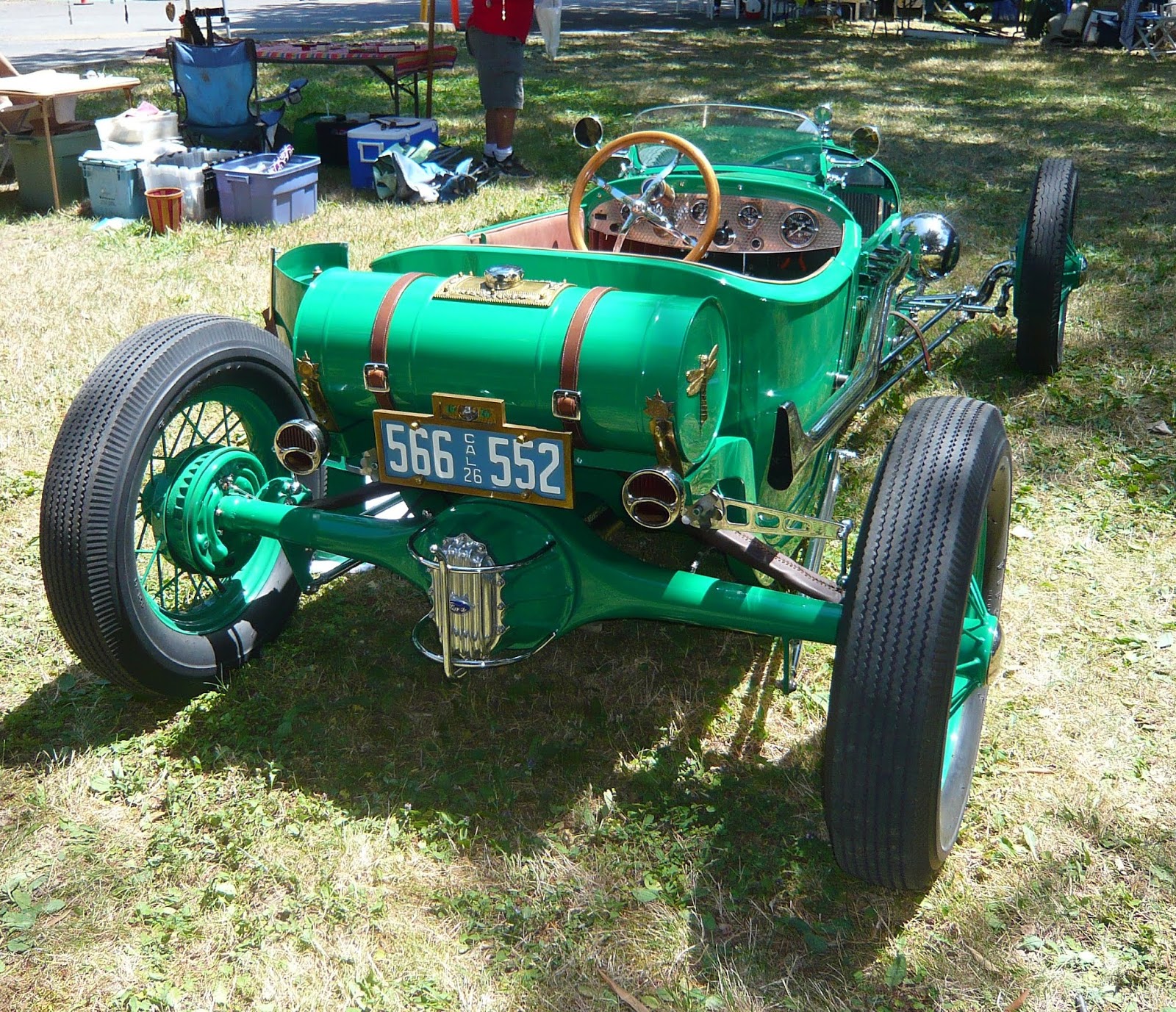


The custom built 2×3 steel rectangular tube frame curves upward in the back and the rear axle is suspended with a Model A buggy spring wrapped with leather, friction shock absorbers and 9-inch drum brakes.    


The three-piece hood is accented by a stainless center bar and is held in place by a leather strap, but it’s what is under the hood that really sets this car apart –  an Esslinger 4-cyclinder 161 cubic inch midget auto race engine fitted with four Mikuni side draft carburetors on a custom intake. This engine, which is based on the Ford Pinto design, sounds terrific through that long,chromed exhaust pipe.

All photos by the author.  

Friday, June 14, 2019


“Redemption”
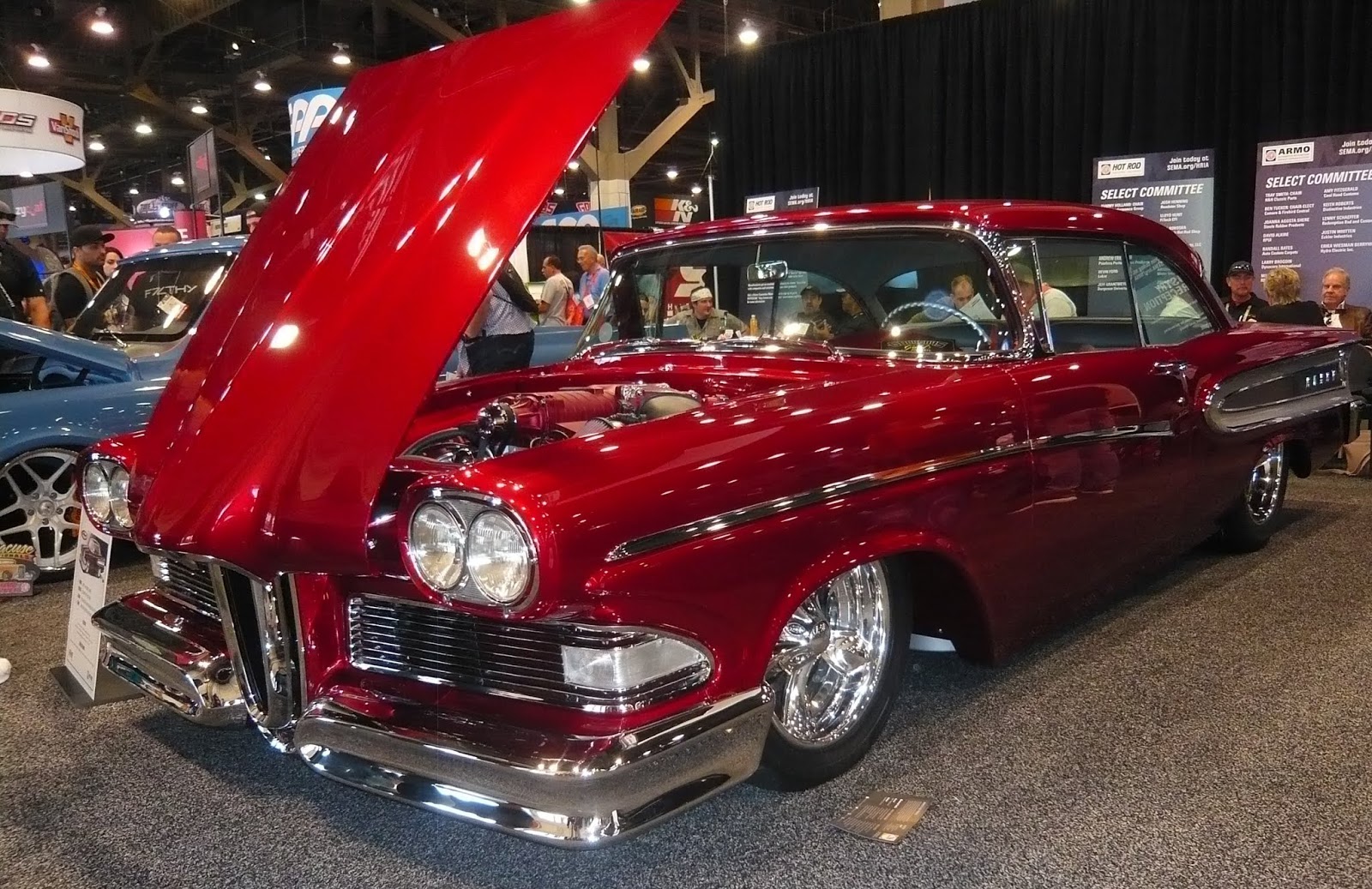
1958 Edsel Ranger Resto-Mod


1958 Edsels are not a typical canvas for a hot rod build, so we were surprised to see this PPG painted burgundy and silver example at the 2018 SEMA (Specialty Equipment Market Association) show in Las Vegas.


This beauty based on the Ford-based Ranger model was built by Alloway’s Hot Rod Shop in Louisville Tennessee for owners George and Kathy Lange is powered by a Roush Racing supercharged Ford Coyote 305-cubic inch engine.


Instead of the original steering wheel mounted Teletouch automatic transmission, the engine’s 700 horsepower is passed through a console-mounted 5-speed Tremec transmission to a Currie Engineering 9-inch Ford rear end.


The interior created by Steve Holcomb’s Pro Auto Custom Interiors with 1964 Ford Thunderbird bucket seats and a custom-built console, with custom built gauges from Classic Instruments and the trademark Edsel floating dial speedometer was rebuilt.       


Photos by the author

Wednesday, June 12, 2019


A pair of tribute drag cars at SEMA


There were a pair of stunning tribute drag cars at the 2018 SEMA (Specialty Equipment Market Association) show in Las  Vegas.


After World War II, Bob Hedman began working at Porter Muffler Shop in Hollywood, then in 1947 left to work for Sandy Belond’s Equaflow Exhaust Company. In 1954 Bob Hedman bought out Belond and changed the company name name to Hedman Muffler and Manufacturing. 


The original version of the “Hedman Husler” Maverick was built in 1970 by the legendary “Dyno Don” Nicholson and campaigned in NHRA National Hot Rod Association Pro Stock as a test bed for Hedman products. The car was driven by Kenny Hedman, son of the company founder.


The original car powered by a Ford 427 SOHC “Cammer” engine fed by dual Holley 4500 carburetors was successful and won several Division 7 NHRA events and was featured in the February 1972 issue of Hot Rod magazine. That car was stolen and replaced by a second version which was raced until 1974.


The car displayed in the Hedman Hedders booth at SEMA 2018 is known as the “Hedman Husler version 3.0” built by Mackey’s Hot Rod Shop is powered by a 409-cubic-inch Ford engine with AFR cylinder heads linked to a Ford C4 transmission that feeds power to the Ford 9-inch rear end. The car had a successful debut at the 2018 NHRA Hot Rod reunion and won a "Wally."


The Derale Performance booth featured a 1964 Ford Falcon NHRA A/FX tribute built by Mike Thomas, with bodywork by Dale Snoke. The car is powered by a Ford 427-cubic inch high-riser FE engine hooked to a Ford C4 transmission and 9-inch rear axle. The automatic transmission is controlled by a nineteen seventies Hurst shifter. 


The 60’s style interior also features a roll cage because this car will be raced after it is off the show circuit. The car graphics are hand-lettered with gold leaf graphics and chrome reverse steel wheels.


Derale is a division of CP Auto Products, Inc. in business in Southern California since 1946 and a charter member of SEMA.


All photos by the author  

Monday, June 10, 2019


Alex Schutte goes wire-to-wire
in POWRi BCRA midgets at Petaluma


On a warm Saturday night June 8, the POWRi BCRA (Bay Cities Racing Association) midgets paid their first visit of the 2019 season to Rick Faeth’s Petaluma Speedway.  Time trials were exciting, with Alex Schutte in his Toyota-powered midget the fastest qualifier with a best lap of 14.888 seconds around the 3/8-mile dirt oval. Maria Cofer in her father’s #57 midget, now powered by a Stanton SR-11 engine, was just .001 of a second slower on her one and only qualifying lap, as a radius rod bolt broke as she started her second lap and she pulled into the infield.
Hawaii’s Larry Petersen powered Dave and Wendy Thurston’s #11 to third place with his lap of 15.997 seconds, followed by Floyd Alvis in the famed “Yellowbird” midget fourth fastest at 16.667 seconds. Rookie of the Year contender and current BCRA overall points leader Robert Carson in the Howard and Karen Segur #99 was fifth fastest at 17.305 seconds, and Beau Lemire in his family-owned Subaru powered midget posted a best lap of 17.730 seconds. Marvin Mitchell currently sixth in the BCRA dirt points, suffered ignition problems and his #78 machine did not post a time.
For the start of the 8-lap heat race, Lemire elected to move to the tail of the field, which put Petersen on the pole with Alvis alongside as Schutte and Cofer shared the second row. After a pair of aborted starts, the field took the green flag and Schutte led the field into turn one with Cofer in hot pursuit as Petersen settled into third place.
On lap three, the caution flag flew as Lemire spun for the second time in the race – the #14 race car appeared to have handling problems and officials pushed him back to the pit area. When the green flag flew again, Cofer stalked Schutte for a lap, then made her move on the low side down the back stretch and Maria powered into the lead which she never relinquished. At the checkered flag the finishing order was Cofer, Schutte, Petersen, Alvis, Mitchell and Carson.
After POWRi BCRA race director Don Thornburg tallied the passing points from the heat race finish to set the feature starting field, Maria Cofer paced the lineup for the 25-lap feature with Alex Schutte alongside. As the field pushed off and lined up for the feature start, the ignition problems in Marvin Mitchell’s #78 car resurfaced, and Mitchell rolled back to the pit area and did not take the green flag.
At the drop of the green flag, Schutte led the field into turn one followed by Cofer and Petersen. On lap two, Floyd Alvis pulled the #18 into the infield with fuel delivery problems, and on lap four Lemire spun for the second time in the race and was out for the rest of the event.  On lap seven, with Schutte still in the lead, Carson’s #99 rolled to stop on the front straightaway. Officials attempted to restart the Joyce Metal Works Special, but it would not re-fire and Robert retired to the pit area.
Schutte commanded the lap eight restart ahead of Cofer and Petersen, and Alex steadily built a lead while on lap 12, the Esslinger engine in the Thurston #11 machine began to backfire, and Larry pulled off the track. As the race continued, Cofer’s car appeared to pick up a push in the corners, which allowed Schutte’s Proficio-sponsored machine to pull away, and Alex had built up a six-car length lead on lap 20.  At the drop of the checkered flag, Alex Schutte won by 3.367 seconds over Maria Cofer. Larry Petersen finished third, trailed by Robert Carson in fourth.  Floyd Alvis finished fifth, Beau Lemire sixth, and Marvin Mitchell seventh.

The POWRi BCRA mighty midgets continue the club’s 80th season of racing action when they return to action at the tight and exciting Lakeport Speedway on July 5th, for the first night of a holiday weekend pavement doubleheader with Ukiah Speedway scheduled for the next night. Follow the last breaking news and updates at   http://www.bcraracing.com/


Tuesday, June 4, 2019


What if Group 7 racing still existed?


Today, we are are going to step outside of our 
usual features and consider "what if?"  

The 1966 Fédération Internationale de l'Automobile (FIA) Yearbook from the group that governed international racing included Appendix 'J 'which contained new regulations for new category Group 7 two-seater racing cars. 

The rules for the Group  7 were simple:  

• Design must be capable of accepting a passenger.
• Enclosed bodywork with no restriction on aerodynamics.
• Unrestricted engine capacity with turbocharging or supercharging allowed with the use of commercially available fuel.
• No minimum weight and no forbidden materials.
• General safety standards of the era required.


In North America, the Sports Car Club of America (SCCA) created the SC Johnson Wax Canadian-American (Can-Am) Challenge Cup series for Group 7 race cars, that saw some of the most outrageous race cars ever created. 

The design of Group 7 cars were only limited by the designers' imaginations, but all Group 7 cars shared one thing in common - they were loud and fast


Photo of the Chaparral 2J courtesy of the Petroleum Museum 


Texan Jim Hall’s Chaparral series of cars were ground-breaking - first with with giant rear driver adjustable wings, which were banned in by revised FIA regulations in 1969.  Later the Chaparral 2J  in 1970 was equipped with  sliding side skirts and fans that sucked air from underneath the car and pulled it onto the ground, a concept which was quickly outlawed.


Photos of the Porsche 917/30 by the author 


In 1972, Penske Racing and the Porsche factory debuted a new Can-Am challenger - the 917/10, equipped with a twin turbocharged flat 12-cylinder 327 cubic inch engine and advanced aerodynamics followed the next year by the 917/30 with an engine said to produce over 1200 horsepower coupled with 820 ft/lbs of torque.  

The Penske Porsches broke the five-year stranglehold of Team McLaren, and for 1974, the SCCA introduced fuel economy standards which eventually killed the Can-Am series. More many years, the Porsche 917 has been unfairly blamed as "the car that killed the Can-AM series."


Photos of the Chaparral 2X by the author 


So, dear reader, I ask you to consider this proposition- what if FIA had not discontinued the Group 7 category in 1975? What would a modern Group 7 car be like? Would they resemble the Chevrolet Chaparral 2X concept seen at the 2016 SEMA (Specialty Equipment Market Association) show? Had Group 7 continued, what powerplants would have been developed and what exotic materials might be used to build a modern group 7 race cars?  

electric?
hybrid?
steam?
turbine?
jet?
natural gas?
4-wheel drive?

It's sure fun to think about! 


Sunday, May 26, 2019

Midget auto racing on display
at the 2018 PRI show 


There was a wide selection of midget auto racing displays at the 2018 Performance Racing Industry show in Indianapolis Indiana. 

The #21 KS midget race car driven by Karter Sarff from Mason City Illinois in the 2019 Lucas Oil POWRi National Midget League was on display in the PAC Racing Springs booth. The car is powered by a Stanton SR-11 engine. PAC Racing Springs is the racing and aftermarket division of Peterson Spring Company  Check out their entire product line at https://www.racingsprings.com/


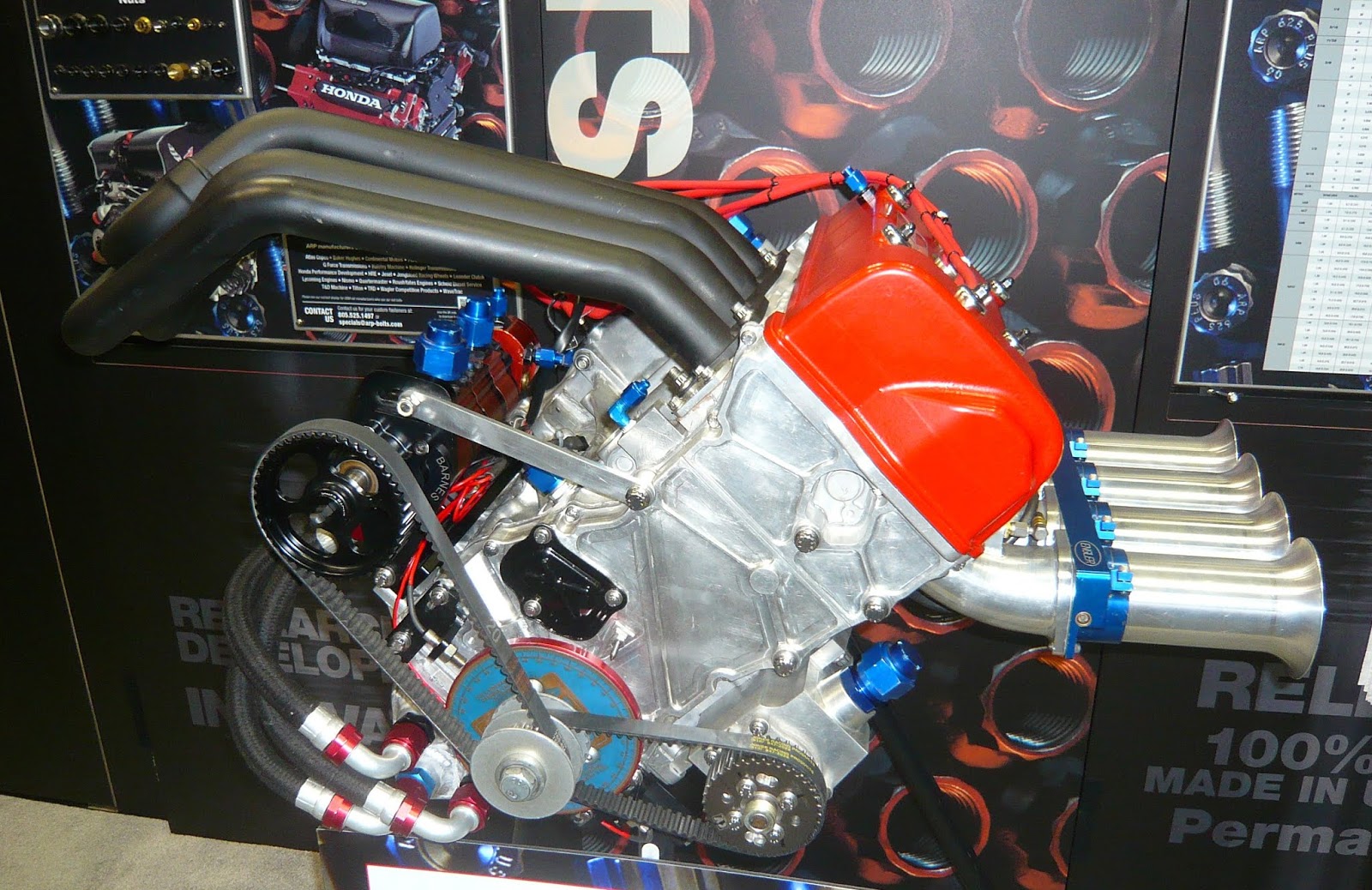
The Automotive Racing Products (ARP) booth featured the Honda engine that Scott Hatton used to win his fifth Badger Midget Racing Association championship in 2018 on display. The development  engine was built by  Haisley Machine of Farimount Indiana and used ARP fasteners throughout. Check out ARP's website at   https://arp-bolts.com/ 


The Mobil One display featured the Keith Kunz Motorsport Spike.Toyota that won  the 2018 United States Auto Cub (USAC) P1 Insurance National Midget championship driven by Logan Seavey. Seavey from Sutter California is only the third driver in USAC history to win the national midget championship as a rookie. 


Seavey started the 2018 season out right with a win in the season's first race in March at Southern Illinois Center indoor race, then added wins at Sweet Springs Missouri and Bakersfield CA on his way to the championship. Logan was a model of consistency thorough 2018 as he scored 15 top-ten finishes and started every feature event. 

All photos by the author 


Monday, May 20, 2019

Camp Wannapaintem
at SEMA 2018

Every year at at the SEMA show, PPG Paints presents a themed display, and in 2018 it was Camp Wannapaintem, and was very special - check out the photos.


Camp Wannapaintem featured "Imagine," the 2018 Ridler Award winner, a 1957 Chevrolet 150 hardtop built by Johnny's Auto Trim & Rod Shop in Alamosa Colorado for owners Greg  & Judy Hrehovcsik.


All photos by the author